Haus Rodenberg: A Moated Castle in Dortmund


Site at a Glance
- Rating
- 4.5
- Popularity
- Low
- Country
- Germany
- Primary era
- Early Modern
- Eras represented
- Medieval, Early Modern
- Civilizations
- Brandenburg-Prussia, Holy Roman Empire
- Site type
- Domestic
- Remains
- Castle
On this page6 sections
History
Haus Rodenberg is a medieval moated castle in Aplerbeck, now a district of Dortmund, Germany, whose surviving complex reflects a Baroque transformation between 1689 and 1698. Situated on the Emscher, it belonged to the County of Mark, a medieval and early-modern territorial state in Westphalia, from the twelfth century.
Medieval Lords and Destruction
The estate entered the written record through the territorial and family relationships of the medieval nobility. In 1283, Count Everhard of Mark exchanged a female ministerial, a service-dependent person of often knightly status who served a territorial lord in administrative or military duties, with Count Theoderic of Cleves. In return, Everhard received Beatrix, the wife of Arnold of Altena, and her son Dietrich.
The knight Dietrich von Rodenberg, recorded in 1290 and still living after 1355, resided at Haus Rodenberg with his three sons, Bernard, Andreas, and Dietrich. Through Anna von Rodenberg’s marriage to Hermann Voss of Aplerbeck in 1356, part of the estate passed to the Voss family. It later came entirely into Voss possession through the marriage of Bilie, also known as Bela, von der Lage, daughter of Bella von Romberg and Hugo von der Dorneburg, to Dietrich Voss of Aplerbeck. The resident family thereafter used the name Voss of Rodenberg.
A succession dispute that began in 1419 between Duke Adolf II, Count of Cleves and Mark, and his brother Gerhard of the Mark, lord of Hamm, initially spared Aplerbeck from looting and arson. On 7 April 1424, Dortmund forces burned the entire settlement during a retaliatory campaign, and Haus Rodenberg was probably destroyed in the attack.
Rebuilding and Baroque Transformation
Hermann Voss of Rodenberg rebuilt the castle after its destruction and added a residential tower. Between 1689 and 1698, the estate was converted into a Baroque moated castle, meaning a castle residence redesigned in the Baroque style and surrounded wholly or partly by water-filled ditches.
In 1728, Anna Louisa Voss of Rodenberg’s marriage to Friedrich Wilhelm Vogt of Elspe of Westhemmerde brought the estate into the Vogt von Elspe family. Their daughter, Katharina Sophia Luisa Theodora Vogt von Elspe, transferred the castle to her husband, Gisbert Wilhelm von Bodelschwingh, owner of the neighboring Haus Bodelschwingh.
Later inheritance and marriage connected Haus Rodenberg with the Bodelschwingh-Plettenberg and Innhausen and Knyphausen families. Christine Sophie Luise brought Haus Bodelschwingh and Haus Rodenberg to Karl Wilhelm Georg von Plettenberg-Heeren, who adopted the name Bodelschwingh-Plettenberg after their marriage in 1805. Count Carl Gisbert Wilhelm von Bodelschwingh-Plettenberg inherited the extensive family property in 1907 and left it to his only child, Wilhelmine. She married Baron Dodo Alexander zu Innhausen and Knyphausen, who subsequently also used the title Count of Bodelschwingh-Plettenberg.
Dodo’s son, Karl Moritz Baron zu Innhausen and Knyphausen, Count of Bodelschwingh-Plettenberg, held the Bodelschwingh family entail, an inheritable estate governed by rules intended to keep family property undivided, and was lord of Rodenberg. His son, Count Edzard, inherited Haus Bodelschwingh, while Haus Rodenberg passed to his daughter Elma Baroness zu Innhausen and Knyphausen, who was married to Udo von Alvensleben.
Municipal Ownership and Restoration
Elma zu Innhausen and Knyphausen sold the estate to the City of Dortmund in 1985. The city carried out a fundamental restoration of the house and park through 1996, preserving the surviving complex for public and cultural use. The castle is used for seminar rooms of the Dortmund adult education center, the Märchenbühne puppet theater, and catering. Rooms can also be rented through the adult education center for weddings.
The surviving castle structure is listed by the City of Dortmund as an architectural monument, a legally protected historic building or built complex. The former castle is also listed as an archaeological monument, meaning that its buried or archaeological remains receive legal protection.
Remains
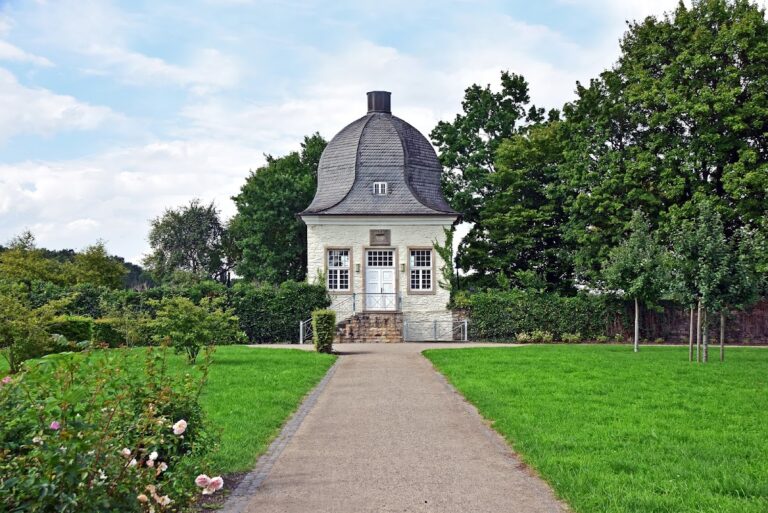
Much of the once extensive moated castle has disappeared. The surviving structure is the outer bailey, the outer part of a fortified complex that commonly contained service, agricultural, or residential buildings separate from the main stronghold. At Haus Rodenberg, this surviving area consists chiefly of economic and service buildings. The rebuilt castle had an attached residential tower, while the later Baroque redesign altered the character of the estate into a residential complex surrounded by water.
Water and Park
The grounds retain the former mill pond and include a park with an orchard. Together with the surviving house, these landscape elements were substantially restored before 1996. The pond and park preserve part of the setting that accompanied the castle’s earlier use as a moated estate and its later development as a Baroque residence.
Nearby sites