St. Pankratius: The Catholic Parish Church of Hövel in Hamm
Site at a Glance
- Rating
- 5
- Popularity
- Very Low
- Country
- Germany
- Primary era
- Modern
- External website
- Open
- Eras represented
- Early Modern, Modern
- Civilizations
- Brandenburg-Prussia, German, Holy Roman Empire, Kingdom of Prussia
- Site type
- Religious
- Remains
- Church
On this page22 sections
History
St. Pankratius is the Catholic church of Hövel in Hamm, Germany, and the oldest and longest-established Catholic religious building in Hövel. Its medieval beginnings are uncertain, but a sandstone church stood here in the first half of the twelfth century. The parish later experienced changes in religious allegiance, destruction during the Second World War, and reconstruction on its original site.
Origins and parish formation
One tradition places a church at the site sometime after 804, while another assigns its foundation to about 1025–1030. In the latter story, Count Bernhard of Werl-Hövel established a private church on a rise near his castle, north of the Lippe River. The tale is considered legendary: the count’s existence is doubtful, and the Bernhard described in the medieval chronicle has been identified instead as Bernhard II of Werl, an ancestor of the counts of Arnsberg. Hövel did not become a separate county until after 1124.
An earlier church may have been founded from Münster, perhaps by Liudger, the city’s first bishop. It may have begun as a chapel or a simple wooden church serving the Hövel estate and the mother parish at Ahlen, and may originally have been dedicated to St. Stephen rather than St. Pankratius. The wooden building was replaced by a sandstone church during the first half of the twelfth century.
Veneration of St. Pankratius, an early Christian martyr traditionally said to have died at fourteen during persecution under the Roman emperor Diocletian, probably reached Hövel under the Counts of Berg. They ruled the County of Hövel after 1124 and regarded Pankratius as an important patron saint, a saint seen as a special protector. His relics were said to have been moved from Rome to Ghent in 985. Trade between Westphalia and Flemish ports may have helped spread the veneration of saints associated with Flanders.
Until about 1180, the church belonged to the parish district of Ahlen. Around that year, Bishop Hermann II made the head of a Cistercian monastic house at the Klosterhof the church’s feudal holder, meaning that the church rights were held as a fief. The church and parish farm, known as the Wemhof, stood near Hövel Castle on land belonging to the Lords of Hövel. In 1193, Hermann assigned the parishes of Ahlen, Bockum, and Hövel to the archdeaconry of the provost of St. Martin in Münster, an ecclesiastical district within a diocese. A parish at Hövel is recorded in 1217; it also served Ermelinghof and the farming communities of Hölter and Geinegge.
The Lords of Hövel initially held the right of parish patronage, which included presenting a candidate for a clerical appointment. They later transferred that right to the Count of Mark, who passed it to Kentrop Abbey. The abbess of Kentrop is recorded as the parish’s feudal holder.
Parish life and the Reformation
Parish income came from land, endowments, and customary payments from farms. In 1323, Deibold of Hövel and his wife Geseke endowed the parish with an annual yield from the Schürkmann estate: twelve Scheffel, a measure of grain, of barley, two of wheat, and two hens. In exchange, the priest was to hold three memorial services each year and provide the bearer with a meal and beer. At the Lübbert estate, the priest received a Scheffel of barley and two bundles of flax; the sexton received rye, part of a pig’s head, flax, and cheese. Such obligations were replaced by cash payments of about 30 to 70 thalers around 1870.
Church accounts mention an organ in 1489 and record the purchase of a new one in 1724 for 159 thalers. In 1534, Bishop Franz demanded church treasures to help pay for war against the Anabaptists, members of Reformation-era movements that practiced adult baptism. The parish redeemed its monstrance, a vessel for displaying the consecrated host, and other valuables for 57.5 gold gulden.
In 1550, Gert von Galen of Ermelinghof adopted Protestantism. He and his descendants helped secure Protestant pastors for Hövel from 1563 to 1618. Lutheranism, a major Protestant tradition rooted in the Reformation, drew worshippers from Hamm to hear pastor Johann Hard. Hamm’s council responded by closing the North Gate on Sunday mornings to deter them. Hard later became a preacher in Hamm.
Return to Catholic worship and local disputes
Theodor Baggel restored Catholic worship in full in 1618 and served the parish through the Thirty Years’ War, the major European conflict fought from 1618 to 1648. He acquired the Kuhkamp pasture in 1623, followed by other smallholdings, pastures, fields, and Hövel Castle. In 1663, he used these properties to establish a benefice dedicated to the Blessed Virgin Mary, an endowed church position with income attached. Its holders had to come from the Baggel or Kluitmann families.
A dispute over a levy on abandoned farms led to a confrontation in 1677. Some owners of deserted Hövel holdings sought to make the community pay the levy. When grass-cutters sent by the von Merveldt family of Westerwinkel arrived, Hövel farmers seized five of their scythes and hung them in the church “for eternal remembrance.” The farmers were sued in a secular court.
For about seven centuries, Hövel’s dead were buried in the cemetery around the church. A new cemetery opened on Bahnhofstrasse in 1861. After the Second World War, the older cemetery was levelled and incorporated into a memorial park.
Demolition, destruction, and rebuilding
By 1892, the medieval church had become too small and was considered structurally unsound. It was demolished along with its late-Gothic choir. A new church, designed by Münster architect Wilhelm Rincklake, was built between 1892 and 1894. It was inaugurated on 5 July 1894 and consecrated again as St. Pankratius on 5 June 1896.
In March 1944, Allied bombers attacked Hövel. Two bombs struck the church’s nave and choir, destroying them, while the west façade and tower survived despite heavy damage. Nearby homes were also hit, but no one was killed. A woman who had taken refuge in the tower was injured and survived. The congregation then worshipped in an emergency chapel made by extending the parish house.
Pastor Wilhelm Weber, who had served since 1939, was arrested by the Gestapo, the Nazi secret police, on 27 November 1943. He was held first in Münster prison and then in the priests’ block at Dachau concentration camp, from 19 February 1944 until 10 April 1945. After returning to Hövel in summer 1945, he pressed for the church to be rebuilt on its original site, despite concerns that it would obstruct traffic in plans for a car-oriented town. The church was reconstructed under his direction between 1954 and 1957, incorporating the surviving western entrance and tower complex. Eberhard Michael Kleffner and Christa Kleffner-Dirxen designed the rebuilt church.
A Stolperstein, a small pavement memorial to a victim of Nazi persecution, was laid for Weber in 2009. It became the sixteenth station on Hamm-Bockum-Hövel’s Path of Remembrance and Learning. The rebuilt church’s stained glass in its western part was associated with the congregation’s sacrifice and the understanding of then-pastor Ludwig Bügener. St. Pankratius is regarded as one of Hamm’s notable ecclesiastical monuments.
Parish reorganization
In 1999, Bishop Reinhard Lettmann asked Catholics in the Diocese of Münster to consider closer cooperation as the number of priests declined. Councils from Bockum-Hövel’s four parishes adopted a shared pastoral-care model. Their new pastoral council first met on 30 October 2000, and the parishes coordinated their Sunday Mass schedules beginning on 6–7 January 2001.
On 1 January 2005, St. Pankratius joined Christus König, Herz Jesu, and St. Stephanus to form the Catholic parish of Heilig Geist Bockum-Hövel. The four former parishes had been dissolved on 31 December 2004. St. Pankratius became the new parish church, while the other churches became branch churches. The reorganization followed priest shortages, an anticipated financial shortfall, population decline, and weakening church affiliation, and some local residents opposed it. Heilig Geist and the parish of Clemens August Graf von Galen, together with Papst Johannes parish in Hamm-Heessen, form the Hamm-Nord deanery within the Diocese of Münster.
The old rectory, built in 1564, is protected as a historic monument. The church bells cast in 1511 and 1678 have also been protected since 8 January 2003.
Remains
The present church is organized around a central tower and two small rooms at the west end, with a broader hall and a recessed choir extending eastward. The hall and choir are spanned by a ceiling divided into recessed panels. The church also preserves older fittings and bells, while the 1564 rectory stands nearby on Am Wemhof.
Church and parish buildings
Westwork and tower
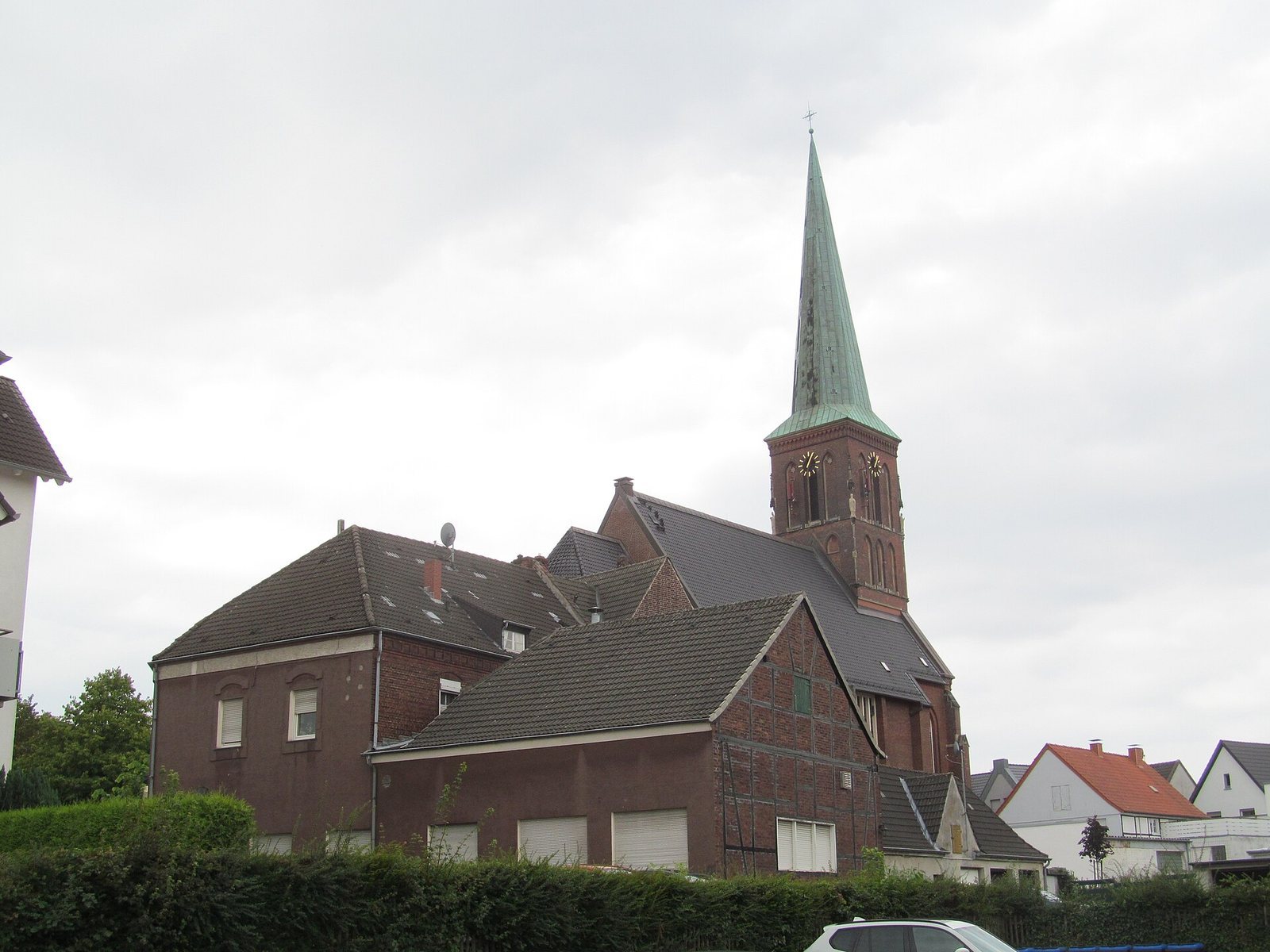
The church retains its westwork, the western entrance and tower complex, from the building that survived the 1944 bombing. A central tower rises above small rooms on either side. At 67 metres high, it is visible across the surrounding area. Sculptures occupy the corners of the upper bell stage: Ludgerus, the first bishop of Münster, with a goose at the northwest; Paul at the northeast; Pope Leo XIII with a dove at the southeast; and Peter with a sword at the southwest. Leo XIII’s dove recalls a similar image of his predecessor Gregory the Great. The dove represents the Holy Spirit.
Hall and choir
A hall 20 metres long and 15 metres wide extends from the tower complex. Its recessed choir ends in a shallow rounded apse, the curved end of the sanctuary. Two tall windows with simple geometric glazing sit above bay-like niches on opposite sides of the hall, bringing light into the interior.
Old rectory
Near the church, the 1564 Old Rectory is a Münsterland hall house, a regional farmhouse form organized around a large central hall. It now serves as the St. Pankratius community hall.
Choir and furnishings
Altar area and mosaic
In 1967, pastor Ludwig Uhlenbrock rearranged the altar area to meet the liturgical requirements of the Second Vatican Council, the Catholic Church council held from 1962 to 1965. Later work by architect Herbert Dunkel left the smaller altar, made of Anröchte dolomite, raised several steps and brought forward toward the congregation. A processional cross dating to 1521 stands beside it. Above the altar, a large mosaic extends across the apse. It shows the risen Christ enthroned in heavenly majesty, surrounded by symbols of the four Evangelists. Created in 1975 after a competition, with artistic guidance from Benedictine Sister Erentrud Trost of Varensell, the mosaic was installed in the early 1980s.
Choir window and organ structure
A large window on the south side of the choir illuminates the altar area. Vinzenz Pieper designed it, Otto Peters of Paderborn made it, and the Mothers’ Association donated it. On the north wall, a rectangular brick structure projects into the open space. Its upper section, arranged in three tiers, exposes the organ pipes; the lower part provides space for singers.
Baroque altar
A Baroque altar stands to the right of the choir. It originally belonged to the Thurn and Taxis family, passed to a Maltese hospital in 1913, and was transferred to St. Pankratius in 1980 when the hospital no longer needed it. Hanno Hesse of Lippstadt restored it. Its decoration includes the family arms, a Maltese cross, and a pelican, a symbol of Christian charity.
Baptistery and devotional objects
The baptismal font combines stonework reused from the seventeenth and nineteenth centuries. A nineteenth-century Madonna on the left side of the end wall was given by the parish of St. Gorgonius in Goldenstedt, and the Diocese of Münster supplied the baptismal-candle stand. Carvings by Franz Xaver Willmann depict St. Joseph and the Stations of the Cross, scenes from Jesus’s path to crucifixion. In the 1980s, the north ground-floor room of the tower became a baptistery with large coloured glazing. A crucifix dating to the mid-eighteenth century stands in the south entrance area.
Stained glass and sculpture
Gallery windows
Above the side rooms, a gallery opens onto the hall through two narrow pointed arches and a wider central opening. A floor opening in the gallery looks down toward three large patterned windows in the west front. Hermann Gottfried designed their continuous coloured glazing in 1985, and Otto Peters’s firm made it. The central window commemorates Bishop Clemens August von Galen, a Catholic bishop and cardinal who publicly opposed aspects of Nazi policy. It shows him with the motto “Neither by praise nor by fear,” and his raised arm points toward the eternal truth of God’s word. The lower part represents creation and growth; above it, war appears as a destroyer, recalling the period in which von Galen had to prove himself.
The narrower south window depicts St. Pankratius alongside Christ’s baptism, penance, and anointing of the sick, Catholic sacraments that express the church’s sacramental life. The north window is dedicated to St. Nicholas, another patron of the church and a helper of people in need. Christ feeding the hungry appears in its upper corner.
Bronze figures
A bronze group of Dietrich Bonhoeffer and Karl Leisner stands on the east wall of the old westwork, facing the new coloured windows. Bonhoeffer was a Protestant theologian involved in resistance to Nazism, and Leisner was a Catholic priest imprisoned in Dachau. Hövel’s marksmen’s association commissioned the group following a late-twentieth-century anecdote about an empty pedestal. Georg Ahrens sculpted it, and Wilhelm Schweitzer of Cologne cast it.
Nearby stands a bronze statue of St. Pankratius, made in the late 1960s by Ernst Paulfeierborn of Paderborn. Relics of the church’s patron, once kept in the altar, are set into the statue’s base.
Bells and organ
Bells
Two principal bells from the earlier church remain in the present tower. Wolter Westerhues cast the larger in 1511; it has delicate pointed ornaments, measures 1,022 millimetres across, and weighs about 700 kilograms. The other, cast by Gottfried de la Paix in 1678, measures 910 millimetres and weighs about 500 kilograms. A smaller bell made in Isselburg in 1768 by Christian Wilhelm and Rutgerus Voigt, a father and son, was lost during the First World War. Two replacement bells cast in 1925 were lost during the Second World War. Petit & Gebr. Edelbrock cast two further bells in 1963. One measures 1,435 millimetres and weighs 1,862 kilograms; the other measures 1,225 millimetres and weighs 1,192 kilograms.
The church’s bell installation once included a small external clock bell. A clock bell made in Münster in 1749 measures 493 millimetres across and weighs about 50 kilograms. It was transferred to the church built in 1894, later passed through the Schulze-Elberg farm, and is now on permanent loan to the Westphalian Bell Museum in Gescher.
Organ
The organ was built by Gebrüder Stockmann of Werl. It has 25 stops, controls that select sets of pipes, across two manuals, or keyboards, and a pedal.