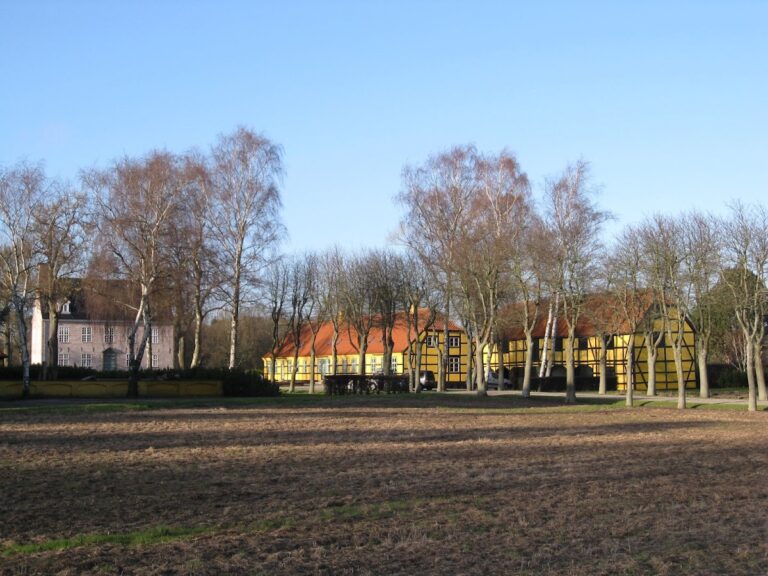
Christianssæde: A Baroque Manor House and Estate in Denmark


Site at a Glance
- Rating
- 4.4
- Popularity
- Very Low
- Country
- Denmark
- Primary era
- Early Modern
- External website
- Open
- Eras represented
- Early Modern
- Civilizations
- Danish
- Site type
- Domestic
- Remains
- Manor House
On this page8 sections
History
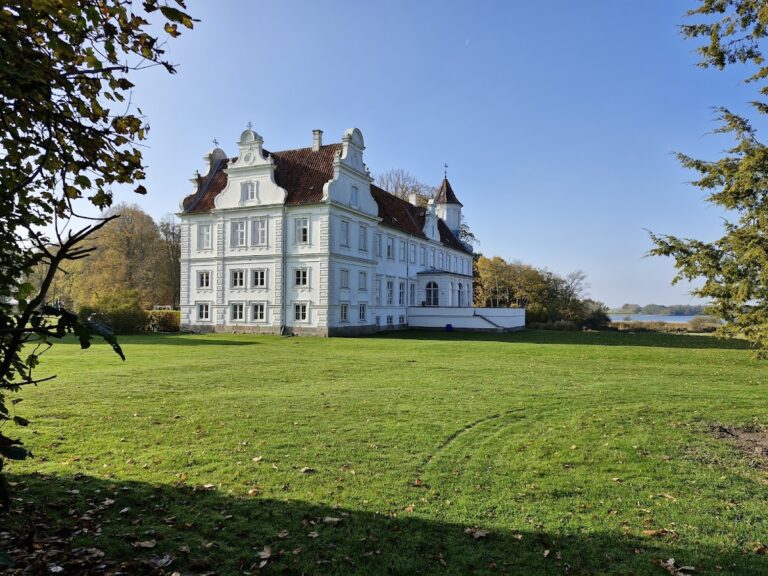
Christianssæde is a Baroque manor house and estate near Maribo in Denmark, centered on a main building completed in 1690. Formerly called Taastrup and later Christiansborg, the estate became the core of the Countship of Christiansborg, renamed Christianssæde in 1741.
From Taastrup to a noble estate
The estate was owned by Henning Lydersen Kabel in 1397. Around 1440 it passed to his son-in-law, Peder Nielsen, and then to Peder’s daughter Anne Nielsen and her husband, Tyge Lunge of Basnæs. Taastrup subsequently passed through several noble families.
In the seventeenth century, Taastrup was inherited by Jørgen Grubbe, a lensmann, an official who managed a royal or noble estate or district, at Halsted Kloster. His son Christian Grubbe inherited it in 1640. Christian Grubbe’s heirs sold Taastrup and neighboring Aalstrup to Joachim Gersdorff in 1653. Gersdorff had become rigshofmester in 1649, a senior official of the Danish realm comparable to a chief steward. He died in 1661, and his widow was later convicted of his murder and executed.
The Christiansborg and Christianssæde countship
In 1669, Gersdorff’s two sons-in-law, Jørgen Bielke and Jens Rodsteen, sold Taastrup to Poul von Klingenberg. Klingenberg was compelled to sell the estate in 1686 to his creditor, Regitze Sophie Vind, the wife of Baron Jens Juel of Juellinge. Jens Juel then commissioned a new main building, completed in 1690.
Regitze Sophie Vind’s son, Baron Vilhelm Frederik Gyldenkrone, took over the estate in 1702. After his death in 1708, his widow Anne Vind Banner retained it until her second husband, Hans Rantzau, sold Taastrup and Aalstrup in 1728 to Count Christian Detlev Reventlow.
In 1729, Reventlow established the Countship of Christiansborg, a hereditary noble territorial estate administered by a count. Its name changed to Christianssæde in 1741, following the renaming of Copenhagen Castle as Christiansborg. Christian Ditlev Reventlow became the second holder in 1738. When his elder brother died without male heirs in 1759, he also inherited the remaining Reventlow estates on Lolland, the Countship of Reventlow, and the Barony of Brahetrolleborg.
The Reventlow family and agricultural reform
Christian Ditlev Reventlow died in 1775 and was succeeded by his eldest son, Christian Ditlev Frederik Reventlow, who later served as prime minister. The countships of Christianssæde and Reventlow were reunited in 1815 after Conrad Reventlow died without male heirs.
Christian Ditlev Frederik Reventlow introduced agricultural reforms that later spread elsewhere in Denmark. Although he lived at Pederstrup, he died at Christianssæde in 1827. Christian Ditlev Reventlow succeeded him and continued the agricultural reforms.
After Ferdinand Carl Otto Reventlow died in 1875, his widow Benedicte Reventlow lived at Christianssæde, renovated the main building, and redesigned the park. Their son, Christian Einar Ferdinand Ludvig Eduard Reventlow, mainly lived at Brahetrolleborg and used Christianssæde for shorter visits.
Dissolution and later ownership
The countship was dissolved in 1924 under the lensafløsningsloven, the 1919 Danish law that ended the legal framework for lens estates and led to the dissolution of countships. Christian Einar Ferdinand Ludvig Eduard Reventlow died in 1929, one year after his only son. His widow and three daughters sold Christianssæde in 1934 to Peter Christian Ege Olsen, who sold much of the land in 1935.
The main building and park were separated from the remaining estate in 1938. The main building changed hands several times before Lolland-Falsters Plejehjemsforening acquired it and converted it into an orphanage for boys in 1952. The ownership chronology lists Frederik F. Wessel and his wife from 1938 to 1947, H. Simonsgaard from 1947 to 1951, Lolland-Falsters Plejehjemsforening from 1951 to 1985, Elisabeth Kruse and Peer Poulsen from 1985 to 1998, Stig Husted-Andersen from 1998 to 2008, his estate from 2008 to 2019, and Andreas Just Karberg from 2019 onward. The present ownership listing also names Albert Rygg Karberg and Alice Rygg Karberg. The home farm and associated land remained with descendants of Peter Christian Ege Olsen in 2013.
Remains
Christianssæde survives as an estate comprising the Baroque principal building, a park, the home farm, associated land, and Christianssæde Forest. The main building and park form a separate property from the rest of the estate, following their division in 1938.
Principal building
The principal building is the new manor house commissioned by Jens Juel after 1686 and completed in 1690. It belongs to the Baroque architectural tradition, and Ewert Janssen is considered a possible architect. Its later conversion into an orphanage for boys in 1952 changed the building’s function from a noble residence to an institutional home.
Park and estate grounds
The grounds include the park associated with the main building, the home farm, its related land, and Christianssæde Forest. Benedicte Reventlow redesigned the park after 1875, while the home farm and associated land remained connected to the wider estate after the main building and park were separated.
Nearby sites