Tågerup Church: A Romanesque Parish Church in Denmark
Site at a Glance
- Rating
- 4.3
- Popularity
- Very Low
- Country
- Denmark
- Primary era
- Medieval
- Eras represented
- Medieval, Early Modern
- Civilizations
- Danish
- Site type
- Religious
- Remains
- Church
On this page8 sections
History
Tågerup Church is a Romanesque parish church in Denmark, on Lolland near Rødby, built at the beginning of the 13th century. Its chancel and nave belong to this medieval phase, while the tower and porch were added later. The church preserves an important sequence of medieval wall paintings, including fifteenth-century scenes in the chancel and early sixteenth-century paintings in the nave.
Medieval foundation and pilgrimage
The church was originally dedicated to Our Lady, a dedication recorded in a 1470 letter granting an indulgence. An indulgence was a formal grant in the medieval Western Church associated with remission of penitential punishment. At Tågerup, the altar dedicated to the Virgin Mary drew many pilgrims on the Feast of the Annunciation, a celebration of the announcement to Mary that she would bear Jesus. This pilgrimage continued until 1636.
Before the Reformation, the sixteenth-century religious movement that challenged the authority and practices of the Western Catholic Church, the Danish Crown controlled the appointment of the church’s clergy. Tågerup Church remained Crown property until 1725, when it passed to Emmerence von Levetzau together with Aalholm and Bremersvold. Ownership then remained with Bremersvold until the church became independent in 1911.
Later additions and restoration
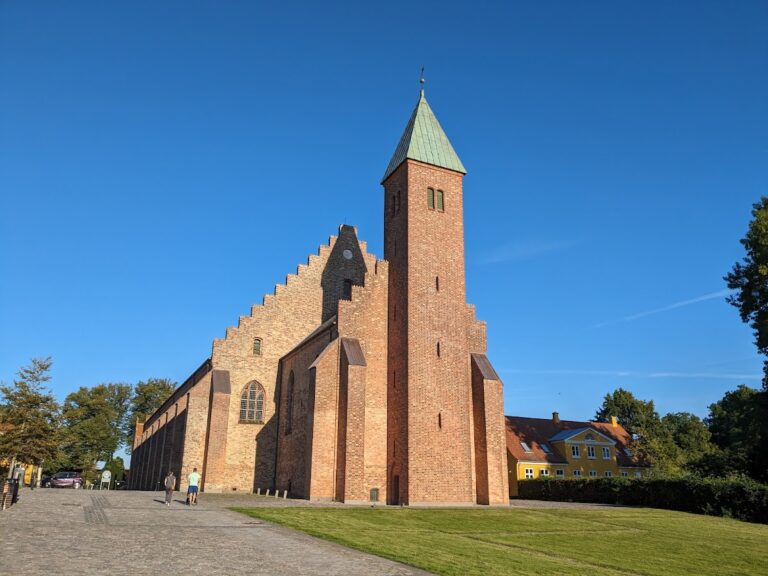
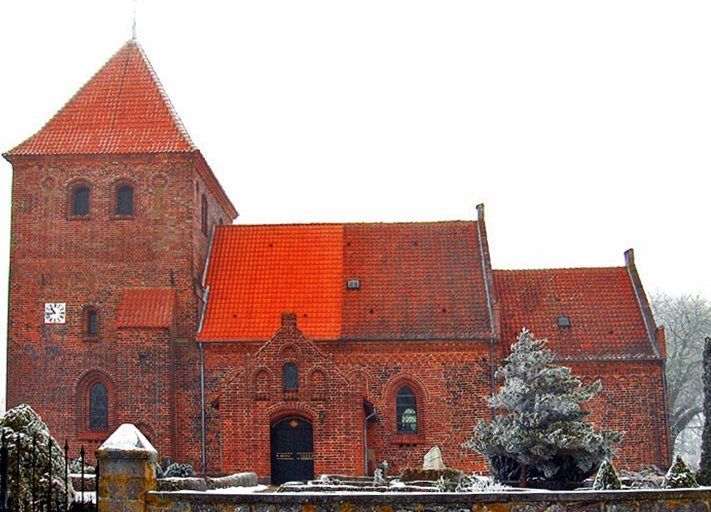
The red-brick tower was added during the Late Gothic period, and a porch was built later. The vault frescos in the chancel and nave were uncovered and restored by Jacob Kornerup in the 1880s. Hans Jørgen Holm carried out extensive repairs between 1891 and 1893, and Egmont Otto Lind completed further restoration in 1943. In 2005, the discovery of additional frescos on the east wall led to the altarpiece being moved to the north wall, allowing the paintings behind it to be seen more clearly.
Remains
Church fabric
Tågerup Church is built mainly of red brick. The Romanesque chancel and nave form the oldest part of the building, with the chancel marking the eastern end where the main altar stands and the nave providing the principal congregational space. The chancel has narrow, shallow vertical strips of masonry, called lesenes, at its eastern corners, together with a sloping base. Its east gable has a central Romanesque window, while a band of stilted-arch decoration with saw-toothed courses runs below the lower roof level. Crosses and emblems are engraved into the lower wall of the gable.
The nave’s south doorway is round-arched and topped by an arched decorative band. The north doorway has been bricked up, and several round-arched windows survive. During the Late Gothic period, the chancel received a six-sectioned vault, a curved roof structure, while the nave was fitted with two cross-vaults formed by intersecting barrel vaults. The tower is as wide as the nave and ends in a pyramidal spire. The later porch contains a Viking-period runestone that was found in a field belonging to Tågerup Rectory and set into the porch’s outer wall in 1869. Its inscription says that Eysteinn’s sons raised the stone in memory of their brother Sperla, Ásbjǫrn Neb’s seaman.
Chancel paintings
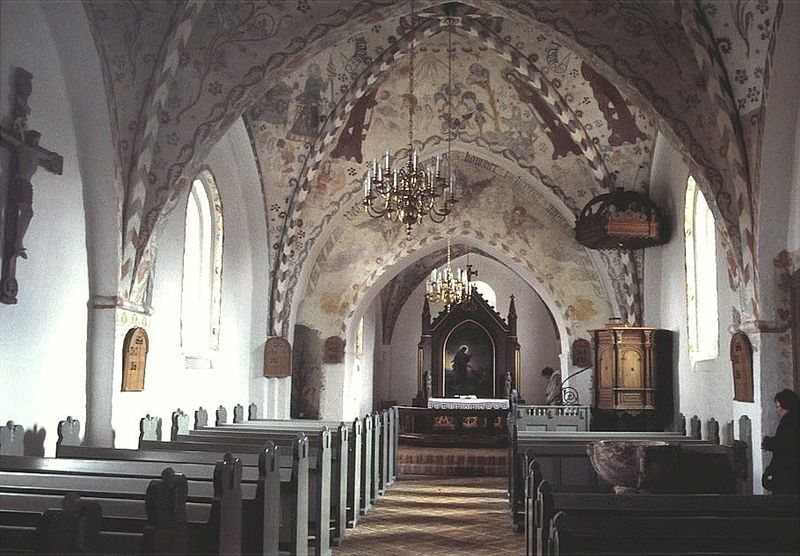
The oldest frescos are in the chancel and date from the mid-15th century. The central scene shows Christ seated on three rainbows as Mary kneels before him. John the Baptist wears a camel hide, and the symbols of the four Evangelists surround Christ, who is surmounted by a crown of thorns and a cross. The paintings include the texts VENITE BENEDICTI PATRIS and ITE MALEDICTI IN, while Christ’s wounds appear as small blots.
The southern part of the chancel shows Pontius Pilate, the Roman governor associated with Jesus’s trial, holding a bowl of water. The western area depicts the whipping and Crucifixion, including the two other victims, Mary, and Mary Magdalene carrying a jug of ointment. Its caption reads Vere filius dei erat isle. The northern area presents the Entombment and Resurrection. Behind the altar, an older fresco shows the Pietà, a devotional image of Mary mourning while holding the dead Christ on her lap. The painting is marked by an especially pronounced expression of despair.
Nave paintings
The nave frescos date from the early 16th century and are attributed to the Brarup workshop, a group of painters associated with distinctive late-medieval church paintings in Denmark. The cycle begins in the first bay with scenes of Creation. They include the sun, a comet, God holding the moon, fish, a shrimp, and a mermaid. Other scenes show God creating animals such as a goose, dove, crane, and deer. The southern section presents the creation of Adam and Eve with the text ADAM PRIMUS HOMO DAMPNAVIT SECULO POMO.
The western section depicts the Admonition and the Fall, with an angel holding a hand organ at the centre. Its inscription reads HIC ADAM ET EVA DECELTI SUNT A DRACONE. The northern section shows the Banishment from Paradise and bears the text HIC EXPELLANTUR DE PARADISO AB ANGLO CUM FLIENTE GLADIO. Adam wears everyday clothing, carries an axe in his belt, and prepares to till the earth, while Eve sits with her children, one of whom has a top and a whip.
The Brarup paintings differ from those associated with the Elmelunde Master, an identifiable but not securely documented medieval painter or workshop in Denmark. Their figures are energetic rather than stereotyped. Eve holds a spindle correctly as she works, and Adam and Eve take long strides during the Banishment. The scenes also contain “Inverted World” images, including a man shearing a horse’s tail and another putting horseshoes on a cat. These motifs derive from Proverbes et rimes of 1480 and also occur at the churches of Hyllested, Brarup, and Hästveda.
Additional frescos found on the east wall in 2005 may show the faces of other figures connected with the Crucifixion. Their discovery explains the repositioning of the altarpiece and has made this further group of paintings part of the visible interior.
Interior furnishings
The altarpiece contains Anton Dorph’s painting Christ Walking on Water, placed within a large Gothic frame. A Renaissance-style pulpit dates from 1586. The church also has a chancel-arch cross from the first half of the 15th century and another cross from around 1500, whose finely carved figure of Christ survives. Near the entrance stands a Romanesque marble font from Gotland, with sculpted faces decorating its bowl.