Constantinsborg: A Historic Manor Estate in Denmark


Site at a Glance
- Rating
- 4.3
- Popularity
- Very Low
- Country
- Denmark
- Primary era
- Modern
- External website
- Open
- Eras represented
- Modern
- Civilizations
- Danish
- Site type
- Domestic
- Remains
- Manor House
On this page11 sections
History
Constantinsborg is a historic manor estate in Denmark, located in Viby J on the southern shore of Årslev Engsø, about 10 kilometres southwest of Aarhus. The estate’s present main building was constructed in 1801 in the Neoclassical style, while the property itself has a history reaching back to at least about 1400. Its development reflects changes from private noble ownership to royal landholding, hereditary estate management, and agricultural enterprise.
Early estate and the Lykke family
By about 1400, the estate was known as Stadsgaard and belonged to Erik Jensen Munk. Ownership passed to his son, Peder Lykke, who managed the property until his death in 1464. The Lykke family retained the estate until 1583. An earlier reference appears in records from 1210 belonging to the Ancient See of Aarhus, the bishopric centred on Aarhus, which owned a forest called Stad in the area. This may indicate that a farm existed before the first known references to Stadsgaard, although the earlier history cannot be established with certainty.
Royal ownership and the Marselis family
In 1583, Valdemar Parsberg sold the estate to Frederik II, king of Denmark and Norway. The king acquired it to enlarge the royal hunting grounds around Skanderborg Palace. Constantinsborg consequently became crown land, meaning property held directly by the monarchy, and was incorporated into the Havreballegård fiefdom, a territory administered for the crown by an appointed holder.
In 1661, the Danish crown transferred the fiefdom, including Constantinsborg, to the Dutch merchant Gabriel Marselis. The transfer formed part of the repayment of debts incurred during the Second Northern War, a major seventeenth-century conflict in northern Europe. Gabriel Marselis’s son, Constantin Marselis, came to Denmark in 1667 to administer his father’s estates. He lived at Constantinsborg and gave the estate its present name.
Constantinsborg was formally recognized as a manor in 1683, together with the privileges associated with that status. Constantin Marselis died in 1699. His widow, Sophie Elisabeth Charisius, then took control and converted the property into a fee tail, a hereditary arrangement intended to preserve an estate within a designated family line. She later married Peter Rodsteen, who was made a baron. After Rodsteen’s death in 1714, the manor passed to Sophie Elisabeth Charisius’s nephew, Christian Charisius.
Expansion and division of the estate
Christian Charisius was married to Dorothea Cathrine Rosenlund. He died in 1724, followed by her death the next year, and their son, Constantin August Charisius, inherited Constantinsborg. He administered the estate for 52 years and expanded it considerably. When he died in 1776, however, the manor was heavily burdened by debt.
In 1787, Hans Frederik Fædder-Charisius took over Constantinsborg and received permission to divide and sell the estate, on the condition that the proceeds were reserved for his descendants. At an auction in 1799, he acquired the main building and its associated lands. Most of the attached farms and other landholdings were sold separately, changing the extent and organization of the estate.
After Fædder-Charisius died, Constantinsborg was sold to Peder Jacob Møller in 1832. Møller later sold it to Hendrik Pontoppidan in 1867. The present manor house had already been built in 1801, during the period when the estate was being reorganized after the earlier expansion and subsequent financial difficulties.
The Pontoppidan agricultural centre
Hendrik Pontoppidan became deeply involved in agriculture and in Hedeselskabet, the Danish Heath Society, which promoted the reclamation and cultivation of heath and moorland. The Pontoppidan family contributed substantially to the transformation of the Jutland moors into agricultural land. Hendrik had made his fortune through trade in Manchester and Hamburg, represented the National Bank of Denmark in the 1840s, became a Danish state consul in 1851, and helped establish Aarhus Privatbank.
Although Hendrik Pontoppidan died in 1901, he had transferred the manor to his son Alfred Pontoppidan before his death. Alfred had studied agriculture in Scotland and Hannover. Under his management, Constantinsborg became a centre for agricultural education in the surrounding area. A descendant of the family sold the estate in 1999 to Troels Holch Povlsen, founder of Bestseller.
Constantinsborg remains privately owned and is operated as a farm within Aarhus Municipality. Its history therefore continues as a working agricultural estate, while its buildings and grounds preserve evidence of earlier phases of ownership, architectural change, and land management.
Remains
Buildings
Main manor house
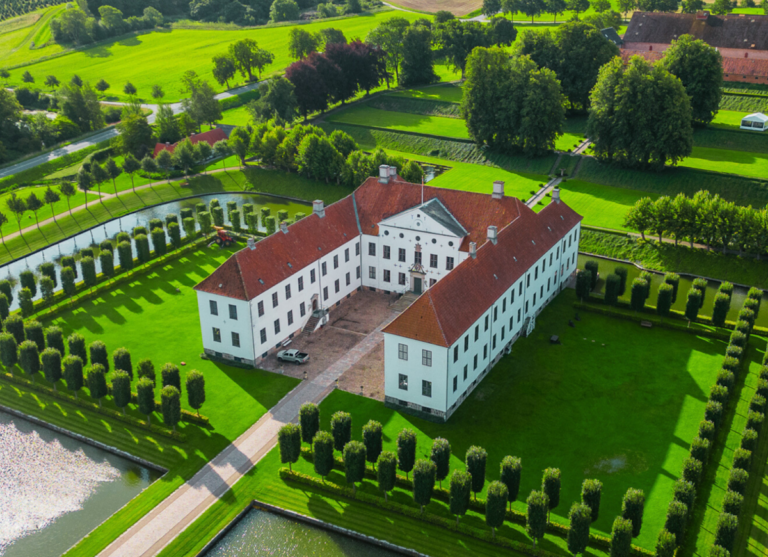
The present manor house is a long, single-storey brick building above a deep basement, with a large frontispiece rising to two floors. Constructed in 1801, it follows Neoclassical architecture, a style based on the forms and proportions of ancient Greek and Roman architecture. The frontispiece contains richly decorated portals, and the northern end of the building is finished with a low Attic wall, a parapet-like upper section above the main cornice.
Earlier Baroque building
Constantin Marselis built an earlier main house in 1677. Designed in the Baroque style, it was approximately three times larger than the present manor house and was described as both expensive and highly detailed. Its arrangement included a three-winged main building facing three-winged stables. The central part formed a two-storey house influenced by Dutch architectural design. The same rebuilding campaign included new farm buildings, whose later replacements retained their original basic outline.
Farm complex
The farm buildings stand directly in front of the manor house and form a large complex. The oldest surviving part of the present group was built by Hendrik Pontoppidan in 1870. Other buildings date from the twentieth century and the 2000s, and the modern structures are used for offices and administration. Together, the buildings express the estate’s continuing agricultural function and its later adaptation to administrative and educational purposes.
Garden and lakeside setting
The garden was probably laid out by Constantin Marselis as a Baroque garden, with hedges, boulevards, and ponds arranged across three terraces. After Hendrik Pontoppidan acquired Constantinsborg in 1867, the grounds were altered in the English style. Free-standing trees and broad lawns replaced the more formal character of the earlier arrangement, while the three terraces were retained.
Constantinsborg stands on the southern shore of Årslev Engsø, a shallow lake extension of Brabrand Lake that is described as a newly created nature reserve. The lakeside setting forms part of the physical environment of the working estate and places the manor within the landscape around Aarhus.
Nearby sites