Bækkeskov: A Neoclassical Manor House and Estate in Denmark


Site at a Glance
- Rating
- 4.7
- Popularity
- Very Low
- Country
- Denmark
- Primary era
- Early Modern
- Eras represented
- Early Modern
- Civilizations
- Danish
- Site type
- Domestic
- Remains
- Manor House
On this page8 sections
History
Bækkeskov is a manor house and estate in Denmark, eight kilometres north of Præstø, whose present main building was constructed in the Neoclassical style between 1796 and 1798. A manor house served as the principal residence and administrative centre of a landed estate, which historically combined the owner’s demesne with tenant farms and other land.
Seventeenth-century ownership
During the seventeenth century, Bækkeskov belonged first to Joachim Beck and then to his daughter Vibeke Beck Galde. The Crown took possession in 1631, but sold the estate to Merete Grubbe two years later. Grubbe subsequently transferred it to Christoffer Godskesen Lindenov, a naval officer and admiral who served as chief of Holmen from 1645 to 1657.
After Lindenov’s death, his daughter Anne Elisabeth Christoffersdatter Lindenov sold Bækkeskov to Otto Krabbe in 1691. Sten Skinkel acquired it in 1693, and his son Rudolf Skinkel sold the estate to Knud Ahasverus Becker in 1729. Becker had become deputy district judge of Lolland and Falster in 1718 and was known for harsh treatment of the estate’s farmers. In August 1738, after he assaulted and killed one farmer, eleven farmers were sentenced to death.
Reorganization under the Munthe family
Bredo Munthe acquired Bækkeskov in 1741. He brought land from some tenant farms under direct manorial control, reorganized estate management, and improved the farm buildings. He was later ennobled as von Munthe af Morgenstierne and died at Bækkeskov on 13 January 1757.
His widow, Anna Dorothea von Munthe af Morgenstierne, transferred the estate to their eldest son, Otto Christopher von Munthe af Morgenstierne. He closed the small village of Bækkeskov and absorbed its land into the manor. In 1782, he established Bredeshave by planting fruit trees on the surrounding land. His later public career included membership of the Generality and Commissariat College, a central Danish body dealing with military and related state affairs, from 1783. He was dismissed in 1789, possibly because he opposed the abolition of the Stavnsbånd, the system that restricted the movement of male peasants and was being removed through late eighteenth-century reforms.
Selby and agricultural change
Otto Christopher von Munthe af Morgenstierne sold Bækkeskov in 1795 to Charles August Selby, an English-born merchant who had founded the Copenhagen firm Selby & Co. in 1777. Selby retired to the estate and reorganized its operations along English-inspired lines. His changes included stable feeding, cattle fattening, and the cultivation of beetroot, cabbage, and potatoes.
The present main building was erected for Selby between 1796 and 1798. Selby was ennobled as a baron in 1807, purchased Orupgaard on Falster in 1809, and died at Güldenstein in Holstein in 1823. Bækkeskov passed to Peter Benedikt Petersen in 1805 and to Mikkel Leigh Smith in 1810, after which Smith’s widow, Cecile Caroline Smith, née de Coninck, sold the estate.
The Vind family and the land reforms
Christian Vind acquired Bækkeskov in 1844. Following his death in 1869, his widow retained the estate, which later passed to their son Carl Rudolph Emil Vind. Carl spent much of his career abroad as Danish envoy in Saint Petersburg and Berlin. Since he had no children, Bækkeskov was eventually endowed to his nephew Ove Frederik Christian Vind.
Ove Vind initially added land to the estate, but the land reforms of 1919 forced him to sell all the tenant farms in 1920. Further land was sold to the government in 1923 and divided into smallholdings. Bækkeskov was placed on the Danish registry of protected buildings and places in 1918. Peter Hermann Zobel purchased the estate in 1996 and retired as chief executive of the insurance company Codan in 1999. It is now owned by Bækkeskov Gods A/S and Michael Immanuel Jebsen, the eldest son of the Hong Kong-based businessman Hans Michael Jebsen.
Remains
Main building
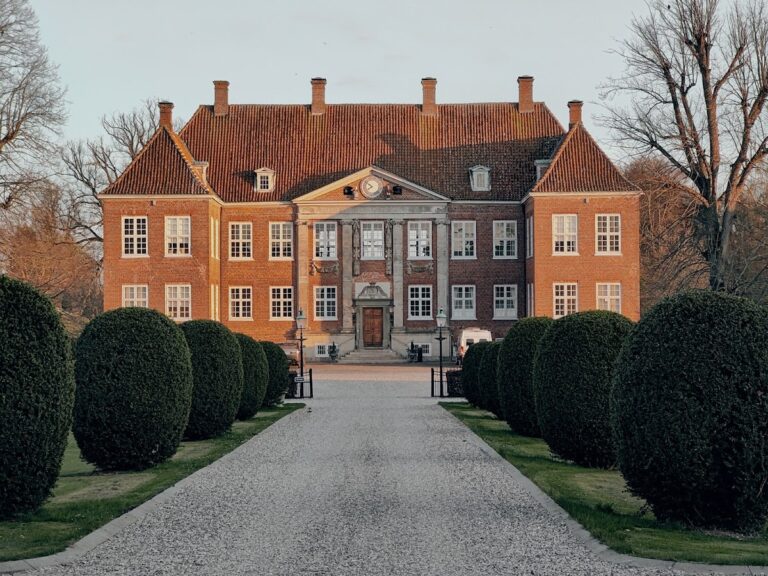
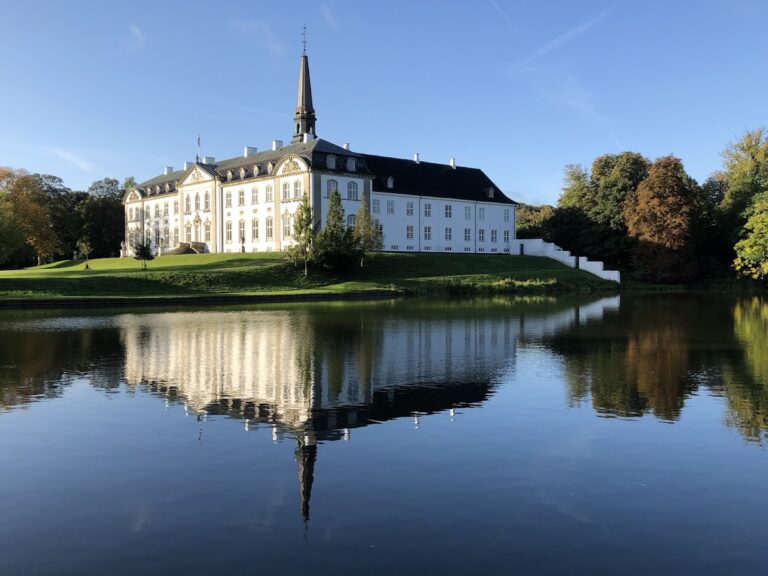
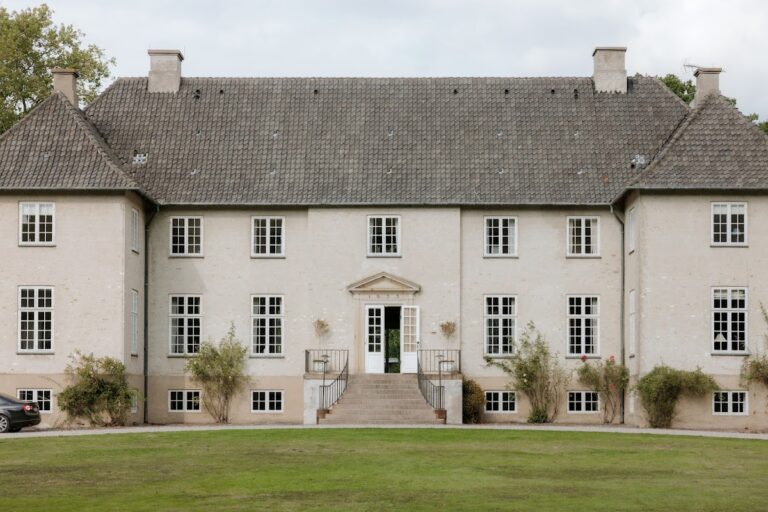
Bækkeskov consists of a manor house, estate land, parkland, and a home farm several kilometres southwest of the main building. The house stands on a small hilltop overlooking Præstø Inlet. Its Neoclassical design, a style inspired by the forms and proportions of ancient Greek and Roman buildings, follows a rectangular plan with two storeys above a high cellar.
The centre of the southern facade is marked by four Ionic pilasters, which are flat, wall-attached supports with capitals derived from the Ionic architectural order. Sash windows reflect English architectural influence. A hipped roof covered with black-glazed tiles crowns the building, and each side of the roof has four dormer windows.
Estate landscape and landholding
Bredeshave, established in 1782, forms part of the estate’s documented landscape history. Fruit trees were planted on the surrounding land. The estate as a whole covers 745.8 hectares, including 180.2 hectares of farmland and 450 hectares of woodland.
Nearby sites