Hôtel Matignon: Residence and Workplace of the French Prime Minister


Site at a Glance
- Rating
- 3.4
- Popularity
- Low
- Country
- France
- Primary era
- Classical
- External website
- Open
- Eras represented
- Classical, Modern
- Civilizations
- French
- Site type
- Civic
- Remains
- Palace
On this page14 sections
History
Hôtel Matignon is an eighteenth-century private mansion in Paris, France, built in the classical style between 1722 and 1725. Originally commissioned as an aristocratic residence, it has served as the official residence and workplace of France’s head of government since 1935. Under the Fifth Republic, the occupant holds the title of Prime Minister.
Construction and the Matignon family
Christian-Louis de Montmorency-Luxembourg, Prince of Tingry and Marshal of France, acquired the site before construction began, with the purchase dated to 1717 or 1719. In 1722 he commissioned the architect Jean Courtonne to design and build the mansion. Rising costs forced him to sell the unfinished property to Jacques III Goyon de Matignon on 23 July 1723.
Jacques III withdrew the building contract from Courtonne, although Courtonne remained architect until early 1724. Antoine Mazin then replaced him and completed the portal, while the wider construction was finished by 1725. The name Matignon recalls the family’s origin in the commune of Matignon in the Côtes-d’Armor.
The property passed to Jacques III’s son, Jacques-François-Léonor de Matignon, whose marriage to Louise-Hippolyte Grimaldi connected the family to the hereditary rulers of Monaco. Maria Caterina Brignole Sale, Princess of Monaco, lived at the mansion from 1757 to 1770, while her husband, Honoré III, generally preferred his estates in Normandy. A marriage between Claude-Constant Jouvenel des Ursins d’Harville and Antoinette Goyon de Matignon took place in the mansion’s chapel on 10 February 1744.
Revolutionary upheaval and nineteenth-century owners
During the French Revolution, Monaco was annexed by the French Republic in February 1793, and the mansion was placed under sequestration. Honoré III was arrested in December 1793 and imprisoned until October 1794. He died at Hôtel Matignon on 12 May 1795.
Honoré III’s eldest son, Honoré IV, sold the property in 1804 to the British businessman Quentin Craufurd and his wife, Eleanore Sullivan. It also passed through Anne Éléonore Franchi before Charles-Maurice de Talleyrand acquired it in 1807 or 1808. Talleyrand was a prominent diplomat and statesman who served successive French governments during the revolutionary and Napoleonic eras. During the Empire, he held dinners, receptions, and balls there for foreign ambassadors and members of the imperial family.
In 1811 Talleyrand was compelled to sell the mansion, and Napoleon I arranged for its purchase. At the beginning of the Restoration, the period after Napoleon’s fall when the Bourbon monarchy returned to power, Louis XVIII exchanged Hôtel Matignon for the Élysée Palace with Bathilde d’Orléans, Duchess of Bourbon.
After Bathilde’s death in 1822, her niece Adélaïde d’Orléans inherited the property. She installed a community of nuns there and later rented it to the American Colonel Herman Thorn, who occupied and extensively renovated the mansion between 1838 and 1848. Thorn used the rear building known as the Petit Trianon for Episcopal religious services.
Governmental use and the Hôtel de Galliera
After 1848, Hôtel Matignon was used or proposed as a residence for the head of the executive government. General Louis-Eugène Cavaignac lived there from July to December 1848, and Pierre Jules Baroche, president of the Council of State, occupied it in 1852.
Antoine d’Orléans, Duke of Montpensier, sold the property in 1852 to Raffaele de Ferrari, Duke of Galliera. It was then known as the Hôtel de Galliera and was remodelled by Félix Duban. After Raffaele de Ferrari’s death in 1876, his widow, Maria Brignole Sale de Ferrari, lived there until 1886. She accommodated the Count of Paris and his family on the ground floor, while her son occupied an adjoining wing and she retained the first floor and the park.
In 1886 the Count of Paris held a major private reception at the mansion for the engagement of his daughter, Princess Amélie of Orléans, to Carlos, heir to the Portuguese throne. The event intensified republican opposition to the presence of French royal pretenders. It was followed by the law of exile of 23 June 1886, which expelled the pretenders and their eldest sons and removed other French princes from the army lists.
Embassy, state property, and the seat of government
After the law of exile, the Duchess of Galliera offered the mansion to Emperor Franz Joseph I of Austria for use as an embassy. She later left France, and the property became the Austro-Hungarian Embassy. During the First World War it was placed under sequestration as enemy property, and the French state acquired it in 1922.
The First World War also brought the philatelic collection of Philipp von Ferrary, an Austrian citizen and son of the Duke of Galliera, to the mansion after he left France. The French government later dispersed the collection and sold it as part of postwar reparations.
In 1923 the mansion, its outbuildings, park, and music pavilion were classified as historic monuments, France’s highest level of statutory heritage protection. After considering conversion into a museum or residential buildings, Gaston Doumergue decided to make the property the headquarters of the President of the Council of Ministers, the title then used for France’s head of government. A law adopted under his successor, Pierre-Étienne Flandin, made the decision effective in December 1934. Flandin became the first head of government to move into the residence in 1935, although the effective change is also dated to 1936.
All subsequent French heads of government used Hôtel Matignon as their official workplace. During the liberation of Paris on 25 August 1944, Yvon Morandat and Claire Morandat took possession of the mansion for the Provisional Government, the temporary French authority established during liberation. On the same day, Charles de Gaulle convened the Provisional Council of the Republic there. De Gaulle did not live at Hôtel Matignon after the Second World War, using the Hôtel de Brienne instead.
The establishment of the Fifth Republic changed the occupant’s official title from President of the Council of Ministers to Prime Minister but did not alter the building’s governmental role. The name also entered everyday political language as a metonym for the Prime Minister or the Prime Minister’s services.
Political agreements
The 1936 Matignon Accords were signed at the mansion after the Popular Front, a left-wing coalition, came to power. The agreement between the French employers’ organisation and the General Confederation of Labour, France’s principal trade-union organisation, provided for trade-union recognition and negotiating rights, a 40-hour working week, and paid holidays.
The 1988 Matignon Agreements concerning New Caledonia were also concluded there. They provided for increased territorial autonomy through an agreement among the French government, Kanak independence activists, and French settlers. Kanak refers to the Indigenous Melanesian people of New Caledonia.
Remains
The mansion
Exterior arrangement
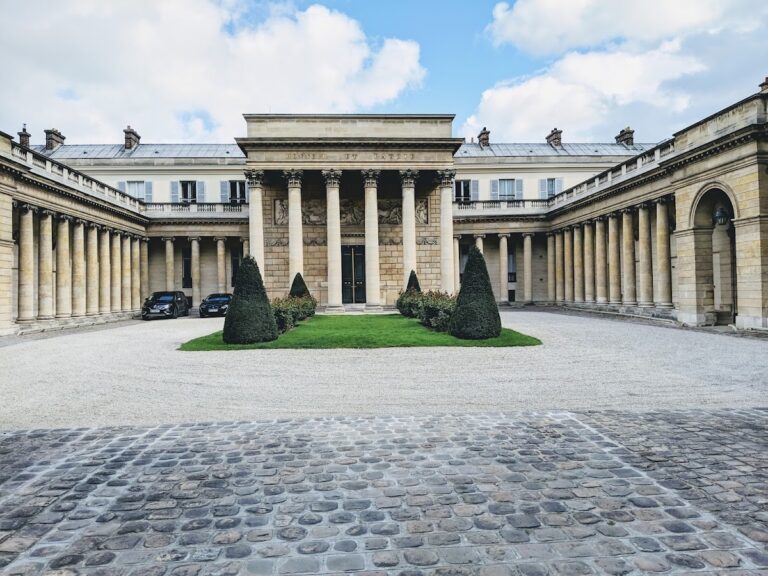
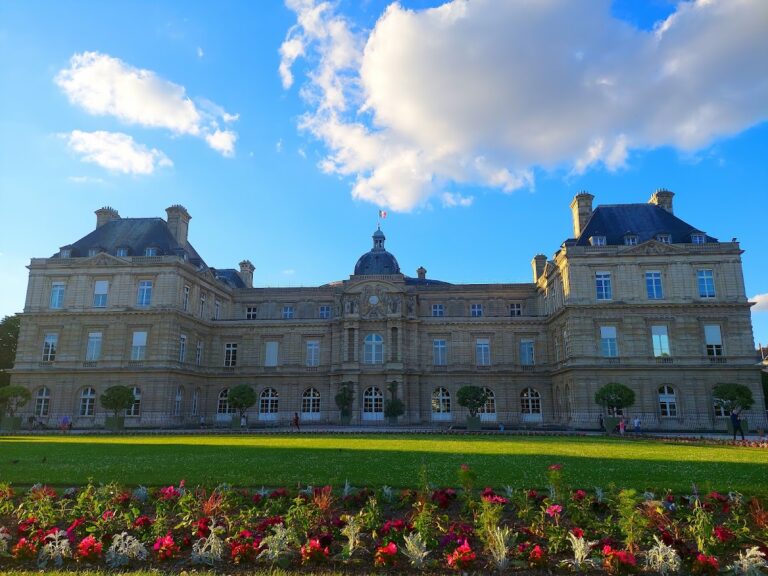
Hôtel Matignon is a two-storey classical building constructed principally of dressed stone. It rises from a broad terrace and is crowned by a balustrade. Courtonne’s plan arranged the rooms in two suites. From the street, a columned portico leads into the main courtyard, which is flanked by two low wings containing offices and outbuildings. A second courtyard, the stables, and the kitchens occupy the right-hand side of the complex.
The main façade is organised around three projecting sections. The lateral projections contain the staircases, while the central pavilion has a balcony decorated with lion motifs. Three panels and a broken pediment bearing the arms of the owners complete the central composition. Mazin completed the portal after Courtonne’s removal from the main building contract, and Courtonne complained that its crowning element resembled that of the mansion too closely.
Interior spaces and decoration
The entrance hall has a segmented cupola, and a room to its right was originally designed as a dining room, an unusual feature in the first plan. The interior decoration includes wood panelling by Michel Lange and cornices and stucco work by Jean-Martin Pelletier and Jean Herpin. These richly decorated rooms made the mansion one of eighteenth-century Paris’s elegant and frequently visited aristocratic residences.
Governmental rooms now include the Council Gallery, Yellow Salon, Blue Salon, Red Salon, a ministerial office, the Prime Minister’s grand office, a meeting room, a dining room, a smoking room, and private apartments for the Prime Minister. The Blue Salon has white walls with gilt mouldings, along with a coffee table and chairs upholstered in blue.
Garden façade
The garden façade runs across the full length of the buildings and conceals both the main courtyard and the servants’ yard. Its arrangement creates a slight asymmetry while retaining the central pavilion as the principal organising element of the composition.
Park and garden structures
The rear park
The rear park covers approximately three hectares. Achille Duchêne laid it out in 1902, combining a formal French perspective with English-style planting. It has been described as Paris’s largest private or non-public garden, exceeding the private garden of the Élysée Palace. About one hundred plant species grow there, alongside an eighteenth-century statue of Pomona and an avenue of 111 linden trees clipped into canopy shapes.
The park also contains an eighteenth-century icehouse, formerly used to store ice collected during winter. Since Raymond Barre planted a sugar maple, planting a tree in the grounds has become a tradition for French Prime Ministers, with Jacques Chirac as the stated exception. Recorded plantings include Hungarian oak by Pierre Mauroy, swamp oak by Laurent Fabius, sweetgum by Michel Rocard, tulip tree by Pierre Bérégovoy, ginkgo by Édith Cresson, silver maple by Édouard Balladur, katsura by Alain Juppé, elm by Lionel Jospin, Persian ironwood by Jean-Pierre Raffarin, English oak by Dominique de Villepin and Manuel Valls, dogwood by François Fillon, southern magnolia by Jean-Marc Ayrault, kobus magnolia by Bernard Cazeneuve, apple tree by Édouard Philippe, ash by Jean Castex, holm oak by Élisabeth Borne, and gray maple by Gabriel Attal.
Music pavilion
The eighteenth-century music pavilion at the rear of the garden is a small building containing salons and a bedroom. It is used for meetings and official dinners.
Nearby sites