Palais Bourbon: Seat of France’s National Assembly


Site at a Glance
- Rating
- 4.5
- Popularity
- Low
- Country
- France
- Primary era
- Early Modern
- External website
- Open
- Eras represented
- Early Modern, Modern
- Civilizations
- French
- Site type
- Civic
- Remains
- Palace
On this page20 sections
History
The Palais Bourbon in Paris, France, began as an Italian-style country residence commissioned by Louise-Françoise de Bourbon, Duchess of Bourbon, in 1722 and completed in 1728. Built on land she acquired in 1720, it later became a parliamentary palace and has housed France’s National Assembly since 1879, apart from the wartime transfer of the government and parliament away from Paris in 1940.
An aristocratic residence in the Pré-au-Clercs
The palace was constructed in the largely rural and wooded area known as the Pré-au-Clercs, on the edge of Paris. The neighbouring Hôtel de Lassay was built at the same time. The duchess later transferred part of her land to the Marquis de Lassay, her reputed lover, and the two residences remained separate architectural ensembles even after galleries connected them.
Four architects successively directed the original work. Lorenzo Giardini and Pierre Cailleteau, known as Lassurance, died before the building was finished. Jean Aubert continued the project, and Ange-Jacques Gabriel completed the palace in 1728. After aristocratic families began returning from Versailles to Paris, the surrounding area developed into the fashionable Faubourg Saint-Germain.
The Bourbon-Condé transformation
Louise-Françoise de Bourbon died in 1743. Louis XV acquired the palace and sold it in 1756 to her grandson, Louis-Joseph, Prince of Condé. The prince undertook extensive alterations intended to turn the country residence into a monumental neoclassical palace. Neoclassical architecture drew on ancient Greek and Roman forms, particularly columns, pediments, symmetry, and civic monumentality.
In 1768, the Prince of Condé acquired the Hôtel de Lassay and planned to unite the two properties. Marie-Joseph Peyre prepared a design influenced by archaeological studies of ancient Rome and Greece. Jacques-Germain Soufflot, Bellisard, and Charpentier also took part in the works, which continued until the late 1780s. The Petits Appartements were built in 1771 and 1772 for Louise-Adélaïde, one of the prince’s daughters.
Revolutionary confiscation and parliamentary conversion
The palace remained with the Bourbon-Condé family until the French Revolution. After Louis V Joseph, Prince of Condé, emigrated following 14 July 1789, the revolutionary government confiscated the property in 1791 and declared it national property. It briefly housed a prison called the House of the Revolution. In 1794, the building became the Central School of Public Works, which was later renamed the École Polytechnique under Napoleon Bonaparte.
A decree of 18 September 1795 assigned the palace to the Council of Five Hundred. This was the lower chamber created by the Constitution of Year III and one of the two legislative councils of the Directory. A meeting hall was prepared, and the council first assembled at the Palais Bourbon on 21 January 1798.
From 1798 onward, the building served as the meeting place of France’s lower parliamentary chamber under successive political regimes. These bodies included the Council of Five Hundred, the Corps législatif under the Consulate and First Empire, the Chamber of Deputies, and the National Assembly. The Corps législatif formally voted on laws but possessed more restricted powers than the revolutionary assemblies.
State ownership and nineteenth-century reorganisation
During the Restoration, the palace was formally returned to the Prince of Condé. Its conversion into a parliamentary building, however, made a return to residential use impracticable, so he leased it to the Chamber of Deputies. The French state became its definitive owner in 1827 and acquired the Hôtel de Lassay in 1843.
Between 1827 and 1832, Jules de Joly directed a major reorganisation. The meeting chamber was rebuilt, the south façade was advanced to create three salons, and a library was constructed along the east wing. These works established much of the palace’s present internal arrangement.
From 1848 to 1851, the Constituent Assembly of the Second Republic met in a temporary rectangular building in the courtyard. Known as the Salle de Carton, it accommodated 900 constituents and later 750 deputies. Its narrow bays, poor acoustics, and difficult circulation hindered proceedings. A demonstration on 15 May 1848 reached the room, and it was demolished after the coup of 2 December 1851.
Political crises and parliamentary continuity
On 4 September 1870, news of Napoleon III’s defeat at Sedan brought crowds to the palace. They sought to pressure deputies into proclaiming a republic. The crowd eventually entered the building and prevented a formal vote. Léon Gambetta proclaimed the emperor’s deposition from the tribune, after which republican deputies went to the Hôtel de Ville to form the Government of National Defence.
The Palais Bourbon was temporarily abandoned as a parliamentary seat between 1871 and 1879. Following the Franco-Prussian War and the Paris Commune, the Assembly met first in Bordeaux and then at Versailles. The palace escaped the fires that destroyed several other Parisian government buildings during the Commune. The Chamber of Deputies returned on 27 November 1879, and the building has remained the seat of the National Assembly, the lower chamber of the French Parliament, except for the wartime transfer in 1940.
On 9 December 1893, the anarchist Auguste Vaillant threw a bomb from a public gallery into the hemicycle. The device contained nails, zinc, and lead. It injured 50 people but caused no deaths. Vaillant was executed on 5 February 1894, and the attack contributed to the adoption of the anti-anarchist laws known as the Lois scélérates.
On 6 February 1934, right-wing groups, veterans’ organisations, and far-right leagues held an anti-parliamentary demonstration outside the Chamber of Deputies. Police and Republican Guards prevented deputies from leaving while armed people in the crowd attempted to enter. The resulting riot on the Place de la Concorde contributed to the fall of the second Daladier government.
Occupation, liberation, and the Fifth Republic
In June 1940, after the government and parliament had left Paris for Bordeaux and then Vichy, German forces occupied the deserted palace. The complex housed parts of the administration of occupied Paris, the Luftwaffe staff, the Luftwaffe military court, and a French office that sent workers to factories in Germany.
During the Occupation, the hemicycle was used 17 times, mainly for speeches. Three speeches by Adolf Hitler were radiodiffused from the chamber on 19 July, 9 November, and 10 December 1940. The room was also used for a film screening for senior German officers and provided the setting in September 1942 for the anti-Masonic propaganda film Forces occultes.
From 4 to 6 March 1942, seven young communist Resistance members were publicly tried in the Galerie des Fêtes. Tony Bloncourt, Roger Hanlet, Pierre Milan, Roger Peltier, Christian Rizo, Acher Semahya, and Fernand Zalkinow were condemned and executed at Mont-Valérien on 9 March. A plaque in the palace gardens commemorates them.
Fighting during the liberation of Paris in August 1944 seriously damaged parts of the palace. A library fire destroyed about 20,000 books. On 25 August, Philippe de Gaulle carried an order of surrender to the German garrison occupying the building and negotiated its capitulation.
The Republican Guard intervened inside the palace to maintain order for the only time in its history in 1947, after the communist deputy Raoul Calas called for insurrection. During the crisis of the Fourth Republic, a police demonstration took place outside the palace in 1958, and a crowd entered the courtyard on 29 May. The Algerian crisis brought the Fourth Republic to an end and led to the establishment of the Fifth Republic.
Expansion and recent changes
The parliamentary complex, known as the Cité de l’Assemblée nationale, now covers about 124,000 square metres and contains nearly 9,500 rooms. Alongside the Palais Bourbon, it includes three office buildings for deputies and their staff, including the Chaban-Delmas building, constructed in 1974 and connected to the palace by an underground passage. A subterranean car park was created beneath the courtyard in 1980, while twentieth-century additions included adapted attic spaces, an electrical plant, and an audiovisual control facility.
The Salle Colbert was built in 1932 as a second hemicycle with about 200 places. It is used by the largest parliamentary group. Proposals made in 2020 and 2021 sought to rename it because of Jean-Baptiste Colbert’s association with the Code Noir, the system regulating slavery in the French colonial system with which he was associated. No renaming had taken place in the period described, although an Assembly reception room was named for Aimé Césaire in 2022.
The history of the palace during the Second World War was formally investigated in 1999 on the order of Laurent Fabius, then president of the National Assembly. The palace and its associated parliamentary complex form part of the protected heritage of the 7th arrondissement and are included in the Paris, Banks of the Seine World Heritage designation, inscribed in 1991.
In 2023, Yaël Braun-Pivet launched an architectural competition to reorganise public reception. The winning project, approved by the Assembly Bureau in September 2024, proposed replacing the 1888 entrance pavilion with a contemporary building. The proposal became controversial because of its cost, heritage implications, and proposed glass architecture. A petition opposing it received more than 135,000 signatures in 2025.
Remains
The Palais Bourbon retains the basic footprint of an eighteenth-century residence while incorporating major neoclassical additions and parliamentary interiors. The original palace was a U-shaped, single-storey building set between courtyard and garden. Its principal range ran parallel to the Seine, while two wings enclosed the courtyard. The entrance from the Rue de l’Université consisted of an ornate archway between two pavilions. Balustrades concealed the roofs, and gardens extended between the palace, the Hôtel de Lassay, and the Seine.
Exteriors and ceremonial spaces
South entrance and cour d’honneur
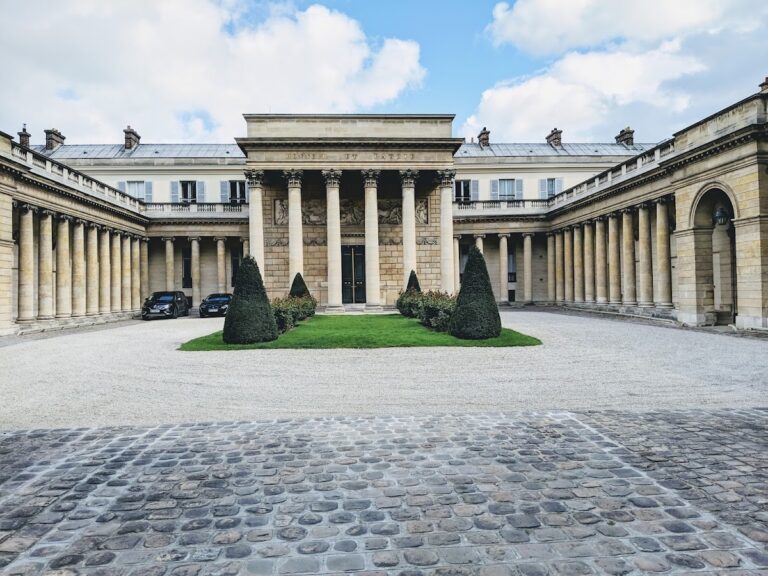
The south entrance through the cour d’honneur became the principal ceremonial entrance after Jules de Joly’s nineteenth-century reorganisation. Its neoclassical portico has four Corinthian columns and was modelled on the ancient Temple of Jupiter Stator. The courtyard retains the outline of the original court but was substantially changed in the 1830s. Statues representing Universal Suffrage and the Law were installed beside the entrance in 1860.
The cour d’honneur also contains Walter De Maria’s Sphere of Human Rights, installed in 1989 for the bicentenary of the French Revolution. The monumental black granite sphere stands on a white marble pedestal on a circular lawn. An arc of plaques partly surrounds it and bears the preamble and articles of the Declaration of the Rights of Man and of the Citizen, the foundational rights statement adopted during the Revolution in 1789. A small gold heart is set inside the sphere.
Seine façade and sculpture
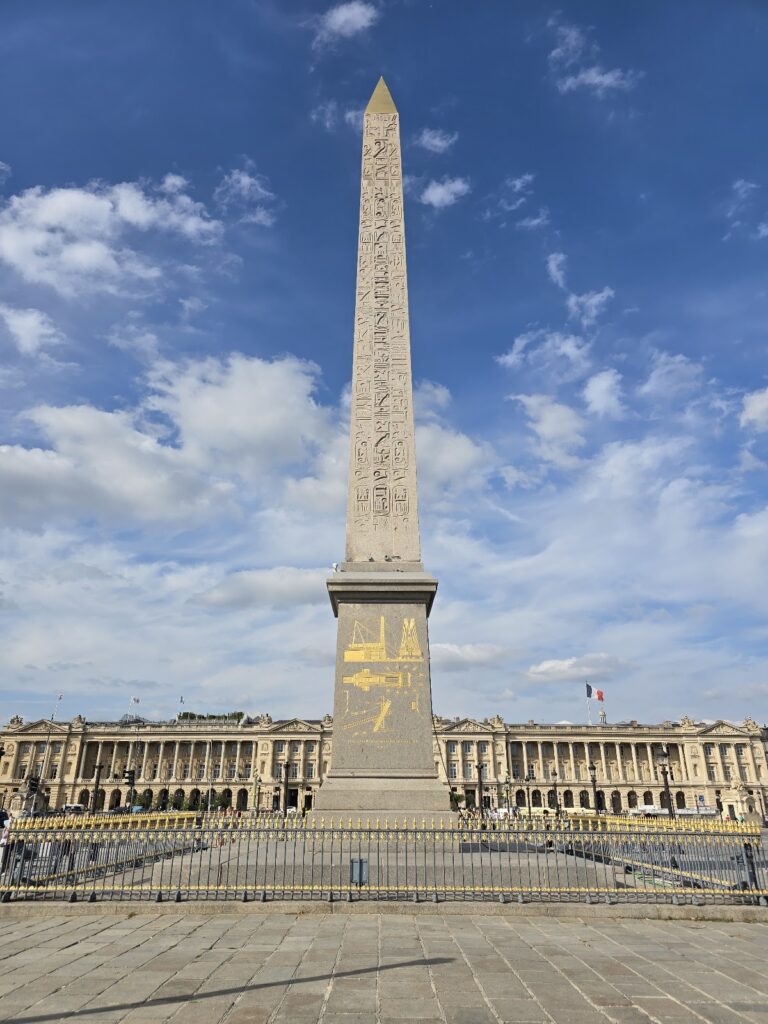
The façade facing the Seine was redesigned by Bernard Poyet between 1806 and 1810. It has twelve Corinthian columns beneath a triangular pediment and was raised so that it remained visible above the Pont de la Concorde while aligning visually with the Madeleine, formerly called the Temple of Glory. The façade stands perpendicular to the bridge, whereas the older building behind it preserves the original angles of the Duchess of Bourbon’s palace.
Antoine-Denis Chaudet’s first pediment showed Napoleon on horseback presenting flags captured at Austerlitz to the Corps législatif. During the Restoration, this was replaced by Alexandre-Évariste Fragonard’s scene of Louis XVIII granting the Constitutional Charter of 1814. The July Monarchy replaced it with Jean-Pierre Cortot’s surviving allegory of France accompanied by Force and Justice. One arm was lost during a storm in 1957 and later restored.
Four statues at the foot of the north staircase represent Maximilien de Sully, Jean-Baptiste Colbert, Henri-François d’Aguesseau, and Michel de L’Hospital. Their original works were by Pierre-Nicolas Beauvallet, Jacques-Edme Dumont, Jean-Joseph Foucou, and Louis-Pierre Deseine. Casts replaced the statues during the 1989 restoration of the colonnade. The staircase is also flanked by Philippe-Laurent Roland’s Athena and Jean-Antoine Houdon’s Themis. Athena represents wisdom, strategy, and civic ideals, while Themis is associated with divine law, justice, and established order. The façade carries François Rude’s Prometheus Animating the Arts and James Pradier’s Public Education, both commissioned in 1837.
Hemicycle and parliamentary interiors
The meeting chamber
The first meeting chamber, designed by Jacques-Pierre Gisors and Emmanuel-Chérubin Leconte, was a semicircular hemicycle modelled partly on a Roman theatre. A hemicycle is a parliamentary chamber in which curved rows of seats face the presiding desk and tribune. Its cupola drew inspiration from the amphitheatre of the Academy of Surgery. Poor ventilation, inadequate heating, and weak acoustics were noted when the Council of Five Hundred began using it.
Jules de Joly replaced that chamber with the present hemicycle, whose basic arrangement dates from 1832. The floor was lowered to increase the ceiling height, the tribune and presidential desk were raised, and a colonnade and balconies were added behind the seating. The chamber is elevated above the surrounding palace, a position that protected it from flooding during the Seine flood of 1910, when parliamentary sessions continued without the room being inundated.
The chamber retains the presidential desk and armchair designed by Jacques-Louis David for the Council of Five Hundred, including the armchair made for Lucien Bonaparte, Napoleon I’s brother. Behind the tribune is François-Frédéric Lemot’s marble bas-relief History and Fame. Fame announces laws with a trumpet while History records them on a tablet. A bust of Marianne, the allegorical female personification of the French Republic, and a medallion of the Roman god Janus occupy the centre.
Red velvet seats fill the hemicycle. Sixty-four carry commemorative plaques for notable parliamentarians who sat there. Since 1994, the honour has included former presidents of the Republic, prime ministers, and presidents of the Council. In 2016, Marie-Claude Vaillant-Couturier, Marie-Madeleine Dienesch, and Rachel Lempereur became the first women to receive it.
The French tricolour stands behind the presidential desk on a gilded, spear-tipped staff. A European flag was installed in the chamber in 2007 and later placed on the same staff at an equal height to the national flag. The two niches in the hemicycle contain James Pradier’s statues of Liberty and Public Order. A presidential armchair from the Directoire period is also associated with the chamber, as is a Gobelins tapestry based on Raphael’s School of Athens. The tapestry was installed in 1879 and has undergone restoration.
Conference and connecting rooms
The Salle des Conférences occupies the east side of the hemicycle. It was formerly the dining room of the Prince of Condé and was converted to its present function in 1830. Paintings by Heim recount aspects of the history of the monarchy and parliaments, while further historical paintings are positioned near the fireplace.
The three salons created or remodelled under Jules de Joly are the Delacroix, Casimir-Périer, and Abel de Pujol salons. They allowed movement between the wings without crossing the courtyard or the meeting chamber. The Salon Delacroix, formerly the Salon of the King, was decorated by Eugène Delacroix between 1833 and 1838 with allegories of Justice, Truth, Prudence, War, Industry, and Agriculture. Grisaille paintings of the Ocean and the Mediterranean occupy its west wall, and the niche between them originally held Louis Philippe’s throne.
The Salle des Pas-Perdus was formed from rooms that had included a bedroom and baths. Completed in 1839, it contains paintings by Horace Vernet and Charles Séchan, including Peace Distributes Her Benefits, The Genius of Steam, and Steam Chasing the Gods of the Sea. The Salon Abel de Pujol, created between 1838 and 1840, has grisaille ceiling paintings of Clovis I, Charlemagne, Louis IX, and Louis Philippe in relation to the establishment of French law.
The Salle Casimir-Périer is a broad vaulted corridor inspired by ancient Roman architecture. It contains Jules Dalou’s four-ton bronze bas-relief of the first revolutionary Assembly meetings. Six statues represent Mirabeau, Maximilien Foy, Jean Sylvain Bailly, Casimir-Périer, Jean-Étienne-Marie Portalis, and François Denis Tronchet. Additional reliefs represent law, justice, peace, work, industry, commerce, force, war, maritime commerce, and agriculture.
Commemorative rooms and former cells
The Salle des Quatre-Colonnes takes its name from its four columns. Its decoration includes statues of Brutus, Solon, Lycurgus, and Cato of Utica, formerly in the Council of Five Hundred’s chamber. The room also contains busts of Jean Jaurès and Albert de Mun, a marble memorial listing deputies killed in the First World War, and Armand Martial’s marble statue of the Republic commemorating deputies and Assembly officers who died in the Second World War. Other associated works include a bust of Olympe de Gouges, a revolutionary-era author and activist associated with women’s political rights. Its pedestal bears the Declaration of the Rights of Woman and the Female Citizen.
Two offices were formerly a two-room sobering-up cell for deputies. The last recorded occupant was the royalist deputy Léon-Armand de Baudry d’Asson, brought there in November 1880 on Léon Gambetta’s order after insulting the Ferry government. A second cell, measuring about 2 by 1.5 metres, was discovered near the hemicycle in 2010. It has bars, a wooden door, and a stone bench and had been walled up for several years.
Library and galleries
Library
The library was built against the east side of the original palace from 1830. Jules de Joly designed it in the manner of ancient Roman baths, with pillars supporting five cupolas and curved bays closing each end. Skylights illuminate the interior. Eugène Delacroix and his assistants decorated the room between 1838 and 1846.
The paintings on the cupolas and bays form an allegorical panorama of philosophy, natural history, legislation, eloquence, literature, poetry, and theology. Their subjects include Orpheus, Attila, Ovid, Demosthenes, Herodotus, Aristotle, Saint John the Baptist, Seneca, and Archimedes. The library preserves the minutes of Joan of Arc’s trial, manuscripts by Jean-Jacques Rousseau, Honoré Daumier’s terracotta busts known as the Celebrities of the Juste Milieu, and the Codex Borbonicus, an Indigenous codex from central Mexico. Some of its original holdings came from books confiscated from aristocrats and clergy who emigrated during the Revolution. The interior was restored for a year and opened to the general public for the first time in April 2025.
Hôtel de Lassay and connecting galleries
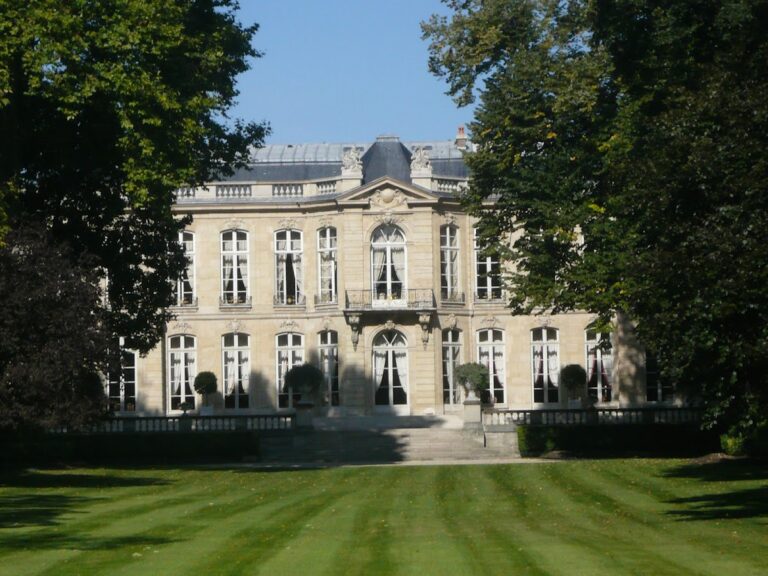
The Hôtel de Lassay lies west of the Palais Bourbon and is connected to it by the Galerie des Fêtes. It serves as the official residence of the president of the National Assembly. Major reconstruction in 1846 and 1848 added a storey while preserving much of its eighteenth-century exterior style and internal arrangement.
The Galerie des Fêtes replaced a wooden passage built in 1809. Constructed between 1846 and 1849, it is used for exhibitions and ceremonies. The adjoining Galerie des Tapisseries was created in 1860, and its paintings were replaced in 1900 by nine Beauvais tapestries.
Later artistic and technical additions
A small rotunda between the Palais Bourbon and the Hôtel de Lassay contains Pierre Alechinsky’s 1992 installation The Fragile Garden. The Salon of Marianne, created in 2004, displays busts of Marianne from different periods and styles. Since 2015, it has also included JonOne’s Liberty, Equality, Fraternity.
Works carried out in 2016 and 2017 renovated the semicircular Salle des Lampes, replaced incandescent bulbs with LED projectors, repaired water infiltration beneath the courtyard, repaved the courtyard in an eighteenth-century manner, and improved security, disabled access, and wireless connectivity. The hemicycle’s 19-metre-high glass canopy was replaced with a lighter plastic canopy, the carpet was renewed, and the Directoire presidential chair was restored. The Gobelins tapestry was temporarily replaced by a facsimile. Water damage also led to consolidation of the staircase on the Concorde side and renovation of the vice-presidents’ offices.
Nearby sites