Fort of Leça de Palmeira: A Coastal Fortification in Portugal


Site at a Glance
- Rating
- 4.5
- Popularity
- Low
- Country
- Portugal
- Primary era
- Early Modern
- Eras represented
- Early Modern, Modern
- Civilizations
- Portuguese
- Site type
- Military
- Remains
- Fort
On this page7 sections
History
The Fort of Leça de Palmeira is a Portuguese coastal fortification in Leça da Palmeira, Portugal, built chiefly between 1652 and about 1720 as part of the defenses at the mouth of the Douro River. Also known as the Castle of Matosinhos and the Fort of Our Lady of the Snows, it protected the shoreline and local communities from maritime attacks.
The First Fort at Santa Catarina
An earlier Fort of Our Lady of the Snows stood at nearby Santa Catarina. Francisco de Sá de Meneses, Count of Penaguião, commissioned it in 1638 with the assistance of Captain António Francisco Chorão. Its purpose was to help defend the coast against pirates and privateers from the Mediterranean, Africa, and other regions, together with the forts of São Francisco Xavier do Queijo and São João da Foz.
The fort’s traditional name was associated with a ship called Senhora das Neves, or Our Lady of the Snows. According to the tradition surrounding the name, the vessel carried a statue of Our Lady of the Conception from Coimbra to Leça da Palmeira in 1483.
Work on the first fort advanced slowly. King Philip III ordered its completion and armament in 1639, but the Portuguese Restoration War began in 1640. This conflict ended Habsburg rule in Portugal and restored an independent Portuguese monarchy under King John IV, making coastal defenses more urgent because of the danger of attacks from Castile. In 1642, Porto’s municipal council asked John IV to hasten construction, with the city treasury paying for the work. Building resumed in 1646, and a royal order established a six-man garrison in 1648, although the fort was still unfinished.
Replacement Fortification
By 1651, Porto’s authorities regarded the first fort as strategically inadequate because its position lay too far from the cove. A larger replacement was designed in 1652 by Friar João Turriano, a military engineer who served as chief engineer of the Portuguese kingdom. António Vieira received the contract for the masonry in 1655. This second fort is the structure that survives today.
By 1701, the new fort held a larger garrison, artillery positions, and four cannons. Its construction was probably complete around 1720, a date carved at the foot of the principal central arch.
Military Changes and Maritime Administration
During the Liberal Wars, the Portuguese civil conflicts between supporters of constitutional liberalism and defenders of absolute monarchy, the fort underwent improvements around 1832. The works affected its warehouses, drawbridge, internal staircase, and parapets. After the garrison was withdrawn, the fort ceased to serve its original military purpose, and its main square was adapted for Porto’s customs office in 1844.
The earlier Santa Catarina fort deteriorated under the effects of floods and tides. Its ruins were sold in 1851, and some surviving fabric was later incorporated into the Hotel Estefânia. The hotel was eventually expropriated for the construction of Dock 1 at the Port of Leixões.
From 1892, the surviving fort took on maritime and administrative duties. It became the seat of the Maritime Captaincy Delegation of the Douro Port, later renamed the Captaincy of the Port of Leixões. A signaling mast was installed, and a signal tower was added to the upper platform in the early twentieth century to monitor maritime traffic. A pilot lookout continued to operate from the fort until 1965, when its work moved to a new pilot station. The fort now houses the Captaincy of the Port of Leixões and the local maritime police command.
The fort was classified as a Property of Public Interest in 1961, a Portuguese heritage designation for structures recognized as having cultural importance. A landscaping project completed in 1962, designed by Ilídio de Araújo, improved the grounds and their surroundings. The Portuguese Republic owns the property, while the Captaincy of the Port of Leixões and the Ministry of National Defence through the Navy are responsible for its operation.
Remains
Shoreline Fortification
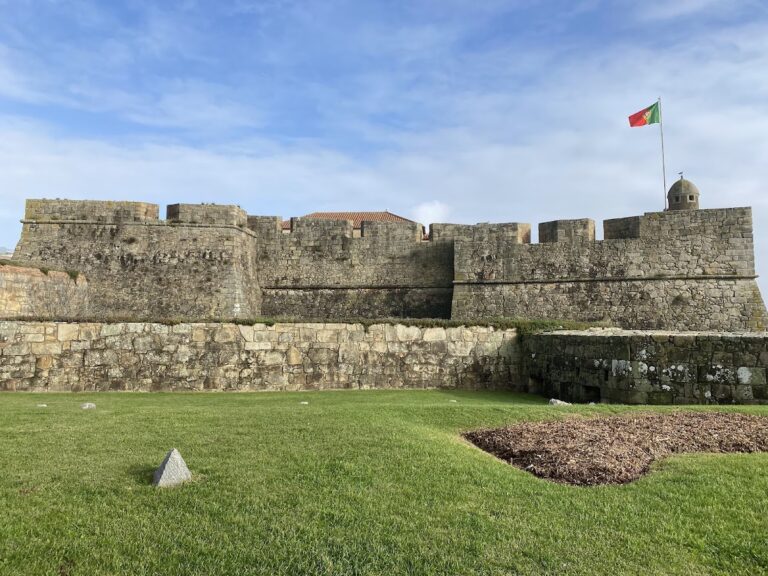
The fort stands about 8 metres above sea level along the urban shoreline of Leça da Palmeira, opposite the Port of Leixões and among homes and residences. Its four-pointed star plan uses projecting angles to allow defenders to cover the walls with intersecting fire. Angular curtain walls, the main walls between the projecting points, surround the fort, while barbicans, advanced defensive structures protecting an entrance or section of a fortification, strengthen its outer defenses.
Granite, masonry, wood, and tile form the principal materials of the fort. Tiered battlements survive around the defensive works, with several cannons placed along them. The date 1720 appears at the base of the main central arch, linking the surviving entrance feature to the period when the replacement fort reached completion. Military dependencies also remain within the complex.
Later Maritime Installations
The interior includes service buildings, aerials, and communications antennas connected with the Captaincy of the Port of Leixões. These installations belong to the fort’s later role as a captaincy of the port, a maritime authority responsible for regulating activities in a port and its waters, rather than to the original defensive arrangement. The signal mast and the early twentieth-century signal tower likewise reflect the site’s continuing use for maritime oversight.
Nearby sites