Igreja e Casa do Mosteiro de São Salvador de Moreira: An Augustinian Monastery Complex in Portugal


Site at a Glance
- Rating
- 4.5
- Popularity
- Low
- Country
- Portugal
- Primary era
- Early Modern
- Eras represented
- Early Modern
- Civilizations
- Portuguese
- Site type
- Religious
- Remains
- Monastery
On this page15 sections
History
Igreja e Casa do Mosteiro de São Salvador de Moreira is a former Augustinian Canons monastery complex in Portugal, in Moreira. Traditionally founded in 832, it became an important religious institution in the Diocese of Porto and was rebuilt in the late sixteenth and early seventeenth centuries in the Mannerist style, a late Renaissance style marked by formal complexity and deliberate departures from classical balance.
Early Foundation and Augustinian Community
The traditional foundation date comes from an interpretation of Dona Gontinha’s testament by João de Barros, Manuel Severim de Faria, and Gaspar Álvares Lousada. According to this tradition, the first house was dedicated to Saint George at Gontão, north of the present site, probably near Moreira de Cónegos. This would make Moreira the oldest monastery or church in the Diocese of Porto and the oldest monastery of Augustinian Canons in the Entre Douro e Minho region.
The Rule of Saint Augustine, the religious code followed by the Augustinian Canons, was introduced in 899. In 1060, at the request of its patrons Tructezindo Gomes and Dona Gontinha, Abbot Mendo transferred the monastery to Moreira and dedicated it to the Divine Savior. A testament of Soeiro Mendes da Maia confirms that the foundation stood at the present location before 1064.
The first church at the present monastery was begun in 1092 and completed in 1112. Hugo, Bishop of Porto, consecrated it that year. The community received major endowments, including an extensive estate donated by Egas Trutesindes and Hermesenda Gonçalves in 1090. Soeiro Mendes da Maia gave all his estates to support the clergy and ordered that he be buried at the monastery.
Moreira was initially a mixed religious house, with communities of canonesses and canons occupying separate cloisters. In 1147, the canonesses moved to the Convent of São Cristóvão, taking part of the monastery’s income and properties. The monastery also controlled several dependent churches until the middle of the sixteenth century.
Jurisdiction and Ecclesiastical Influence
The monastery acquired rights, lands, and the right of presentation, meaning the institutional power to nominate clergy for appointment to churches. In 1298, Sancho Pires, Bishop of Porto, granted Moreira this right for São Cosme de Gemunde, São Mamede de Perafita, São João do Mindelo, and Santa Maria de Vila Nova da Telha. In return, Prior João Pires surrendered the monastery’s rights over São Fins da Feira and Santa Marinha da Retorta. São Tiago de Labruge was annexed to Moreira in 1476.
A territorial jurisdiction known as a couto was probably granted by Afonso Henriques, Portugal’s first king, around 1170. Its boundaries were investigated in 1285. In 1290, indulgences were offered to people who helped fund work on the church and monastery. In 1367, King Fernando maintained a levy supporting the institution, which was then in poor physical and financial condition.
In 1496, a synod presided over by Diogo de Sousa, Bishop of Porto, formally judged Moreira older than the other Augustinian Canons’ monasteries in the bishopric and granted it precedence. The ruling strengthened the authority of Prior João do Porto and confirmed Moreira’s leading position within the order in the Diocese of Porto.
Commendatory Rule and Union with Santa Cruz
Around 1483, Moreira came under commendatory administration. A commendatory administrator controlled a monastery’s revenues or institutional affairs without necessarily leading its resident religious community. Among the holders of this position were Pedro da Costa, Bishop of Osma; Manuel dos Santos, Bishop of Targa; and Fulgêncio de Bragança, son of Jaime I, Duke of Bragança.
The commendatory system ended in 1562, when Moreira began to enter the Congregation of Santa Cruz of Coimbra. This was an Augustinian reform congregation based at the Monastery of Santa Cruz in Coimbra. Fulgêncio de Bragança renounced his possession of Moreira so that it could join the congregation, receiving a lifelong pension in return. Canons from Santa Cruz took possession on 22 July 1562. A royal charter of 12 November 1565 and Pope Pius V’s bull Rationi congruit, issued on 17 January 1566, formally confirmed the union.
Gregório became prior in 1567, and the church of São Silvestre do Couço was transferred to Moreira and annexed to it in 1568. Priors Gregório and Cipriano later resisted visitation by the Bishop of Porto, arguing that the papal bulls exempted the monastery from episcopal inspection. An agreement reached with Rodrigo Pinheiro, Bishop of Porto, in 1571, and confirmed by his successor Aires da Silva in 1575, defined the limits of episcopal authority. The monastery, its enclosure, its regular religious, and their families were exempted, while the bishop retained authority over parishioners, secular clergy, certain regular clergy, and dependent churches. Sentences issued at Braga in 1656 and 1671 assigned the chapel of São Silvestre do Couço to this visitation.
Rebuilding and Later History
By 1584, the medieval monastery was too small and seriously degraded. Jorge, Prior-General of Santa Cruz of Coimbra, therefore ordered the complete rebuilding of the complex in July of that year. Work began under Prior Henrique Brandão, and Marcos de Lisboa, Bishop of Porto, laid the first stone on 3 May 1588. Philip II, the Spanish monarch who also ruled Portugal during the Iberian Union, began his patronage of the works on 22 February 1591. The church and monastery were completed after 34 years, in 1622, when the church was inaugurated with a major celebration and procession.
The Augustinian Canons remained at Moreira until 1770. In that year, Pope Clement XIV united nine monasteries of the Congregation of Santa Cruz of Coimbra with the Monastery of Mafra. Moreira’s goods, silver, and liturgical ornaments were transferred to Mafra, while its resident canons were sent to Santa Cruz of Coimbra. From 1794, the former monastery’s properties and revenues were administered permanently by São Vicente de Fora, and in 1795 the assets of São Salvador de Moreira were joined to that monastery’s holdings.
The suppression of Portugal’s religious orders in 1834 separated the monastery house and enclosure from the church. The church became Moreira’s parish church in the same year. The house and estate were sold to Luís Lopes Vieira de Castro, then passed through his widow to Dona Rita de Moura Miranda. The statesman Luís de Magalhães later inherited the property and made it his residence. The estate received members of Portugal’s “Generation of the 70,” including Antero de Quental, Oliveira Martins, Jaime de Magalhães Lima, Alberto Sampaio, António Feijó, and Eça de Queirós. Queirós referred to the property as “Quinta de Refaldes” in The Correspondence of Fradique Mendes.
The church continues to serve as the parish church of Moreira, while the complex has been classified as a Monument of Public Interest since 2012.
The Santo Lenho
The monastery’s religious history also includes the Santo Lenho, a relic understood in Christian devotion as a fragment of the True Cross associated with the crucifixion of Jesus. Tradition holds that crusaders brought it from the East. Its earliest recorded reference is in the testament of Trutesindo Guterres, dated 19 April 1078, which mentions the Holy Wood and other relics at Moreira.
The relic was reportedly lost during the reign of Afonso Henriques and rediscovered in 1510 by Vasco Annes, the claustral prior responsible for the monastery’s internal administration. It lay beneath the high altar stone inside an older reliquary. Pedro da Costa, Bishop of Porto, ordered celebrations and commissioned a new reliquary. Devotion was especially strong on 3 May, the Feast of the Holy Cross, and 14 September, the Feast of the Exaltation of the Holy Cross. Processions reportedly drew people from more than 70 parishes, particularly fishermen from Matosinhos. Religious tradition credited the relic with protecting Moreira and the surrounding Terra da Maia from calamities.
Remains
The surviving complex consists of the church, the convent, and the Quinta do Mosteiro, an estate occupying more than 10,000 square metres. Its design reflects northwestern Portuguese architecture of the second half of the sixteenth century. The architect is unknown, but the scheme is associated with the simplified model of the Monastery of Grijó, designed by Francisco Velasquez in 1572, and with Mannerist architecture influenced by Sebastiano Serlio’s Renaissance architectural treatises.
Church Exterior and Plan
Façade
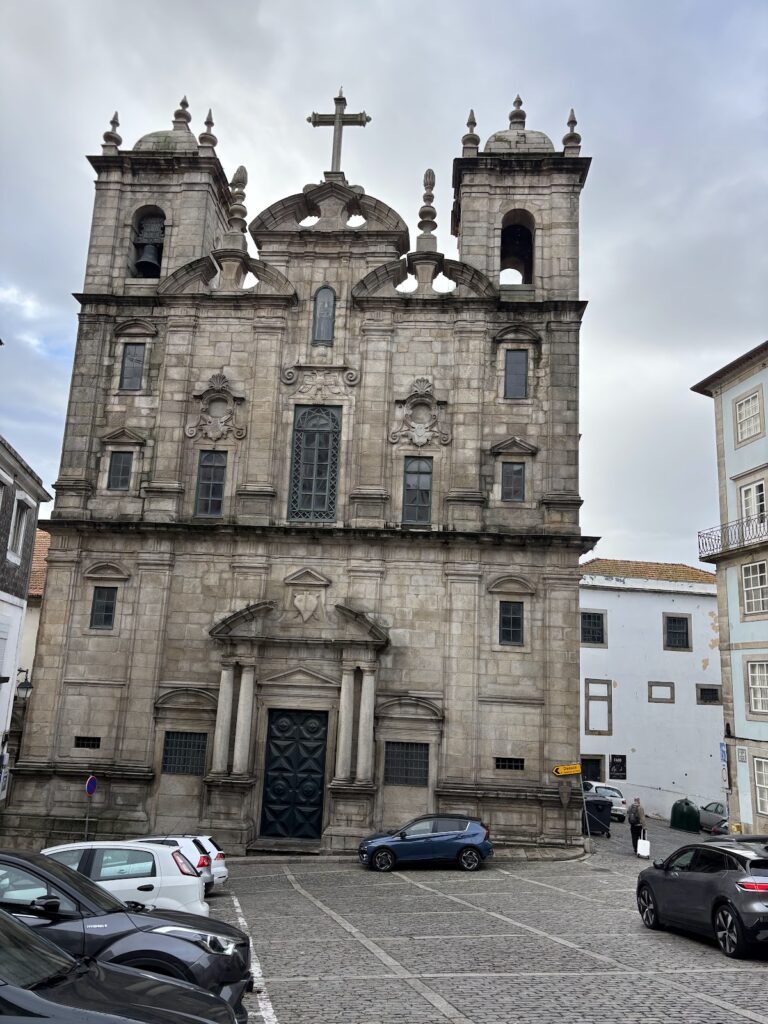
The church has an austere granite façade arranged in two registers. The lower Tuscan register contains a galilee, a covered entrance porch, with a coffered ceiling formed from recessed decorative panels. Three straight-arched openings are separated and framed by four rectangular columns with rectangular bases, smooth shafts, and simple capitals.
The upper Ionic register is much taller and contains a Serliana, an arrangement in which a central round arch is flanked by two straight-headed openings. Four rectangular columns with smooth shafts and capitals bearing two volutes separate and frame the windows. They stand on pedestals or pseudo-plinths. The unusual height of this register and the plinths give the façade the appearance of an intermediate storey, although no such storey exists. A pediment crowns the façade, with a central clock and a balcony in front of it.
Nave and Chapels
The church has a single nave with a barrel vault covered in coffers. Two lateral chapels open from the nave to form a false transept, while two further lateral chapels occupy the second of the nave’s upper thirds. A large upper choir above the main entrance rests beneath a segmental-arched ceiling and contains the canons’ choir stalls. Two bell towers were added in 1695 at the transition between the nave and the main chapel.
Interior Decoration and Furnishings
Main Chapel
The main chapel is rectangular and has two large windows on each side. Its side walls, like those of the two lateral chapels nearest the entrance, are covered with continuous-pattern seventeenth-century azulejos, or glazed ceramic tiles, in blue and yellow.
At the head of the chapel stands a large tripartite Baroque altarpiece. It is vertically emphasized, intricately carved in wood, and richly covered with gilded woodcarving. The high altar was made later than the church and belongs to the Baroque woodcarving tradition of the Maia region. It is contemporary with the two lateral altars in the crossing between the nave and the main chapel.
Santo Lenho Reliquary
The Santo Lenho is preserved behind crystal glass in a gilded silver cross-reliquary decorated with precious stones. The container relates to the relic’s reported discovery beneath the high altar stone in 1510, where it was found inside an earlier reliquary.
Baroque Organ
The monastery also retains a 45-pipe Baroque organ dating from 1701 and made by Arp Schnitger. After about a century of deterioration, the instrument was restored between 1998 and 2001 by the German organ builder Georg Jann.
Monastery House and Quinta do Mosteiro
The former monastery enclosure is physically distinct from the church, reflecting the separation and sale of the house and estate after the religious orders were suppressed. The Quinta do Mosteiro contains a large garden that has existed for centuries. Together, the convent, house, enclosure, and garden preserve the material setting of the former religious complex beyond the parish church itself.
Nearby sites