Cisy Castle: A Medieval Hilltop Fortress in Poland



Site at a Glance
- Rating
- 4.6
- Popularity
- Medium
- Country
- Poland
- Primary era
- Medieval
- Eras represented
- Medieval, Early Modern
- Civilizations
- Holy Roman Empire
- Site type
- Military
- Remains
- Castle
On this page10 sections
History
Cisy Castle is a medieval hillside fortress in Poland, near Cieszów in the Czyżynka valley, about 5 kilometres west of Świebodzice. Its construction date is uncertain, but the stronghold probably began under Bolko I the Strict, a Piast duke associated with the Duchy of Jawor, and was expanded by his grandson Bolko II the Small, ruler of the Duchy of Świdnica-Jawor. The castle guarded a trade route and protected the eastern border of the Duchy of Jawor during the thirteenth century.
Origins and ducal rule
A forged document dated 1242 refers to a person or place called “Cziskenberg,” providing the earliest mention of a stronghold in the area. One political explanation connects the castle’s origin with Bolesław the Bald’s seizure of the western part of the Duchy of Wrocław from Henry IV Probus in 1277. Cisy also served as a counterpoint to Stary Książ Castle, around 3 kilometres away in the Duchy of Wrocław.
The first direct reference to Cisy Castle dates from 1327, when Bolko II issued a document there. Further documents mention “Ciskberg” in 1341 and 1343. In 1355, Bolko II captured the castle during an operation against rebellious castles in the Wałbrzych area and then transferred it to Nickel Boltze, castellan of Strzegom. A castellan was a senior official responsible for administering and defending a castle district.
The Świdnica court and later owners
Agnes of Habsburg, the widow of Bolko II, lived at the castle. From 1381, and especially after 1384, it increasingly served as a residence of Agnes’s court from Świdnica. Her last recorded stays took place shortly before her death in 1392. During the fourteenth century, the castle’s estates also included the nearby town of Dobromierz.
Sander Bolz von Grunau of Skarżyce bought Cisy in 1408, and Ulrich von Seydlitz acquired it in 1429. Hussite forces connected with George of Poděbrady, the fifteenth-century king of Bohemia, partially destroyed the castle in 1466. It was then rebuilt and enlarged with a western outer bailey, a defended area adjoining the principal enclosure. During the second half of the fifteenth century, supporters of Vladislaus II Jagiellon, king of Bohemia and Hungary, controlled the castle while opposing Wrocław and Matthias Corvinus, king of Hungary.
Further rebuilding added an eastern outer bailey, and a semicircular bastion was erected in the sixteenth century to defend the bridge. A bastion was a projecting fortification designed to strengthen the defence of a wall or approach. At the beginning of the seventeenth century, the castle belonged to Nicholas von Czeschhaus.
Destruction, decline, and conservation
Swedish troops burned Cisy in 1634 during the Thirty Years’ War, a European conflict fought from 1618 to 1648 amid religious, dynastic, and political struggles. The castle subsequently declined into a ruin. Susanne von Sauermann, née Czettritz, owned it from 1655, and Christoph Friedrich, Count of Stolberg-Wernigerode, purchased it in 1719. The property later passed to Count von Zieten of Struga, who cleared trees and shrubs from the grounds in 1833. Later owners neglected the ruins, and local peasants removed stones for building material.
Interest in Cisy revived during the nineteenth century, when the ruins became a destination for excursions. Around the middle of that century, ownership passed to the Wrocław merchant Marcus Schottländer. Later owners included a mining association from Szczawno-Zdrój, the Berlin commercial councillor Wilhelm Ledermann, and the Wrocław wholesaler Emanuel Aufricht.
Walter Brehmer of Wałbrzych initiated conservation work in 1927, securing the grounds and reconstructing the gate and tower. Some nineteenth-century and interwar preservation work was destroyed during fighting in 1945. After the Second World War, youth scouts cared for the site. The ruins were secured as a permanent ruin in 1961, and in 1975 vegetation was cleared, the courtyard was tidied, and the 24-metre bridge over the dry moat was repaired. Cisy Castle has been legally registered in Poland as a protected historic monument and cultural-heritage property since 30 March 1960.
Remains
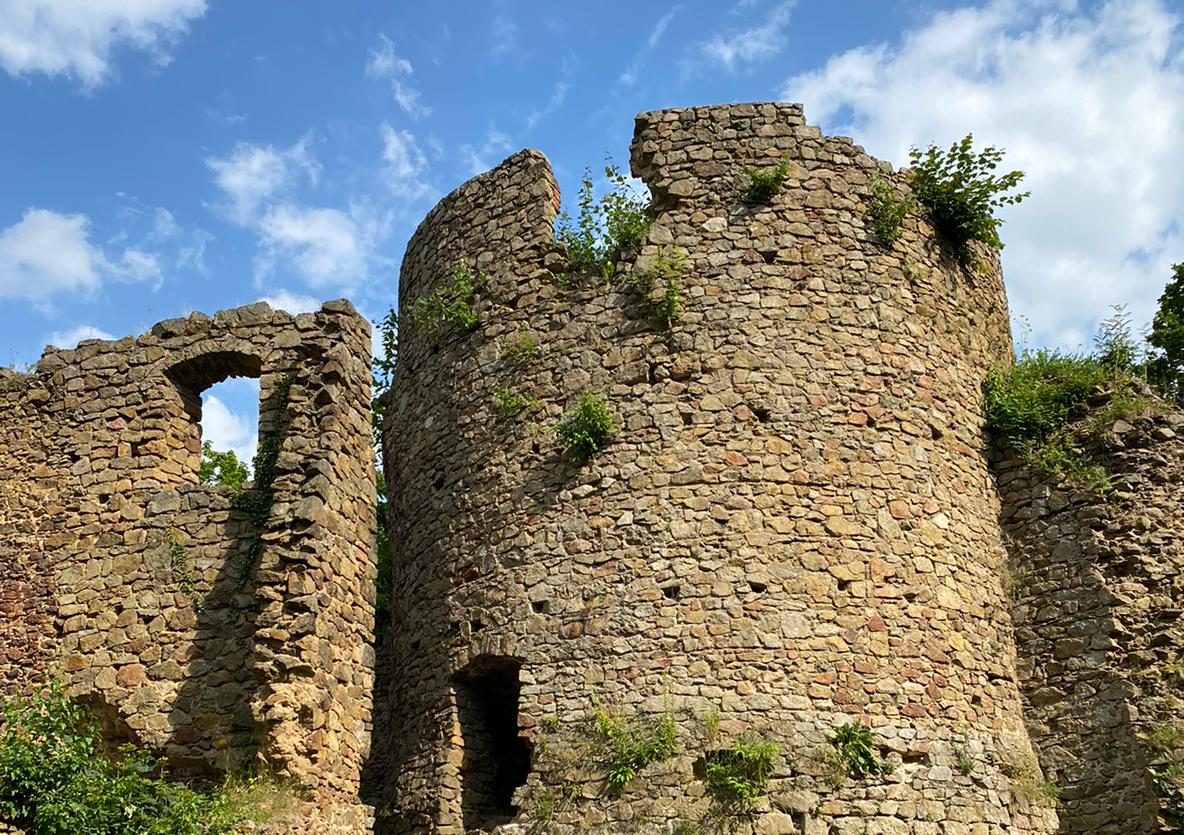
The castle proper occupied an irregular, roughly quadrilateral plan measuring about 22 by 28 metres. Built mainly from local sandstone, its walls followed the hillside terrain. The main enclosure stood within an outer wall, while eastern and western outer baileys extended beyond it and were protected by an additional wall made of roughly broken stone. The surviving complex is centred on the tower, fragments of the defensive walls, parts of the gates, and a section of a residential building.
Defences and entrance
Defensive walls
The defensive wall had buttress-like reinforcements at its corners and contained a gate in the northwestern curtain, the section of wall between strong points. The castle was surrounded by a dry moat. Beyond the main enclosure, the eastern and western outer baileys formed additional defended areas enclosed by a rough-stone wall.
Eastern gate and bridge
The entrance was approached from the east along a narrow approach and across a bridge over the moat. The eastern gate remains partly preserved, while the bridge measures 24 metres and was repaired in 1975. A semicircular bastion added in the sixteenth century strengthened the bridge’s defence.
Southeastern tower
A circular tower approximately 10 metres in diameter occupied the southeastern corner of the castle. It is among the best-preserved elements of the ruin and remains a defining part of the surviving defensive structure.
Residential building
A residential building stood inside the defensive walls. It had at least two storeys and contained numerous rooms. Part of this building survives among the castle’s remains, alongside the fragments of the surrounding walls and gates.
Nearby sites