Ehrenberg Castle: A Medieval Fortress Ensemble in Austria




Site at a Glance
- Rating
- 4.7
- Popularity
- Medium
- Country
- Austria
- Primary era
- Medieval
- External website
- Open
- Eras represented
- Medieval, Early Modern
- Civilizations
- Habsburg, Holy Roman Empire
- Site type
- Military
- Remains
- Castle
On this page9 sections
History
Ehrenberg Castle is a medieval hilltop fortress in Austria above Reutte, probably founded around 1290 during the consolidation of Tyrolean rule. Its creation may have followed Count Meinhard II of Gorizia-Tyrol’s transfer of Falkenstein Castle to the Bishop of Augsburg, which prompted the construction of a replacement stronghold. The castle became the centre of a fortified pass system and later formed part of one of the most important fortress ensembles in Central Europe.
Foundation and Early Administration
During the thirteenth century, the surrounding region lay largely within the sphere of the Hohenstaufen dynasty, a major ruling house of the Holy Roman Empire. At the end of the century, its lordship passed from the widow of Conrad IV, one of the dynasty’s kings, as a dowry to Meinhard II, Count of Tyrol. Heinrich von Starkenberg appears as Ehrenberg’s first captain in 1293. Construction was financed partly from the prince’s revenues, while the judicial districts of Imst, Petersberg, and Hörtenberg supplied further money and compulsory labour.
The castle was besieged during a feud around 1296 and was enlarged afterward. In 1314, Duke Henry of Carinthia pledged Ehrenberg and the court known as “im Wald” to Count Conrad of Kirchberg as security for a debt. The pledge was redeemed in 1317, when administration returned to Heinrich von Starkenberg. The barrier at the foot of the castle rock, later known as the Ehrenberg Klause, was first recorded in the same year and probably originated with the early road defenses.
Pledges and Territorial Power
Ehrenberg and its court were repeatedly transferred as security for debts during the later Middle Ages. The castle was pledged to Duke Conrad IV of Teck in 1352 for 14,000 Bernese marks, to Duke Albert II of Austria in 1354, and to Conrad of Freyberg in 1362. Austria redeemed the pledge again in 1365. The toll station in the pass below the castle produced substantial revenue, making the stronghold and its surrounding jurisdiction especially attractive to creditors. Officials such as Sigmund Henlein, who was recorded as caretaker in 1445, administered the complex.
After further pledges, Ehrenberg passed to the Augsburg merchant Georg Gossembrot. During his rule, Reutte was raised to market-town status. Gossembrot was deeply unpopular, and after his death at nearby Füssen in 1502, he was reportedly poisoned by his subjects. In 1523, the lordship passed through the Augsburg Paumgartner family to Gabriel Salamanca, a Spanish administrator regarded as exceptionally cruel. Popular opposition forced the duke to redeem the pledge in 1525.
Sieges and Military Modernization
The castle faced renewed warfare during the Schmalkaldic War, the sixteenth-century conflict between the Protestant Schmalkaldic League and the Holy Roman Emperor. Forces of the league captured the Ehrenberg Klause on 11 July 1546, and the castle surrendered the following day. Tirol recaptured the complex in September after placing seven guns on Falkenberg and bombarding the castle. Repairs continued until 1551. Elector Maurice of Saxony attacked in 1552 but failed to take the castle. His troops bypassed the defenses over Falkenberg, while the Klause was damaged and plundered during their withdrawal.
After these wars, Ehrenberg received limited governmental attention. In 1566 its garrison numbered five men and a stable boy, and in 1601 the caretaker moved his residence to Reutte. The strategic value of the complex as a border barrier was later recognized again, and Archduke Maximilian ordered major improvements between 1607 and 1609. Further defenses were added hastily in 1632 during the Thirty Years’ War, the European religious and political conflict fought from 1618 to 1648. A Protestant army of more than 6,000 men under Duke Bernhard of Weimar attacked the Klause but was repelled by the Tirolers.
Claudia de’ Medici, widow of Archduke Leopold V, commissioned Fort Claudia on Falkenberg from 1639. Its builder was Elias Gumpp. During the War of the Spanish Succession, the international conflict over the Spanish throne from 1701 to 1714, the Bavarian elector captured Ehrenberg in 1703. Austrian forces retook it a month later. Local farmers had hauled guns onto the dominant Schlosskopf and used them to bombard the castle, exposing the weakness of its existing defenses. The Austrian government consequently planned the large Schlosskopf fortress, built between 1726 and 1741. Its strategic effectiveness was never tested in war.
Abandonment and Conservation
In 1782, the Tyrolean fortresses were abandoned except for Kufstein. The complex was sold as a source of building stone and dismantled. Industrialist Friedrich Carl Hermann acquired the ruin in April 1857 when it was threatened with demolition. Since the mid-twentieth century, the association Rettet Ehrenberg has worked with the owners to halt deterioration across the wider fortress ensemble. Ehrenberg is a state-protected cultural monument and is regarded as one of the most important fortress ensembles in Central Europe, as well as one of the oldest important fortification systems in the northern Tyrolean Alpine foothills.
Remains
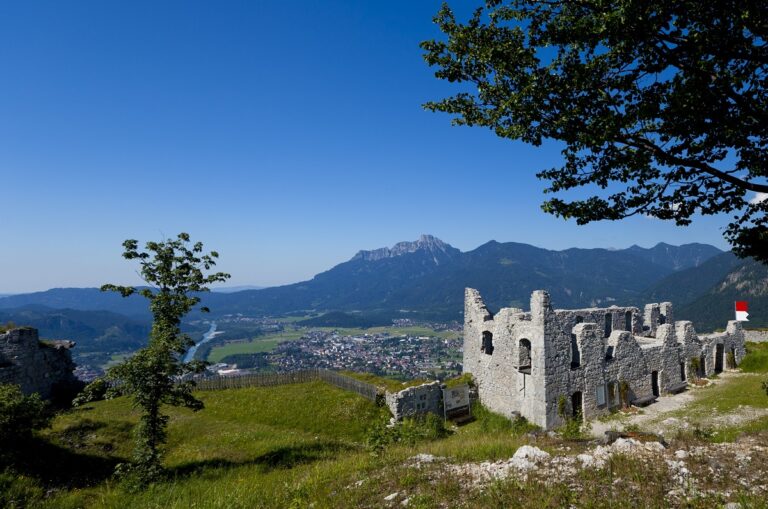
Ehrenberg stands at approximately 1,100 metres above sea level on a rocky hill at the northern edge of the Lechtal Alps, south of Reutte and above the ascent toward Lake Heiterwang. The castle, Schlosskopf fortress, Fort Claudia, and the Ehrenberg Klause form an interconnected defensive system. Long connecting walls link the castle with the Klause and Schlosskopf, while an eighteenth-century hornwork, an outward-projecting fortification designed to strengthen an approach, secures the Schlossanger between the castle and the later fortress.
The Hilltop Castle
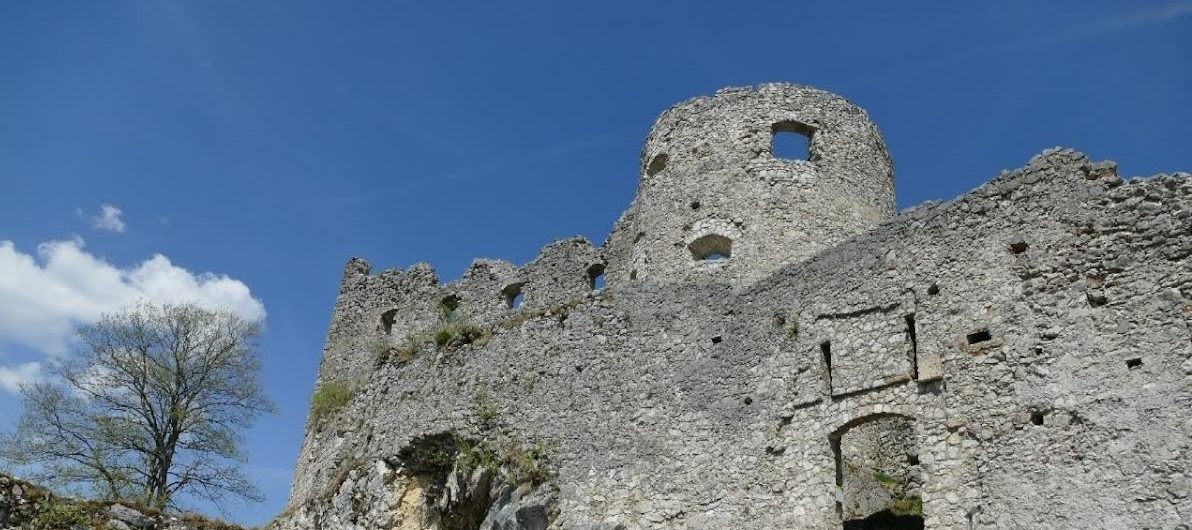
The castle is a hilltop fortress whose irregular outer wall follows the shape of the rocky plateau. A rectangular inner castle occupies the higher rock outcrop, with a gate fortification in front of it. The earliest stronghold was probably modest, consisting mainly of a palas, the principal residential building of a medieval castle, and an outer bailey. Its palas contained a large hall. The transverse Hohe Stock was built during the third quarter of the fifteenth century, and extensive additions followed between the fifteenth and seventeenth centuries.
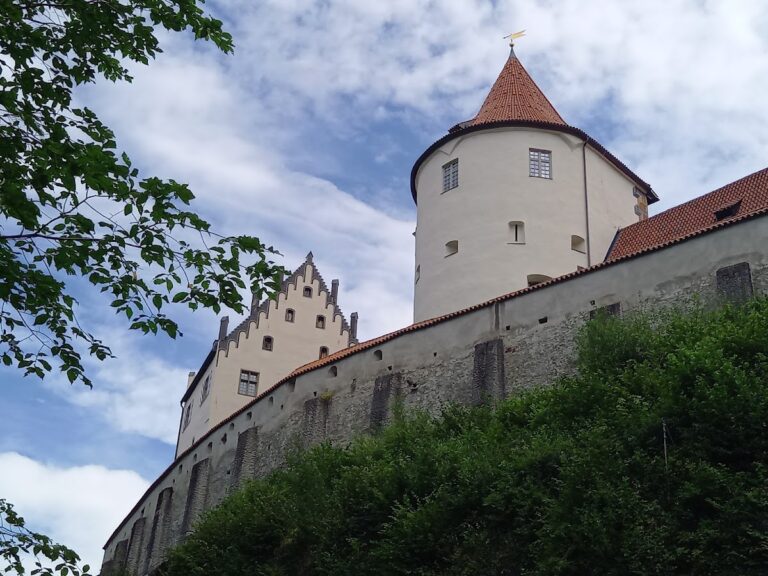
The southern corner is strengthened by a semicircular tower. South and east of the buildings, a zwinger, or defended space between inner and outer walls, forms part of the approach to the inner gate. Masonry survives in places to several stories and is interrupted by numerous window openings. The outer ring wall belongs largely to the sixteenth and seventeenth centuries. It enclosed the earlier inner castle in the manner of an outer bailey and defensive forecourt, although its fortifications were already technologically outdated when built.
The large northeastern artillery tower, known as the Falken Tower, was created from 1551 by converting a semicircular crenellated shell tower. Two smaller round towers and a bastion, a projecting gun platform, were added along the wall. A bastioned gate complex protects the southwestern entrance. These elements, together with the walls leading toward the lower defenses, show how the medieval hilltop castle was adapted to the increasing use of artillery.
The Ehrenberg Klause
The Ehrenberg Klause at Katzenberg occupies the lower part of the defensive system. Beside its barrier wall stood a fortified house, and Georg Gossembrot added a granary from 1482. An inventory from 1525 lists a customs and post station as well as an inn, reflecting the administrative and commercial functions concentrated at the pass barrier.
In the early seventeenth century, two projecting Italian-style bastions strengthened the northern side of the Klause. After 1618, a hornwork and additional outer defenses were added, followed in the eighteenth century by a two-story barracks. Parts of the Klause buildings were dismantled after the 1782 abandonment. Revitalization began in the 1990s, when the main building was restored and prepared to house the European Castle Museum, a museum devoted to castle history and material culture. The bastions, hornwork, and barracks were conserved and supplemented.
Fortifications at Schlosskopf and Falkenberg
Schlosskopf rises above Ehrenberg and contains the later baroque fortress constructed between 1726 and 1741. Fort Claudia occupies Falkenberg, while the Klause blocks the valley below. Together, these positions provided overlapping defenses for the pass. Their connecting walls and outworks made the fortress complex broader than the hilltop castle itself, extending its defensive organization across the surrounding terrain.
The surviving ensemble is intended, in accordance with the owners’ stated intentions, to serve as a place of recreation and a destination for the local population and visitors. Its present form combines the fragmentary medieval castle, later artillery defenses, the lower pass barrier, and the eighteenth-century fortress works that transformed Ehrenberg into a connected military landscape.