Maarjamäe Palace: A Historic Manor and Museum in Tallinn


Site at a Glance
- Rating
- 4.7
- Popularity
- Medium
- Country
- Estonia
- Primary era
- Modern
- External website
- Open
- Eras represented
- Modern
- Civilizations
- Russian
- Site type
- Domestic
- Remains
- Elite Residence
On this page6 sections
History
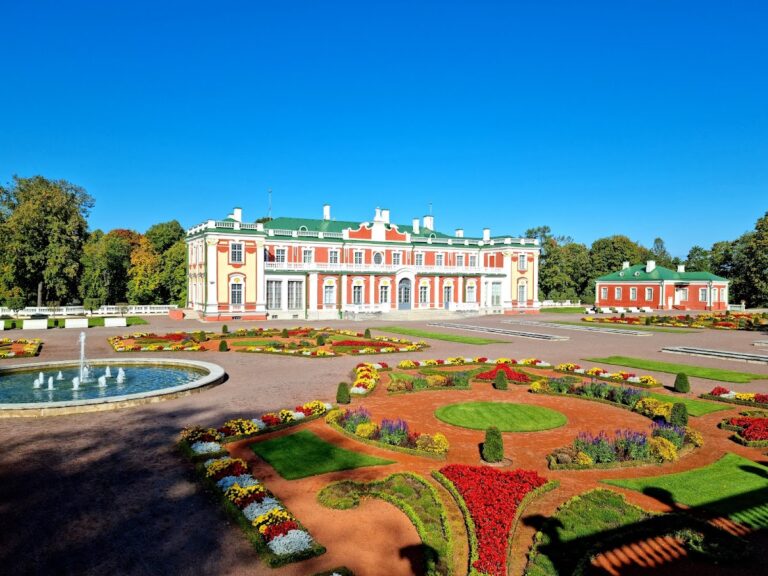
Maarjamäe Palace is a nineteenth-century manor in Tallinn, Estonia, built as the summer residence of Russian Count Anatole Orlov-Davydov. The palace was completed in 1874 in a pseudo-Gothic and eclectic style, adapting medieval Gothic forms while combining elements from different historical traditions.
From sugar factory to summer residence
The estate is dated to 1811, and its site had previously been occupied by a sugar factory known as Streitberg. In the 1870s, Orlov-Davydov acquired the property and commissioned a residence designed to resemble a medieval castle. The project was designed by Robert Gödecke, an architect and professor from Saint Petersburg, and supervised by the local architect Nikolai Tamm. The name Marienberg was probably chosen in honor of Orlov-Davydov’s wife and daughter, both named Maria. Imperial Russian military-topographic maps from 1846 to 1863 marked the estate as the Marienberg Dachas.
Changing institutional uses
After Estonia became independent, the palace housed a Dutch diplomatic mission from 1920 to 1932. During the 1930s, Johannes Valdt established the Riviera Palace hotel and restaurant there. In 1937, the Republic of Estonia purchased the manor and installed an air-defense aviation school, which operated until 1940. The building’s interior and facade were substantially altered during this period.
After Estonia was reattached to the Soviet Union in 1944, the Soviet army occupied the palace. It served as an officers’ club and a cinema projection hall. When the military units later departed, soldiers’ families, mostly officers’ families, continued living in the palace and its outbuildings. On 29 April 1975, the manor buildings were transferred to the State Historical Museum of the Estonian Soviet Socialist Republic. Since that year, the palace has functioned as a branch of the Estonian History Museum.
The museum’s exhibitions address history from the beginning of the nineteenth century, including Estonia’s past and the history of the Baltic Germans, the German-speaking population historically established in the eastern Baltic. A 2018 exhibition presented Estonia’s history from independence in 1918 through the period following the restoration of sovereignty in 1991. The palace and its grounds are protected as a cultural monument.
Remains
The palace building
The surviving complex is centered on the principal manor building, a nineteenth-century structure in pseudo-Gothic, eclectic form. Its design uses the appearance of a medieval castle, while its construction belongs to the period of Orlov-Davydov’s residence. A weather vane carries the date 1874, probably identifying the year of construction. Later military occupation changed the building’s interior and facade, and the former summer hall was reconstructed in 2017 and 2018.
When former military families remained in the palace and its ancillary buildings, the interior was divided into several small apartments with shared kitchens. The complex now contains the Estonian History Museum branch, along with a restaurant and museum shop.
Park and outdoor monuments
A park surrounds the palace. It contains monuments to figures associated with the communist movement that formerly stood in cities of the Estonian Soviet Socialist Republic. The grounds also include an outdoor display of monuments and monumental sculpture from that period, preserving material evidence of the era’s public commemorative culture.
Nearby sites