Festung Schlosskopf: An Early Modern Fortress Above Reutte


Site at a Glance
- Rating
- 4.7
- Popularity
- Low
- Country
- Austria
- Primary era
- Early Modern
- External website
- Open
- Eras represented
- Early Modern, Modern
- Civilizations
- Habsburg, Holy Roman Empire
- Site type
- Military
- Remains
- Fort
On this page8 sections
History
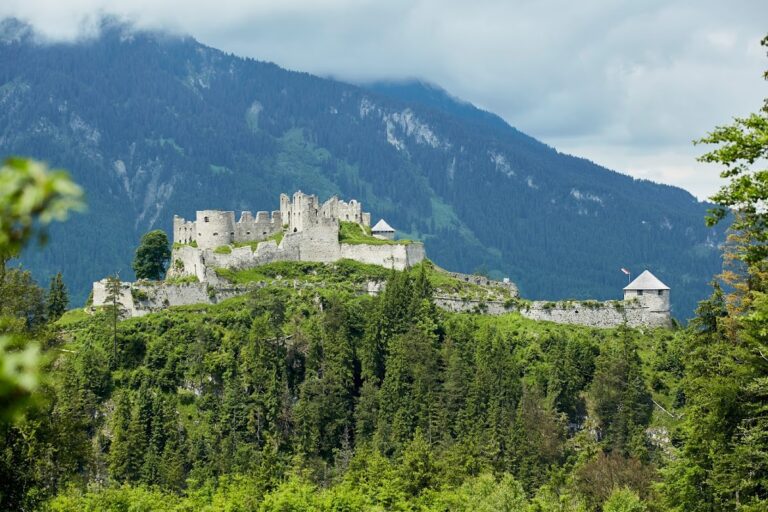
Festung Schlosskopf is an early modern fortress in Austria, above Reutte, forming part of the Ehrenberg fortress complex in the Außerfern region of Tyrol. Construction began in 1726, resumed in 1733, and was completed in 1741 under the fortress commander Johann Andre von Pach. Together with Burg Ehrenberg, the fortified Klause, and Fort Claudia, it belongs to a fortress ensemble described as one of the most important in Central Europe and the Alpine region.
Plans for the Schlossberg
The fortress mountain rises about 150 metres above Burg Ehrenberg. Its plateau allowed artillery to fire down toward the castle, a possibility demonstrated in 1703 during the War of the Spanish Succession, a European conflict fought from 1701 to 1714 over the Spanish succession. Tyrolean forces recaptured Burg Ehrenberg from the Bavarians after farmers from the Außerfern hauled heavy guns several kilometres uphill from Weißenbach.
The strategic value of the mountain had been recognized earlier. In 1645, the princely architect Elias Gumpp proposed a masonry redoubt, a fortified defensive position, on the Hornberg. He also planned a hornwork, an outlying fortification projecting from a larger defended complex, on the Schlossanger between the castle and Hornberg. These proposals were not implemented at the time. After the Bavarian invasion, a guardhouse was built on the mountain and protected with palisades, defensive barriers made from upright wooden stakes.
Construction and abandonment
Work on the permanent fortress started in 1726 but was soon suspended. Building resumed in 1733 and continued until completion in 1741. The cost is estimated at more than three million gulden, a historical currency used in the Austrian lands. The large expenditure is consistent with the fortress’s size and the difficulties of transporting materials to its mountain location.
In 1782, the Tyrolean fortresses were abandoned for military and financial reasons, with Kufstein the sole exception. Schlosskopf therefore never underwent a military test. The Austrian government later sold the Ehrenberg castle and fortress complex for 2,000 gulden to two citizens of Reutte. They cleared the installations, removed reusable materials, and left mainly the foundations. The remains then deteriorated with little interference, while serious preservation work at Burg Ehrenberg began only after 1970.
Rediscovery and conservation
Schlosskopf remained almost entirely forgotten until 2000 and could be reached only by steep, partly dangerous mountain paths. During the development of the Ostallgäu-Außerfern castle region, the architectural-historical and tourism value of the site was recognized. Dense vegetation was cleared from the fortress mountain, and initial repairs were made to the deteriorating walls.
After conservation work, the site became the “demonstration fortress Schlosskopf,” an interpretive presentation in which surviving remains are supplemented to help explain the historic complex. It opened in July 2008 as part of the planning concept for Burgenwelten Ehrenberg. Some completed and planned interventions have been controversial. Conservation work in the fortress area was provisionally concluded with the opening of the demonstration fortress. In 2014, a suspension bridge was completed between Burg Ehrenberg and Fort Claudia, the small fort on the opposite side of the federal road.
Remains
Festung Schlosskopf stands at approximately 1,250 metres above sea level above Burg Ehrenberg and Reutte. Its arrow-shaped plan follows the contours of the mountain. The complex is just under 200 metres long and between 40 and 70 metres wide, with outer and central defensive works connected by long tunnels and walls.
Outer defenses and entrance
A large outer work stands before the Hohe Batterie, the fortress’s principal artillery position, and protects the approach from the high plateau. The main entrance passes through a tunnel in the left front of the angled outer rampart. This defensive form is a tenaille, an indented work placed before a fortification. In the front part of the tunnel, curving side passages form a feature called a “carousel,” allowing two vehicles or artillery pieces to pass at the same time.
Two small bastions, projecting defensive structures designed to protect the sides of walls or approaches, stand on the flanks of the outer work. They protected the road leading to the gate. The outer work therefore combined the entrance tunnel, artillery defenses, and flanking positions into the forward part of the fortress.
Hohe Batterie and central work
The Hohe Batterie occupies a higher rocky outcrop behind the outer work. Another long tunnel runs beneath it and leads to the central work, where the principal gun positions were located. The southeast front of the main rampart has survived only in part. Its flanks project outward at angles, creating saillants, projecting angles that allowed defensive fire to be directed along the sides of the defenses.
Interior buildings and connected defenses
The principal surviving sign of the interior buildings is the elongated ruin of the barracks in the northern part of the fortress, above the steep drop. The ruinous hornwork at the Schlossanger and the long connecting walls between Schlosskopf and Burg Ehrenberg were built during the same period as the fortress. Together, these defenses controlled and secured access to the Fern Pass, an important Alpine route.
Before the clearance after 2000, dense vegetation made it almost impossible to orient oneself across the fortress area. The conserved presentation now includes several metal viewing platforms and towers. It also contains a reconstruction of a wooden treadle crane, which can be used during guided tours to move large stone blocks.