Elizabeth Fort: A Star Fort and Military Stronghold in Cork


Site at a Glance
- Rating
- 4.4
- Popularity
- Medium
- Country
- Ireland
- Primary era
- Early Modern
- External website
- Open
- Eras represented
- Early Modern
- Civilizations
- English
- Site type
- Military
- Remains
- Fort
On this page7 sections
History
Elizabeth Fort is a seventeenth-century star fort in Cork, Ireland, built by the English administration on elevated ground south of the city and outside its medieval walls. Its first construction took place in 1601 during the Tudor conquest of Ireland, when Sir George Carew established a timber-and-earth fortification and named it for Queen Elizabeth I, who ruled from 1558 to 1603. The older Shandon Castle and Cork’s medieval walls had become less effective against artillery placed on the surrounding hills, making the new position a defensive vantage point over the city.
Foundation and Reconstruction
The citizens of Cork demolished the original fort in 1603 because they feared that James I, who succeeded Elizabeth that year, might turn it against the city. After Cork was retaken by Lord Mountjoy, the English lord deputy who led the campaign, the fort was rebuilt.
The site had earlier religious associations. A Hiberno-Norman church stood there from at least the High Middle Ages. Records and maps refer to it as “St Mary del Nard” in 1199 and “Holy Cross del Nard” in 1311, while John Speed’s map of 1610 marks “Holy Roe” within the newly completed fort. Reconstructions carried out between 1624 and 1626 formed the basic structure of the present fort, with further works reputedly undertaken under Cromwell during the 1649 campaign in Ireland. These rebuilding works removed the remaining parts of the earlier church.
Siege and Military Use
During the Williamite War in Ireland, a conflict between supporters of James II and those of William III and Mary II, Cork became a Jacobite stronghold. Elizabeth Fort resisted for a time during the 1690 siege of Cork, but the city’s position was weakened when Williamite artillery fired on its eastern walls from the Red Abbey, a prominent historic religious site. The bombardment opened a breach, and Cork capitulated within four days.
After the siege, Elizabeth Fort no longer served as Cork’s defensive structure. It was converted into a military barracks in 1719, beginning a long period in which the site was used for purposes beyond active fortification.
Prison, War, and Civic Use
In 1817 the fort became a prison and convict depot. Prisoners were held there before penal transportation, the forced relocation of convicted people to overseas British colonies. New South Wales and other British colonies received those transported from the depot, and from 1822 most of the prisoners held at Elizabeth Fort were women. The convict depot remained in operation until 1837.
Military use returned in the late nineteenth century, when the fort became a station of the Cork City Artillery. During the Irish War of Independence, fought from 1919 to 1921, it served as a base for the Black and Tans, a British auxiliary force recruited for service with the Royal Irish Constabulary. The British relinquished the fort after the Anglo-Irish Treaty.
Anti-Treaty forces burned Elizabeth Fort in August 1922 during the Irish Civil War. The interior buildings that survive today date from the rebuilding that followed the fire. They later accommodated an air-raid shelter during the Emergency, Ireland’s official term for its state of emergency during the Second World War from 1939 to 1945. The buildings continued in use as a Garda station, serving the police force of the Irish state, until 2013.
After the Garda station closed, management passed to Cork City Council, having previously been held by the Office of Public Works. Development as a tourism and heritage site began in 2014, and the fort’s walls have been regularly accessible to the public since September of that year.
Remains
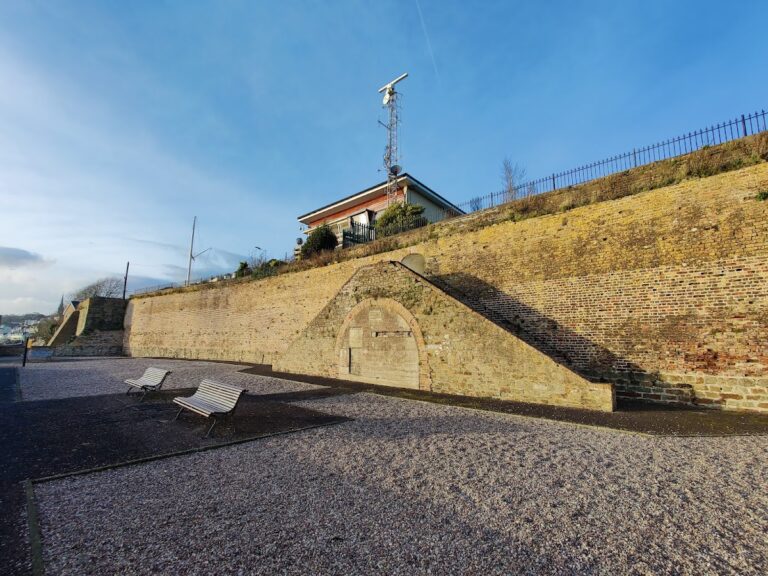
Elizabeth Fort occupies approximately 1.5 acres, or 0.61 hectares, off Barrack Street on elevated ground south of Cork. Its surviving form is that of a seventeenth-century star fort, a defensive design with projecting angular bastions that allowed overlapping artillery fire and reduced exposed ground around the walls. The fort’s position outside the medieval city walls gave it a defensive outlook over Cork.
Fortifications
The first defensive works on the site were made from timber and earth. The basic fabric of the present fort belongs to the rebuilding of 1624 to 1626, supplemented by later works reputedly carried out in 1649. Those changes established the principal seventeenth-century fortification and removed the earlier church remains from the site. The walls continue to be regularly accessible as part of the surviving fort.
Interior Buildings
The interior buildings were reconstructed after the burning of August 1922. Their later history reflects the changing functions of the enclosure: they incorporated an air-raid shelter during the Emergency and remained in use as a Garda station until 2013. These rebuilt structures survive within the earlier fortification, linking the seventeenth-century defensive fabric with the site’s twentieth-century institutional uses.