Castle of Ripaille: A Savoyard Residence and Religious Estate in France


Site at a Glance
- Rating
- 4.4
- Popularity
- Medium
- Country
- France
- Primary era
- Medieval
- External website
- Open
- Eras represented
- Medieval, Early Modern, Modern
- Civilizations
- Duchy of Savoy, Holy Roman Empire
- Site type
- Domestic
- Remains
- Castle
On this page15 sections
History
The Castle of Ripaille is a historic residence and religious estate in Thonon-les-Bains, France, on the shore of Lake Geneva. Developed by the House of Savoy from the mid-fourteenth century, it grew from an older manor and country residence into a pleasure residence, political center, monastery, fortress, and later seigneurial property. It should not be confused with the separate Castle of Thonon, a principal Savoyard residence from 1411 until the end of the fifteenth century that was destroyed in the seventeenth century.
Early manor and Savoyard residence
The locality was inhabited in antiquity and became a prosperous Roman settlement. Ruins near the manor indicate this earlier occupation. Before the castle took shape, the site consisted of a stone-and-wood country residence set within a large hunting reserve. Ripaille itself was an old manor dating from the late thirteenth or early fourteenth century. Amédée V of Savoy is said to have stayed there in 1293, after the Treaty of Saint-Jean-de-Moirans.
Between 1371 and 1388, Bonne of Bourbon enlarged the manor and transformed it into a pleasure residence. Her son, Amédée VII of Savoy, died at Ripaille in 1391. The complex was subsequently enlarged several times by Amédée VIII of Savoy, the first duke of Savoy.
Amédée VIII and the Ripaille priory
In 1410, Amédée VIII added the Augustinian priory of Ripaille and transferred the house, manor, and dependencies to the order. The Augustinians were members of a Catholic religious order. Pope Martin V consecrated the convent in 1417, dedicating it to Notre-Dame and Saint Maurice. He provided it with an annual income of 1,000 gold florins for a prior and fourteen religious members.
Ripaille acquired a dual religious and political character under Amédée VIII. In 1434, he withdrew there with six companions, including Louis de Chevelu. Their association with the foundation of the Order of Saint Maurice, a military-religious order connected with the House of Savoy, gave the residence an additional dynastic association. Ripaille served as a place of meditation while also operating as a political center. Its court received writers, musicians, ambassadors, and illuminators, and the complex housed the financial administration of Savoyard territories. Amédée VIII, who later became the antipope Felix V, died at the castle on 6 January 1451.
War, religious change, and private ownership
The Augustinian monastery ended during the Bernese invasion of Chablais in 1536. Emmanuel Philibert restored the castle and converted it into a stronghold in 1579, while Charles Emmanuel completed the works. In 1589, a Genevan invasion forced the Ripaille garrison to capitulate. The enceinte, or enclosing defensive wall, was razed and many buildings were destroyed. Savoyard troops expelled the occupiers in 1590.
In 1624, Charles Emmanuel I established the Carthusian charterhouse of Ripaille by joining it with the convent of Vallon. The Carthusians were members of a Catholic contemplative order. They abandoned the monastery in 1793 during the French Revolution and withdrew to Switzerland. The buildings were sold as national property in 1795 to Amand, then passed to Tillot. In 1809, Tillot sold the complex to General Count Pierre Louis Dupas, returning Ripaille to use as a seigneurial residence.
Industrial ownership and modern preservation
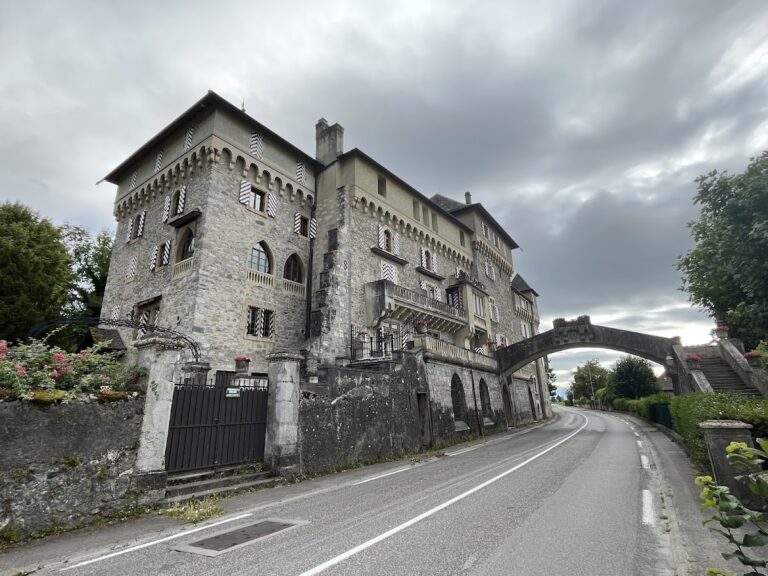
Frédéric Engel-Gros, a textile industrialist from Mulhouse who headed the DMC textile works, acquired Ripaille toward the end of the nineteenth century. He remodeled the exterior in a Renaissance style and gave parts of the interior an Art Nouveau treatment. The renovation is also associated with the architects Aymonet Corniaux and Charles Schulé. During this period, the property served as DMC headquarters.
André Engel, the son of Frédéric Engel-Gros, created the estate’s arboretum in 1930. The arboretum was damaged by the storm of 1999. In 1976, Madame Harold Necker, assisted by public authorities, created the Fondation Ripaille to preserve and promote the estate’s heritage. The foundation is the current owner of the castle, while members of the Necker-Engel family retained interests in parts of the wider estate.
Ripaille has been protected as a French historic monument since 11 July 1942. Protection was extended on 19 November 1991 to a group of historic buildings and features, including the entrance pavilion, Bonne of Bourbon Tower, the pavilion and Carthusian cell, the Priory and Saint Michael buildings, the courtyard ground, former charterhouse farm buildings, Noyer Tower, and a bastion of the enceinte. An order dated 20 March 2025 replaced the earlier protections and extended protection to the entire Ripaille estate and the historic buildings on its parcels.
The estate also preserves later historical associations. A memorial to the French Righteous Among the Nations was inaugurated in the Ripaille clearing on 2 November 1997 by President Jacques Chirac. The honor of Righteous Among the Nations recognizes non-Jews who helped save Jews from persecution and extermination during the Holocaust. The memorial commemorates 2,740 French people who helped save Jews during the persecution of the Second World War.
Popular tradition links the expression faire ripaille with feasts attributed to the Savoyard dukes at the estate. The expression, however, was attested several decades before the first pavilion was built. The name Ripaille is instead associated with rispe, meaning scrub or heath, a reference to the landscape that formerly occupied the site.
Remains
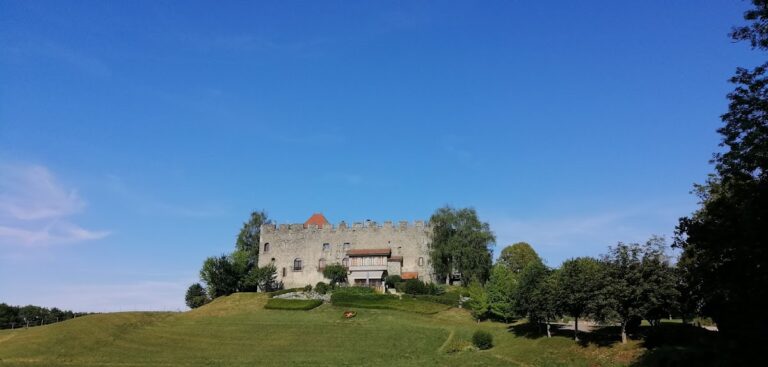
The Castle of Ripaille stands at the center of a large estate beside Lake Geneva. The domain is bounded by the Port-Ripaille marina to the north, the Vongy industrial zone to the east, the Thonon agglomeration to the south, and the lake to the west. The principal complex has a fairly regular rectangular plan, with secondary structures attached to it and a dry moat running around the perimeter. Its earliest form began as a wooden pavilion on a stone base. Later alterations, including the Renaissance remodeling and the Art Nouveau interiors, remain part of the site’s architectural character.
Castle and principal buildings
West facade and towers
The principal facade faces west toward the large garden. Four of the six original cylindrical towers survive. They have conical roofs and corbelled arches, preserving a visible element of the complex’s earlier fortified and residential form. The entrance pavilion and Bonne of Bourbon Tower form part of the protected historic group, while Noyer Tower and a bastion of the enclosing wall belong to the surviving defensive fabric.
Interior spaces
The castle’s representative rooms contain ornamental wood paneling, known in French as boiseries, while some interiors reflect the Art Nouveau remodeling carried out under Frédéric Engel-Gros. The complex also includes the former chapel, kitchens, a large cellar, the principal residence apartment, exhibition spaces, and a projection room. These spaces belong to the layered domestic, religious, and institutional history of the building.
Priory and charterhouse buildings
Religious buildings
The buildings known as the Priory and Saint Michael, together with a pavilion and Carthusian cell, preserve the religious phases of Ripaille. The priory was added for the Augustinians in 1410 and consecrated in 1417 to Notre-Dame and Saint Maurice. After the Augustinian period ended, the complex was incorporated into the Carthusian charterhouse established in 1624. The surviving buildings therefore belong to successive Catholic communities that occupied and adapted the estate.
Former charterhouse farm
The former charterhouse included a mill, hayloft, laundry, pigsty, farm, barn, forge, and kennel. These rural buildings formed part of the working estate associated with the monastery. Their inclusion within the protected historic group preserves the material range of the charterhouse beyond its principal religious buildings.
Park, forest, and memorial
Arboretum and forest
The arboretum occupies approximately 22 hectares of the park, much of which is planted with vines. An arboretum is a landscaped collection of trees and other woody plants arranged for cultivation, study, or display. The estate’s wine-growing domain produces the white wine known as Le Ripaille. The adjoining forest covers 53 hectares and was formerly part of the Savoyard hunting reserve. It is maintained jointly with Thonon-les-Bains, which owns part of it.
Righteous Among the Nations memorial
The memorial to the French Righteous Among the Nations stands in a clearing between the forest and the arboretum. Its position within the estate connects the surviving landscape with a twentieth-century commemoration of the 2,740 French people honored for helping save Jews during the Second World War.