Ocriculum Archaeological Park: An Umbrian and Roman River Town in Italy


Site at a Glance
- Rating
- 4.5
- Popularity
- Low
- Country
- Italy
- Primary era
- Classical
- External website
- Open
- Eras represented
- Classical
- Civilizations
- Roman
- Site type
- City
On this page21 sections
History
Ocriculum Archaeological Park is the remains of an ancient Umbrian and Roman settlement in Italy, near modern Otricoli. Occupation in the area began during the Iron Age, while the Roman town developed on the plain beside the Tiber after the settlement moved from its earlier hilltop position. The construction of the Via Flaminia in the late third century BCE connected Ocriculum with Rome and northern Italy, helping it become a strategic road and river station.
Umbrian origins and the Roman alliance
Ocriculum began as an Umbrian settlement, probably on the hill now occupied by Otricoli. An archaic necropolis has been identified there, and other cemeteries and cult places dating from the archaic and Hellenistic periods developed around the settlement. These remains indicate a long period of activity before the town was reorganised on the plain.
In 308 BCE, after the Battle of Mevania, Ocriculum allied itself with Rome. The settlement later moved down toward the Tiber, probably because of the advantages offered by the river crossing, the new road, and the river port known as the Port of Oil. The Via Flaminia was built through the area in the late third century BCE, probably around 220 BCE. Together, road and port placed Ocriculum between Rome, Umbria, Sabina, and the territory of the ancient Faliscan people, known as the Ager Faliscus.
The Roman municipium
Ocriculum became a Roman municipium, a town incorporated into the Roman state whose inhabitants held Roman civic rights and whose local government was commonly led by elected magistrates. Its administration was headed by quattuorviri, a board of four municipal officials, and the town was assigned to the Arnensis tribe, one of Rome’s voting tribes. Under Augustus, Ocriculum belonged to Regio VI, a territorial division of Italy. The reforms of Diocletian later placed it within Tuscia et Umbria.
During the Roman imperial period, Ocriculum prospered through farming, commerce, river transport, and pottery manufacture. Its workshops produced ceramics, roof tiles, and bricks, and the relief-decorated vessels called Popilius Cups were associated with local production. The Port of Oil remained active until the fifteenth century. It handled ceramics and resources from the Sabina, including timber, while Sabine olive oil was especially well known.
The town also attracted members of the Roman elite as a place of residence and leisure. Titus Annius Milo, a Roman politician associated with Cicero, owned a villa at Ocriculum. Pompeia Celerina, a wealthy landowner and the mother-in-law of Pliny the Younger, possessed estates in the city.
Military and imperial events
Ocriculum lay within a landscape that saw important military movements. During the Second Punic War, the consular armies of Quintus Fabius Maximus and Gnaeus Servilius Geminus met near the town. In 69 CE, during the civil war between Vespasian and Vitellius, Marcus Antonius Primus stopped at Ocriculum with his army and celebrated the Saturnalia, the Roman festival associated with the god Saturn.
The town also received members of the imperial court. Constantius II, the Roman emperor who ruled from 337 to 361, stopped at Ocriculum in 357 while travelling to Rome. In the winter of 412–413, a battle at or near the town opposed the forces of Heraclianus, the imperial usurper and comes of Africa, to the army of Emperor Honorius commanded by the comes Marinus. Marinus won the battle, Heraclianus fled, and he was later executed.
Late antiquity and abandonment
Ocriculum became an episcopal centre in late antiquity. Four bishops are associated with the town: one attended the Roman council of 487, another was present at the council of 499, Fulgentius was mentioned by Pope Gregory I, and Dominic attended the councils of 595 and 601.
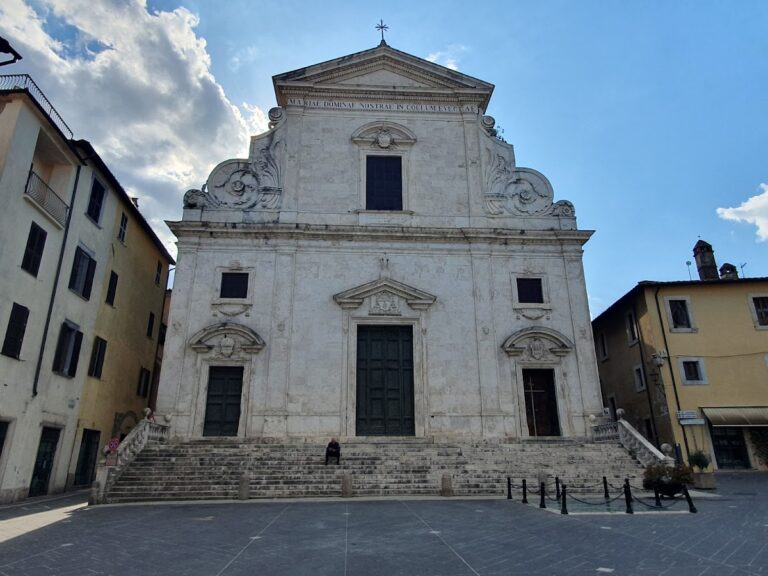
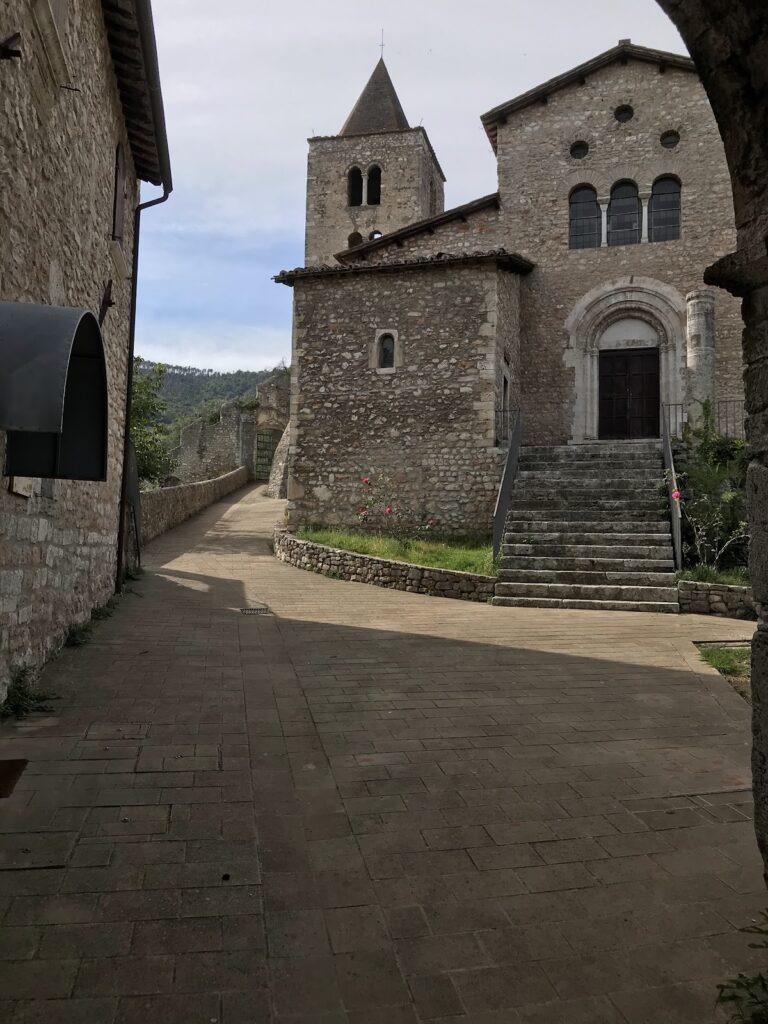
Between 569 and 605, during the Lombard invasions, the lower city was destroyed and abandoned. Its inhabitants moved back to the hilltop settlement, where the medieval nucleus of Otricoli developed. The later church of San Vittore was rebuilt in the eighteenth century on the site of an earlier Benedictine monastery. Roman building material was reused in its facade, including inscriptions connected with the Arnensis tribe.
Excavation and archaeological preservation
Eighteenth-century excavations carried out under the patronage of the Holy See brought Ocriculum’s major buildings and sculptures to wider scholarly attention. The forum was excavated between 1778 and 1781. Giuseppe Pannini rediscovered the baths, including their octagonal mosaic, and recorded the site in plans and watercolours. Later archaeological work included the excavation of a section of the Via Flaminia by the Soprintendenza for Umbria, the Italian regional heritage authority, together with long-term archaeological and geophysical investigation of the Roman town.
The archaeological park now preserves the ancient urban area within approximately 36 hectares. Sculptures, mosaics, inscriptions, and architectural elements recovered from Ocriculum are divided among the archaeological site, the Vatican Museums, and the Antiquarium of Casale San Fulgenzio in Otricoli. The landscape also provides the setting for the annual historical re-enactment Ocriculum: A.D. 168, which interprets Roman religious, civic, domestic, and gladiatorial life.
Remains
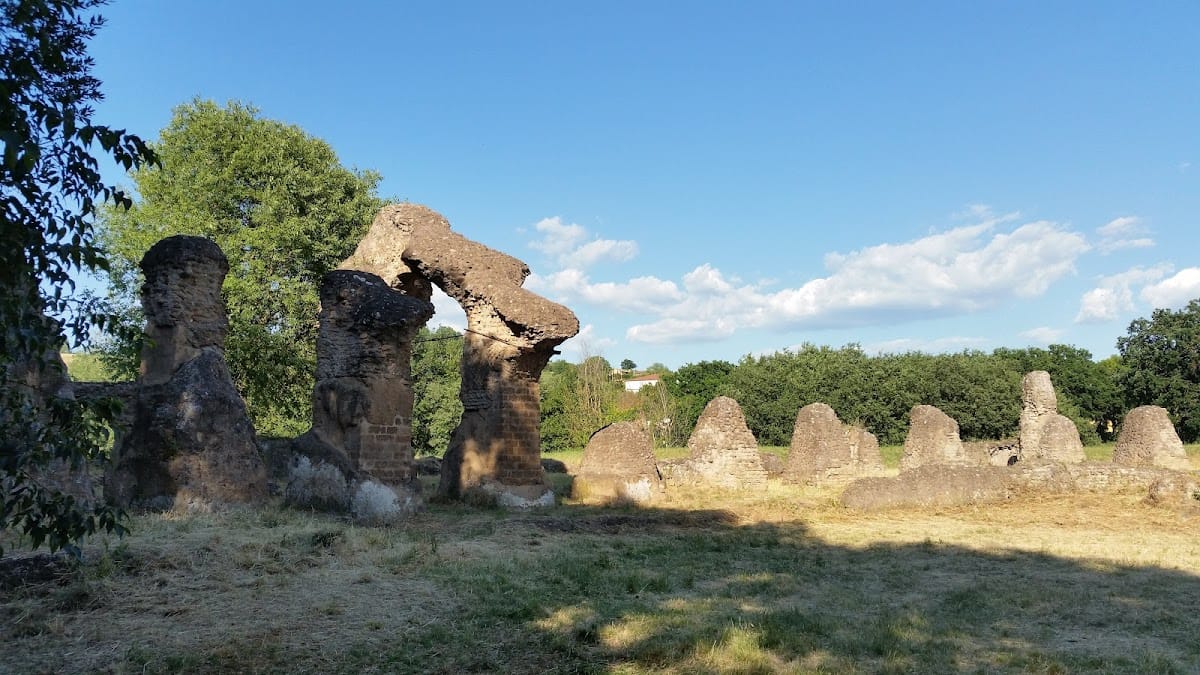
The park occupies a varied landscape of hills, saddles, an infilled valley, and a smaller valley opening toward the Tiber. The ancient town extended across about 36 hectares and was linked to both the river and the Via Flaminia. Its surviving remains include public buildings, entertainment structures, water installations, roads, tombs, industrial evidence, and later farm buildings that incorporate Roman masonry.
Central public buildings
The forum and basilica
The Roman Forum lay east of the cardo maximus, the town’s principal north-south street, and north of the San Vittore river. Its basilica was a large square building with a semicircular apse. A group of imperial portrait statues from the Julio-Claudian and Severan dynasties was found in association with the building. The Julio-Claudians ruled from Augustus through Nero, while the Severans were a later imperial family active mainly in the late second and early third centuries CE. The portraits indicate a public setting connected with the imperial cult.
The Great Substructures
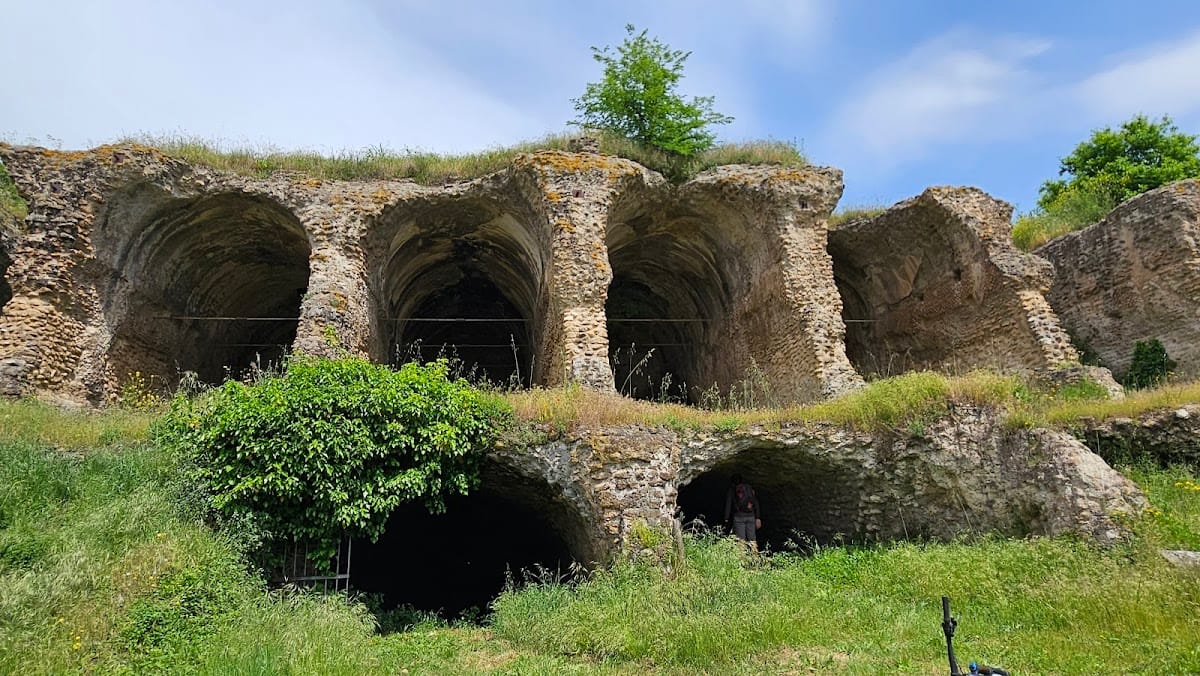
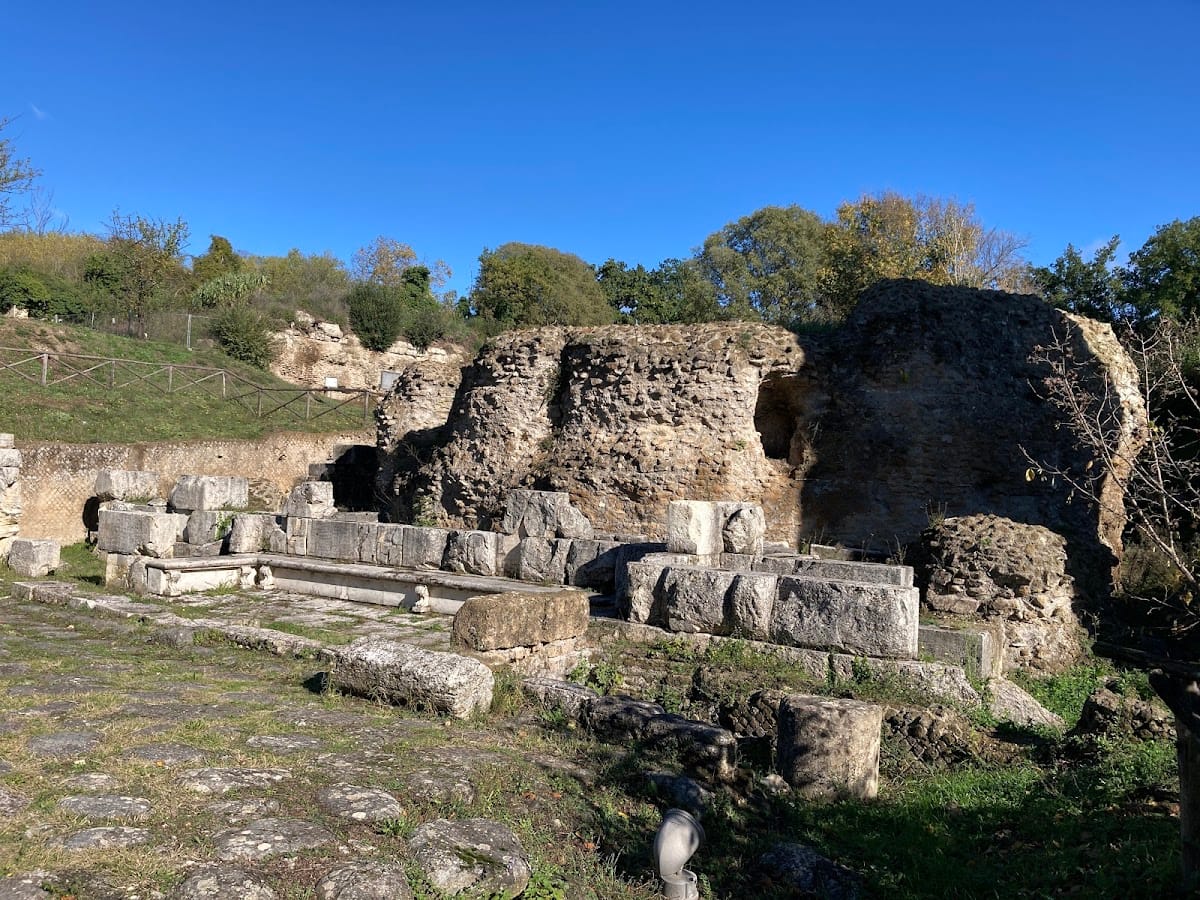
The Great Substructures, or Grande Sostruzione, extend for about 80 metres. Twelve vaulted rooms or structural compartments are arranged on two levels, supporting a high terrace and a major public building. Their function has been interpreted in more than one way, including as a monumental platform for a sacred precinct and temple, or as a warehouse associated with the nearby port. The upper walls use opus reticulatum, a Roman technique that arranged small diamond-shaped stones in a net-like pattern over a concrete core. Plaster survives in places. A smaller nearby complex added another terrace and helped extend the central urban area.
Theatre and amphitheatre
The theatre
The theatre was built against a natural slope in opus reticulatum. Its seating bank, or cavea, was supported at the sides by constructed walls containing three vaulted spaces on each side. Two passages ran behind the seating, while the upper gallery survives in a sector covered by a barrel vault. The outer perimeter was formed by a retaining wall strengthened with pillars.
Large blocks of tuff formed the formal entrance. The stage front was finished with coloured marbles, sculpture, and other decoration. Colossal statues of three Muses from the theatre are now preserved in the Vatican Museums.
The amphitheatre
The amphitheatre stood outside the city along the Via Flaminia and was probably built during the Augustan period. Parts of its seating galleries, the two principal entrances, the ancient arena floor, and a section of the podium survive. A bank cut from the rock forms roughly half of the seating area, while much of the outer structure has disappeared.
Baths and water installations
The baths
The baths were built in the second century CE by L. Julius Julianus in an artificially levelled area. Water from the San Vittore stream was carried through an underground channel. An octagonal hall retains parts of the mosaic pavement that covered its floor. The principal mosaic showed Medusa at the centre, surrounded by mythological scenes, and is now displayed in the Round Hall of the Vatican Museums. A nearby circular room contained a scene of Ulysses and the Sirens.
A winter-bath complex to the north is known through inscriptions describing restoration in the fourth century and through statue bases. These remains show that the bathing facilities continued to receive architectural attention during the later Roman period.
The nymphaeum and fountain
The nymphaeum was a monumental fountain structure about 50 metres long. Built in opus reticulatum, it formed part of a large facade along the valley slope. Alternating rectangular and semicircular niches held public fountains. Underground tunnels connected the structure with the cistern of the Antiquarium of Casale San Fulgenzio, and the water system was also supplied by the San Vittore stream.
A public fountain near the Via Flaminia is divided internally by two stone balustrades. Their surfaces preserve marks made by the ropes of buckets used to draw water. Near the nymphaeum, a monumental rectangular pillar in opus reticulatum formed part of an entrance structure marking access to the urban area.
Roads, tombs, and working landscapes
The Via Flaminia
A visible section of the Via Flaminia is about 6 metres wide and 25 metres long. Large leucitite flagstones form its pavement, with pronounced marks left by cart wheels. Funerary monuments and a public fountain stood alongside the road, which connected the town’s urban area with its wider regional routes.
Funerary monuments
Several monumental tombs stood inside the city near the Via Flaminia. They included a circular tomb associated with the gens Arnensis, a Roman clan whose civic affiliation appears in inscriptions from Ocriculum. Another monument had a square base, a circular body, and an upper section resembling a dovecote. A further square-based drum was faced with travertine. A funerary bed made from bone and carved stone elements was associated with the tombs, and some of their materials were later reused in other buildings.
Archaic and rural remains
The archaic necropolis near the former hilltop settlement was identified at Cerqua Cupa and Crepafico. Its grave goods are displayed at the Antiquarium of Casale San Fulgenzio. Later farm buildings preserve Roman construction, including opus reticulatum walls with surviving arches, an opus spicatum floor formed from bricks or tiles arranged in a herringbone pattern, and part of a large Roman cistern incorporated into a farmhouse.
Sunken tracks crossing the site expose sections of arcaded buildings, wells, and walls. A Roman temple was discovered in a farmyard after surface material was cleared, and ploughing brought a Roman altar to the surface. A pondus lignarium, a Roman weight used for weighing timber, is preserved at the Antiquarium. It provides physical evidence for the timber trade linked to the Port of Oil.
Sculpture and inscriptions
Recovered sculpture includes imperial portraits, statues and heads of Augustus and Claudius, figures of Venus, and members of the Julio-Claudian family. The head known as the Jupiter of Otricoli is a copy of the cult statue from the Capitoline temple. That model was attributed to the Greek artist Apollonius and was inspired by Phidias’s Zeus at Olympia. The head is now in the Round Hall of the Vatican Museums.
Inscriptions and architectural remains remain distributed between the park, the Vatican Museums, and the Antiquarium of Casale San Fulgenzio. Inscriptions referring to the Arnensis tribe were also reused in later structures, including the church of San Vittore, preserving evidence of Ocriculum’s civic identity within the Roman system.