Santa Maria Assunta, Orte: Former Cathedral and Co-Cathedral in Italy


Site at a Glance
- Rating
- 4.5
- Popularity
- Very Low
- Country
- Italy
- Primary era
- Early Modern
- Eras represented
- Early Modern, Modern
- Civilizations
- Italian, Papal States
- Site type
- Religious
- Remains
- Cathedral
On this page8 sections
History
Santa Maria Assunta, Orte, is a Catholic church in Italy rebuilt in the early eighteenth century in forms combining late Baroque decoration with restrained Rococo detail. A church already stood on the site by the ninth century, and its medieval predecessor was altered and enlarged during the fourteenth and sixteenth centuries. Dedicated to the Assumption of the Virgin Mary, it remains the principal Catholic place of worship in Orte.
Medieval origins and rebuilding
The earlier church was a medieval basilica whose form developed through successive alterations. A major reconstruction in the early eighteenth century replaced that building while retaining its three-nave arrangement. The work was carried out by the architects Castrachini and Bizzacchero, and the rebuilt church was completed and reopened for worship in 1721. Bishop Giovanfrancesco Tenderini presided over its reopening and reconsecration.
Cathedral and co-cathedral status
Santa Maria Assunta served as the cathedral of the former Diocese of Orte. In 1437, that diocese was united on an equal basis with the Diocese of Civita Castellana. In 1986, it was incorporated into Civita Castellana, after which Santa Maria Assunta became its co-cathedral, a cathedral sharing the seat or status of a diocese with another cathedral.
The church has held the title of minor basilica from time immemorial. A minor basilica is a church granted a special honorary status by the Catholic Church. In continuity with the former Diocese of Orte, Santa Maria Assunta is also associated with the titular Diocese of Hortanum, created in 1991. A titular diocese exists in name and is assigned to a bishop without functioning as an ordinary territorial diocese.
Recent restoration
The pipe organ underwent restoration that was completed in 2001, and the restored instrument was inaugurated on 18 May of that year. A related renovation of the church removed the crystal chandeliers and ended the formerly customary use of gold-edged damask vestments for solemn ceremonies following the practices of the period before the Second Vatican Council, held from 1962 to 1965.
Remains
Plan, exterior, and interior decoration
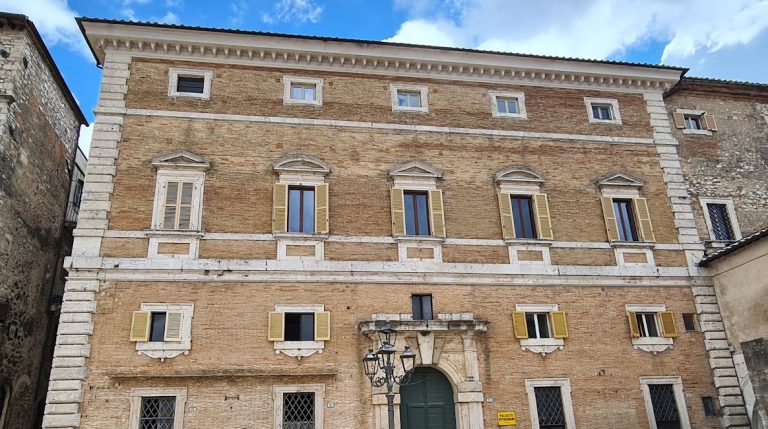
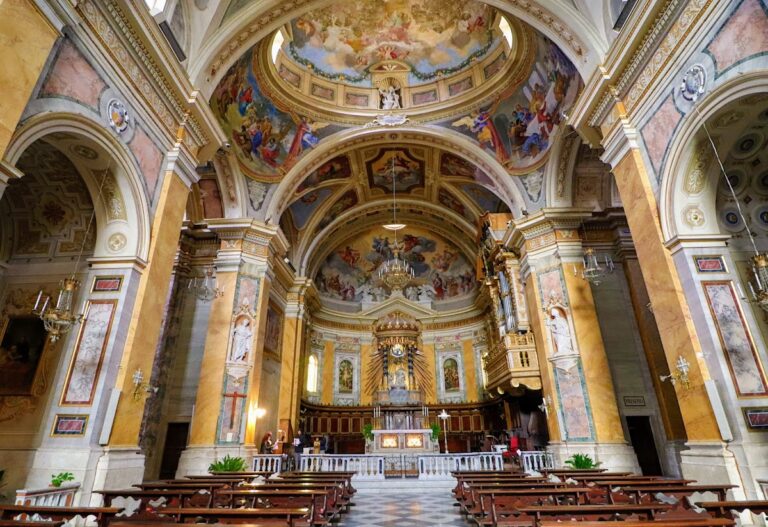
Facing Piazza della Libertà, formerly called Piazza Santa Maria, the church stands beside the episcopal palace. Its three-nave basilica has a cruciform plan, with a crossing where the nave and transept meet. Barrel vaults, continuous curved ceilings, cover the main spaces, while a dome rises above the crossing. The decorative scheme combines late Baroque richness with the lighter, elaborate ornament associated with Rococo.
The west façade, added between 1898 and 1901, is faced with white marble. Volutes, spiral-shaped architectural scrolls, pilasters, cornices, and valuable stucco work, made from moldable plaster for architectural decoration, give the front its detailed appearance. Three portals open onto the façade, with the central entrance larger and more elaborately treated than the other two. The remaining exterior sides are partly covered with rough plaster. Inside, the walls beside the aisles carry rich late-Baroque stucco decoration comparable to that of the façade.
The original terracotta floor was replaced in the second half of the twentieth century with white Carrara marble arranged with Bardiglio bands. Bardiglio is a grey marble used here to create contrasting strips across the floor.
Sanctuary and choir
The high altar is made of polychrome marble, using stones of different colors, and dates from the seventeenth century. Its altarpiece, painted by the Italian artist Giuseppe Bottani in 1752, shows the Madonna in Glory with the Eight Holy Martyrs. The same subject is also described as the Queen of Martyrs and Eight Saints.
Behind the altar, the semicircular apse contains a walnut choir made by Father Girolamo da Mestretta. A marble balustrade encloses the sanctuary area. Beneath the high altar, a glass case preserves relics of the Holy Martyrs, who are regarded as co-patrons of the city.
Pipe organ
Domenico Densi built the pipe organ in 1721, incorporating part of the sound-producing material from an earlier instrument made by Domenico Benvenuti in 1582. The organ has mechanical action, one 51-note keyboard, and a 14-note lectern pedalboard. Both keyboard and pedalboard use a short first octave, a historical arrangement in which some of the lowest notes are omitted or reassigned. The instrument is controlled from a window-style console.
Nearby sites