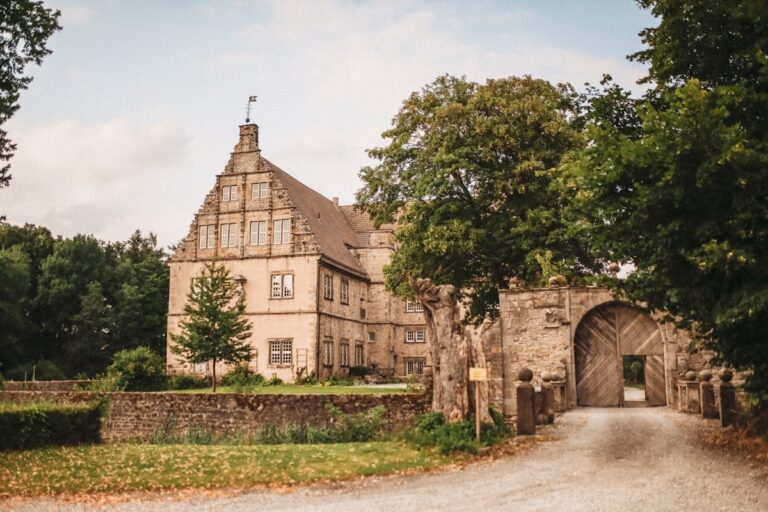
Bökerhof: A Haxthausen Manor House and Romantic Circle Residence


Site at a Glance
- Rating
- 5
- Popularity
- Very Low
- Country
- Germany
- Primary era
- Early Modern
- Eras represented
- Medieval, Early Modern
- Civilizations
- Holy Roman Empire
- Site type
- Domestic
- Remains
- Manor House
On this page9 sections
History
Bökerhof is an eighteenth-century manor house in Bökendorf, Germany, now within the city of Brakel, built for the von Haxthausen barons between 1768 and 1771. It became one of the family’s principal seats and later served as the meeting place of the Bökendorf Romantic Circle, linking the estate with major German writers and collectors of folklore.
The von Haxthausen estate
The von Haxthausens were among the four aristocratic families regarded as pillars of the Prince-Bishopric of Paderborn, a historic ecclesiastical territory whose prince-bishop exercised both religious and secular authority. At the beginning of the fourteenth century, the Prince-Bishop of Paderborn granted the family Bökerhof, Abbenburg estate, and Vörden House. These properties became family seats.
Between 1768 and 1771, Baron Caspar Moritz von Haxthausen commissioned Anton Went, a court architect employed by the Hildesheim court, to plan and construct Bökerhof. Werner Adolph von Haxthausen, Caspar Moritz’s son, became the first resident. The present manor house was erected on the ruins of a fifteenth-century moated castle, a fortified residence surrounded partly or wholly by a water-filled ditch.
The Bökendorf Romantic Circle
During the nineteenth century, Bökerhof became the center of the Bökendorf Romantic Circle, which was active from 1810 to 1834. The group was shaped especially by the brothers Werner and August von Haxthausen, while their sisters Anna, Ludowine, and Ferdinandine also took part. Jenny and Annette von Droste-Hülshoff, Jacob and Wilhelm Grimm, Clemens Brentano, and Josef Görres were among those associated with the circle. Ludwig Emil Grimm visited Bökerhof in 1817.
Other poets joined around 1820, including Heinrich Straube, August von Arnswaldt, August Heinrich Hoffmann von Fallersleben, and Luise Hensel. Bökerhof and Bökendorf provided a setting for personal and literary relationships that continued over many years.
The Brothers Grimm collected fairy tales, legends, and folk songs in East Westphalia. Stories told at Bökerhof, together with notes made by her uncle August Franz von Haxthausen, also introduced Annette von Droste-Hülshoff to an authentic criminal case from the Bökendorf area dating to the end of the eighteenth century. She later transformed this material into the novella The Jew’s Beech, published in 1842.
Renovation and later interpretation
During the 1990s, Bökerhof’s interior and exterior were thoroughly renovated, with the historic plans used to restore its earlier appearance. In 2009, the entire roof was re-covered with Solling sandstone slabs in accordance with heritage-preservation standards. The estate formerly housed a literary museum devoted to the Biedermeier period, the Central European cultural era of the early to mid-nineteenth century, and to Romanticism, a movement associated with emotion, imagination, nature, folklore, and the medieval past.
Remains
Manor house
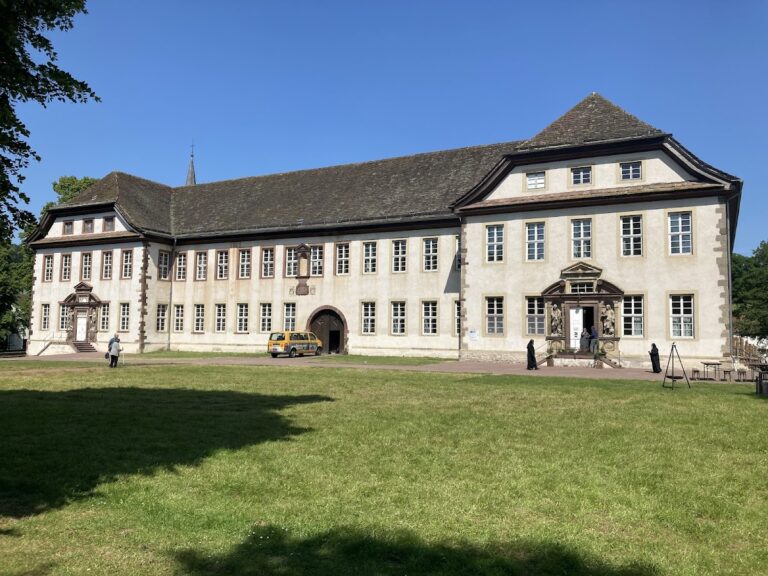
Bökerhof is a two-story manor house with two tower-like extensions projecting from the sides of the main building. It stands on the ruins of a fifteenth-century moated castle, linking the eighteenth-century residence to an earlier fortified site. The roofs are covered with Solling sandstone slabs, renewed across the entire roof in 2009. A watercolor by Annette von Droste-Hülshoff from 1820 preserves a romantic view of the rear of the house.
Garden and park
Planting and hornbeam passage
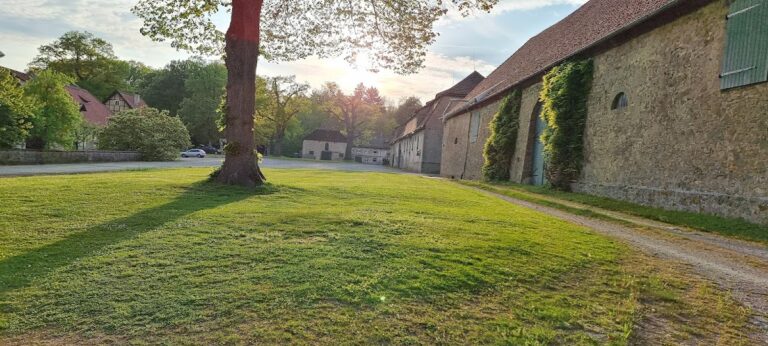
The manor is surrounded by a garden of approximately three hectares. Old beeches, chestnuts, spruces, and elms stand among its plantings, while a prominent plane tree marks the estate meadow. Behind the house, a hornbeam passage was formed by regularly cutting the branches back at a height of more than two metres. The resulting dense leafy canopy remains walkable.
Axes and devotional route
The garden was organized around a broad spatial axis with Bökerhof at its center. The southwest axis survives across the estate meadow, continues up a rising slope beside a lime-tree avenue, and follows a Way of the Cross, a sequence of devotional stations commemorating stages of Christ’s Passion, to a large wooden cross in the forest. The eastern axis survives as an avenue along the approach to Bökerhof.
Nearby sites