Oldenburg (Marienmünster): A Medieval Hilltop Castle and Noble Residence


Site at a Glance
- Rating
- 4.4
- Popularity
- Very Low
- Country
- Germany
- Primary era
- Medieval
- External website
- Open
- Eras represented
- Medieval
- Civilizations
- Holy Roman Empire
- Site type
- Military
- Remains
- Castle
On this page7 sections
History
Oldenburg (Marienmünster) is a medieval hilltop castle in Germany, dating to around 1100 and associated with the Counts of Schwalenberg. Widukind is recorded as having built it on land he owned, and the castle was first documented in 1123 under the name Sualenberg. It became the ancestral seat of the counts in the Wetigau, a regional territory, and gave its name to the Counts of Schwalenberg from 1127.
The Schwalenberg seat
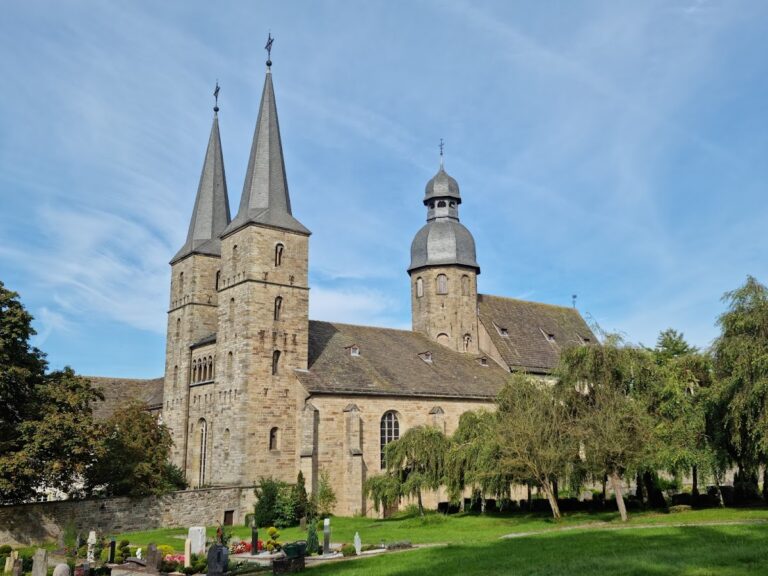
The noble family connected with the castle first appears in 1116 through Count Widekind I of Schwalenberg. In 1128, Count Widekind and his wife, Lutrud of Itter, founded the Benedictine monastery of Marienmünster a few hundred metres from the castle. Benedictines were members of a religious community following the Rule of Saint Benedict, and the monastery formed part of the same local historical setting.
Around 1230, the counts established a new seat at Schwalenberg Castle. After Count Volkwin IV of Schwalenberg moved the ancestral residence there, the earlier castle became known as Oldenburg, meaning “old castle.” In 1350, the last members of the Schwalenberg family sold the county to the Bishop of Paderborn and the noble lords of Lippe.
The Oeynhausen residence
In 1372, the Paderborn bishopric pledged its share of Oldenburg to Johann von Oeynhausen. The bishopric was both an ecclesiastical territory ruled by a bishop and a political lordship, while a pledge transferred rights or control over property as security for an obligation. Johann received permission to build a stone house, almost certainly the late-medieval residential tower that survives today. The noble lords of Lippe also pledged their share to the von Oeynhausen family.
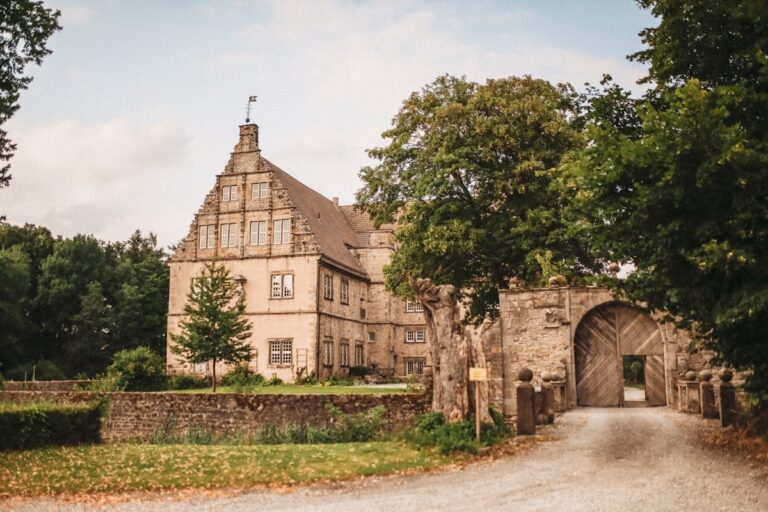
During the sixteenth century, the Oeynhausens abandoned Oldenburg as their residence in favour of the newly built Grevenburg Castle. The tower was later used, among other purposes, as a granary, and its interior was partly remodelled. In 1845, the von Oeynhausen family acquired the complex as private property. The long-vacant tower was subsequently restored and is now privately inhabited. Oldenburg therefore reflects successive connections with high nobility and lower nobility in the present city of Marienmünster, in East Westphalia-Lippe.
Remains
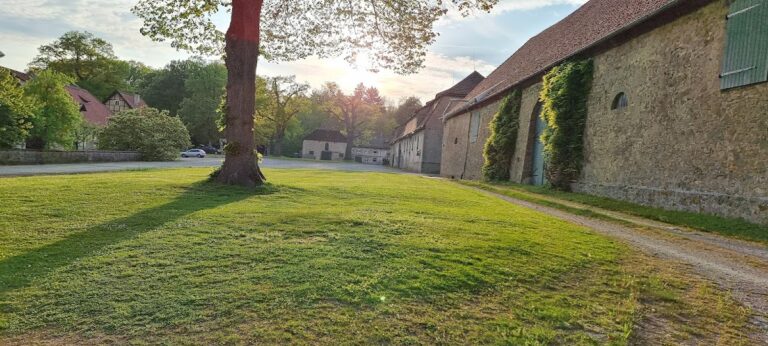
Oldenburg occupied a projecting hilltop spur. The surviving high-medieval castle landscape consists of parts of the rampart and ditch system, while later building remains occupy the castle area associated with Paderborn and Lippe.
Surviving buildings
Residential tower
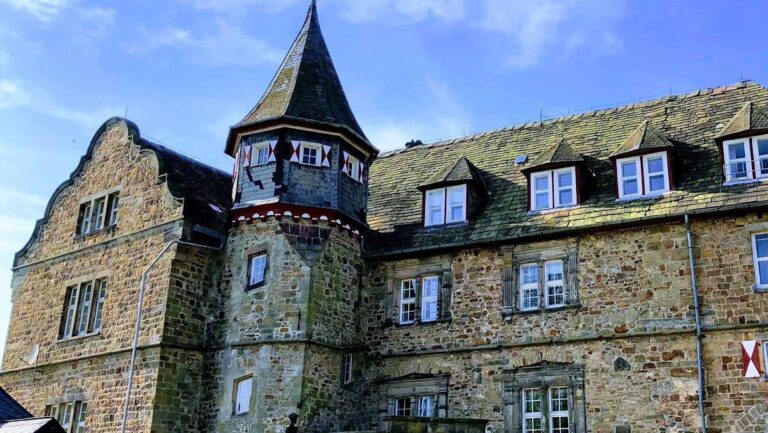
On the Paderborn portion stands a well-preserved, four-storey residential tower built after 1372. A residential tower was a fortified building designed primarily for habitation. The structure has ashlar quoins, which are dressed stone blocks reinforcing the corners, and gable walls made with half-timbering, a method using a visible timber framework with infill between the beams. Its round-arched entrance portal bears the date 1687, which marks a remodelling campaign during which the present storey floors were installed.
Lippe administrative building
Northeast of the residential tower are excavated remains of the Lippe administrative building. An administrative building of this kind served a territorial office or district, providing a physical reminder of the separate Lippe share in the former castle area.
Nearby sites