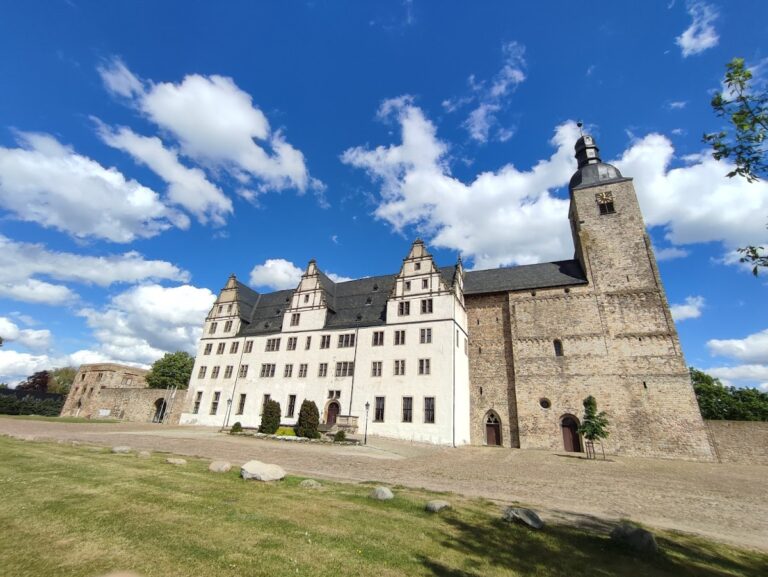
Schloss Randau: A Historic Estate Castle in Magdeburg, Germany


Site at a Glance
- Rating
- 3.3
- Popularity
- Very Low
- Country
- Germany
- Primary era
- Modern
- Eras represented
- Modern
- Civilizations
- German
- Site type
- Domestic
- Remains
- Manor House
On this page10 sections
History
Schloss Randau is a historic estate castle in Magdeburg, Germany. The present building was constructed between 1880 and 1885 in a Classical form, but its history reaches back to a medieval castle on the Elbenauer Werder, a large island between the Elbe and the Old Elbe.
Early settlement and the medieval castle
The area north of present-day Randau was inhabited during the Middle Stone Age, around 5000–4000 BC. Surface finds from approximately AD 600–800 on the Göbs may come from a Slavic settlement centered on a hillfort. The connection between that settlement and the later castle cannot be established.
After an earlier destruction, Emperor Frederick Barbarossa, the Hohenstaufen ruler of the Holy Roman Empire from 1155 until his death in 1190, settled the Elbenauer Werder around 1160 with Dutch colonists. Randau Castle occupied a strategically important position on the island southeast of Magdeburg. It is first mentioned in a legal settlement dated 28 May 1236 between the Unser Lieben Frauen Monastery and Iwan of Dornburg. The witness Thegenardus of Randowe was probably among the castle’s earliest owners, although the date of its foundation remains uncertain.
During a late thirteenth-century feud between the Magdeburg nobility and the archbishop, who was also the territorial lord of Magdeburg, the lords of Randau used the castle as a base for raids and plundering. Their activities also endangered shipping on the Elbe. Troops from Magdeburg captured and destroyed the castle in 1297, during the rule of Archbishop Burchard II. A later local legend tells of the female ancestor of the old Randau castle.
The Alvensleben estate
In 1391, the Alvensleben family of Rogätz acquired Randau Castle and its estate as an archiepiscopal fief, land granted by an archbishop to a vassal in return for service and allegiance. When the Rogätz branch died out in 1553, an inheritance settlement transferred the property to Andreas von Alvensleben. He introduced the Reformation at Randau, the sixteenth-century religious movement that challenged established Western Christian institutions and led to the formation of Protestant churches.
After 1609, Kuno von Alvensleben decided to build a new castle. He was a Magdeburg cathedral canon, a cleric belonging to the chapter responsible for cathedral administration and worship, an envoy of the archbishopric, and a member of the Fruitful Society, a seventeenth-century German literary and scholarly association that promoted the German language and cultivated learning. The new castle and its chapel, the curia of the Magdeburg cathedral canons, and a valuable library were destroyed by fire in 1631 when the forces of Johann Tserclaes, Count of Tilly, destroyed Magdeburg during the Thirty Years’ War.
From 1693 to 1724, a debt claim transferred the knightly estate, together with its associated rights and privileges, to the von Pfuel family. After 1742, Johann Friedrich Karl von Alvensleben, known as the “Minister Alvensleben in London,” moved the estate farm farther south, to the area of the present Schloss Randau. He built a new residence and laid out geometrical gardens with Baroque characteristics. His successor, Gebhard Johann Achaz von Alvensleben, added a Classical central projecting section and side buildings.
Johann Friedrich Karl also established the wider form of the estate complex. It included a dairy, windmill, colonists’ houses, workers’ housing, and a house for the pastor’s widow. A broad central avenue was aligned with Magdeburg Cathedral, while wooded areas interrupted views toward the surrounding branches of the Elbe. Gebhard Johann Achaz’s daughter Amalie married the later Prussian prime minister and war minister, General Ernst von Pfuel, at Randau on 11 September 1832.
The nineteenth-century rebuilding
The estate declined economically during the next generation and was offered for sale in 1850. In 1863, the Magdeburg entrepreneur and commercial councillor Paul Hennige bought the knightly estate. He reacquired land that had been sold and restored the estate to its earlier operating scale. Around 1880, the manor house was demolished, and Hennige commissioned the present Schloss Randau on its foundations. The Berlin architect Professor Carl Alexander Schütz designed the building, while Moritz Meurer of Berlin and Rome carried out its interior painting.
Twentieth-century use and recent history
Schloss Randau served as a primary school and kindergarten from 1968 to 1984. It later became a station for young tourists. Partial restorations took place in 1985 and 1992. A proposed educational center failed after the investor Wyborski became insolvent and died unexpectedly on 30 April 2001. The castle then remained unused and deteriorated.
In August 2024, the City of Magdeburg acquired Schloss Randau. The acquisition also addressed outstanding claims against the former owner and sought to prevent a financial loss to the municipal budget. The city is examining a multifunctional concept combining culture, events, accommodation, and environmental education, potentially involving several investors under hereditary leasehold.
Remains
Schloss Randau consists of the late nineteenth-century castle, adjoining service and agricultural buildings, and a spacious park. The present building occupies the foundations of the earlier manor house, while the remains of the medieval castle survive archaeologically in the ground on the Göbs, a sandy river-island area north of Randau.
Earlier castle site
The medieval castle site on the Göbs was reportedly enclosed by three ditches. Eighteenth-century traces were said to include a large church with a cloister and several other buildings. These descriptions concern visible traces of the destroyed castle at that time. The surviving archaeological remains are preserved as an archaeological monument, meaning a site or subsurface remains protected for their archaeological significance.
Estate complex
The later estate was arranged around a residence standing on an elevation toward the Elbe. Its geometrical gardens retained Baroque characteristics, and the wider grounds were organized by a broad avenue directed toward Magdeburg Cathedral. The estate also incorporated agricultural, residential, and service buildings that defined its working character.
Present Schloss Randau
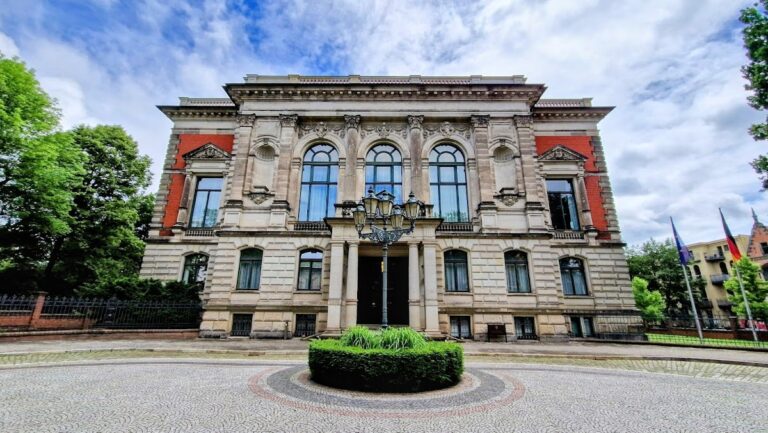
Built between 1880 and 1885, the present Schloss Randau has a Classical form. Its exterior includes a ceremonial staircase and round arches supported by columns. Service and agricultural buildings adjoined the castle, while further economic buildings were erected along Schlossstraße around 1890. Some of these later buildings remain preserved.
Park and garden features
A spacious castle park adjoins the building. Its original features included an obelisk, a circular garden feature, a bridge, an aviary, a greenhouse, an earth grave, and a viewing tower. Together with the avenue, wooded areas, and geometrical gardens, these elements formed the designed landscape of the estate.
Nearby sites