Kloster Brenkhausen: A Medieval Nunnery and Coptic Monastery in Germany


Site at a Glance
- Rating
- 4.7
- Popularity
- Low
- Country
- Germany
- Primary era
- Medieval
- External website
- Open
- Eras represented
- Medieval, Early Modern
- Civilizations
- Holy Roman Empire
- Site type
- Religious
- Remains
- Monastery
On this page11 sections
History
Kloster Brenkhausen is a former Cistercian nunnery and present-day Coptic Orthodox monastery in Brenkhausen, now part of Höxter in Germany. The community was established in the thirteenth century beside an existing parish church and developed through Gothic construction, later Benedictine use, Baroque rebuilding, secularization, and modern Coptic restoration.
Foundation and medieval development
A settlement already existed at Brenkhausen before the monastery was founded. The nuns first gathered at Ottbergen around 1234, then moved around 1236 to Brückenfeld, outside Höxter. Around 1245, they relocated to Brenkhausen under Hermann I von Holte, the abbot of Corvey. They established themselves beside the parish church, which was remodelled as construction of the monastery began. The provost, the cleric responsible for the community’s administration, was appointed from Amelungsborn Abbey.
A fire in 1276 destroyed the monastery buildings, documents, and privileges. Rebuilding took place during the 1280s. In 1288, the abbot of Amelungsborn was commissioned to visit the community. In 1301, the abbot of Hardehausen became its ecclesiastical superior and visitor. At this time the monastery was known by the Latin name Vallis Dei, meaning “Valley of God.”
Construction was completed in 1320, and Hermann, auxiliary bishop of Paderborn, consecrated the church on 3 December that year. In 1339, Auxiliary Bishop Hermann received 23 women into the convent as nuns. The monastery appears to have belonged to the Diocese and Prince-Bishopric of Paderborn, a territory governed by a bishop who also exercised secular authority, rather than to neighbouring Corvey Abbey.
Education, decline, and Benedictine reform
Late-fourteenth-century documents mention both a monastery school and a girls’ boarding school. The latter educated daughters of upper-class families, giving the community an educational role in addition to its religious purpose.
By around 1560, moral and economic disorder had brought the monastery into decline. Only the abbess and two nuns remained. Corvey tried to reorganize the community, but withdrew its provost after pressure from Hardehausen Abbey. The monastery was reoccupied by Corvey’s provost in 1595, and Benedictine nuns from Corvey settled there in 1601. The first Benedictine abbess was elected in 1608. Benedictines, like Cistercians, are a Western Christian monastic order, but the change brought Brenkhausen under a different religious tradition.
War, Baroque rebuilding, and secularization
The Thirty Years’ War, the major European conflict of 1618 to 1648, devastated the monastery. Rebuilding began in 1630. Brenkhausen received lower jurisdiction in 1656, giving the monastery authority over certain local legal matters. Around 1683, the community experienced a revival under Provost Florenz von dem Felde. The church was furnished in the Baroque style between 1678 and 1691.
A census carried out in 1700 under the Abbot Florenz of Corvey counted 51 residents, including 14 nuns and seven pupils of the monastery school. Three Baroque wings of the convent were erected between 1710 and 1746. Ambrosius Bruns, who later became abbot of Grafschaft Abbey, served as confessor to the nuns from 1717 to 1719.
Secularization transferred the monastery from ecclesiastical to secular ownership in 1803. The complex became an agricultural estate containing a cattle stable, barn, and distillery. Its first secular owner was Hereditary Prince William Frederick of Nassau-Orange. During the Napoleonic Kingdom of Westphalia, General Pierre David de Colbert-Chabanais held the estate temporarily. It then passed to the Russian general Friedrich Karl von Tettenborn and, in 1818, to Landgrave Victor Amadeus of Hesse-Rotenburg, who united it with the mediatized principality of Corvey.
Coptic Orthodox renewal
The Coptic Orthodox Church purchased the monastery from the state government in 1993 under Abbot-Bishop Anba Damian. The first Coptic Eucharistic liturgy was celebrated there on 29 January 1994, and Coptic Pope Shenouda III supported the project from its beginning. The Coptic Orthodox Church is an Oriental Orthodox church rooted in the Egyptian Christian tradition.
Renovation began in 1994 with the south and west wings and continued with the north wing from 2007. Deacons and volunteers from varied backgrounds undertook much of the work themselves, including wall repairs using traditional earthen construction. International building-service groups also contributed. The Detmold St. Martin Order initially supplied technical advice, engineers, and help obtaining materials and furnishings.
The former convent church is now the Catholic parish church of St. John the Baptist in Brenkhausen. The Gothic wing of the former monastery serves as the Catholic parish centre, while the Baroque convent section belongs to the Coptic monastery, dedicated to the Holy Virgin Mary and St. Maurice. The complex therefore preserves Catholic and Coptic religious uses within the former monastic site. The former convent church has the unusual dedication to St. John the Baptist rather than to the Virgin Mary, a dedication common in many women’s monasteries.
Remains
Church and convent buildings
Former convent church
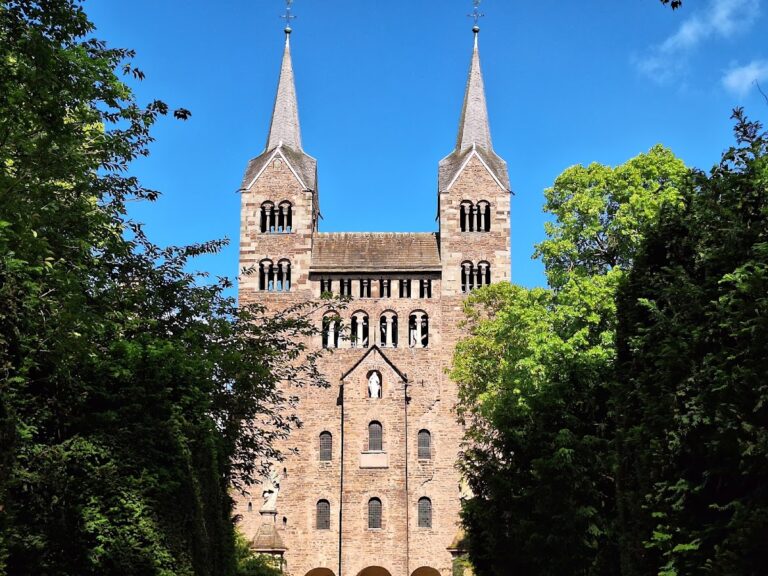
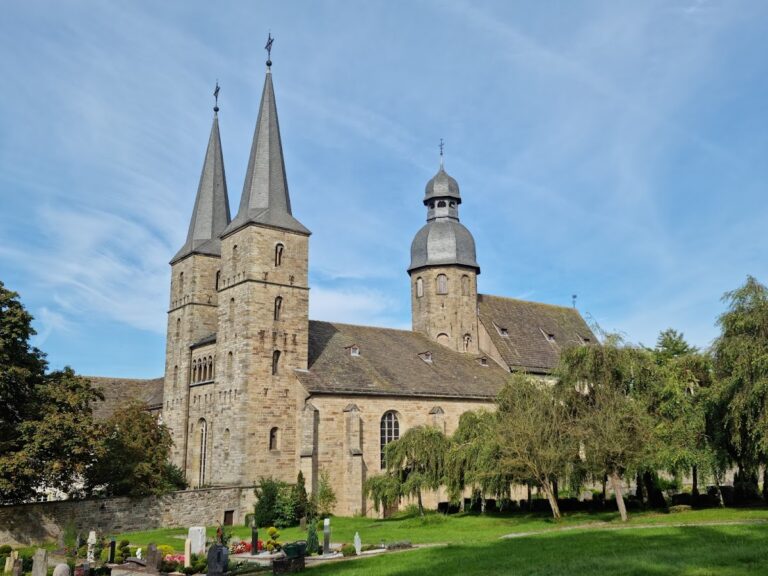
The former monastery church is a three-aisled pillar basilica with a choir that ends in a straight wall. Its nuns’ gallery was removed in the nineteenth century, and one side aisle was demolished and rebuilt around 1924. These alterations form part of the church’s surviving architectural history, while the building continues to serve as the parish church of St. John the Baptist.
Only the high altar remains of the church’s Baroque furnishings, although several figures in the main nave also survive. The altar carries the coat of arms of Corvey and the date 1696. Its figures represent Benedict of Nursia, his sister Scholastica, John the Baptist, and Vitus, the patron of Corvey. The principal altarpiece represents the Assumption of Mary, while an image above the Corvey abbot’s coat of arms depicts the Trinity.
Gothic convent wing
The former monastery complex includes a Gothic convent wing, which is now used as the Catholic parish centre. It forms part of the surviving convent complex alongside the later Baroque buildings and retains the architectural evidence of the monastery’s medieval phase.
Baroque convent wings
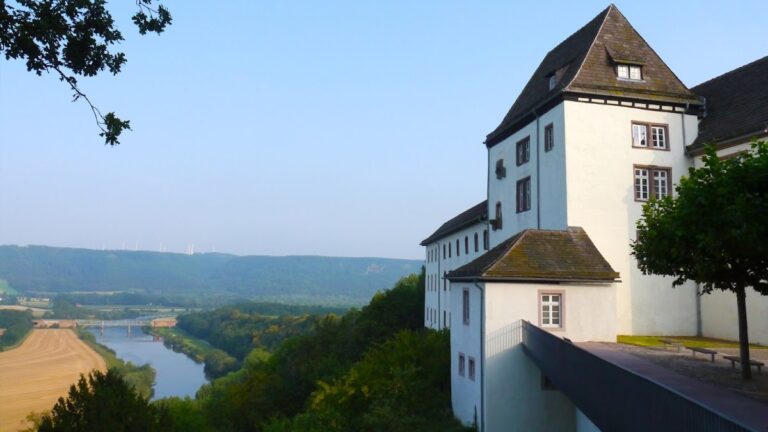
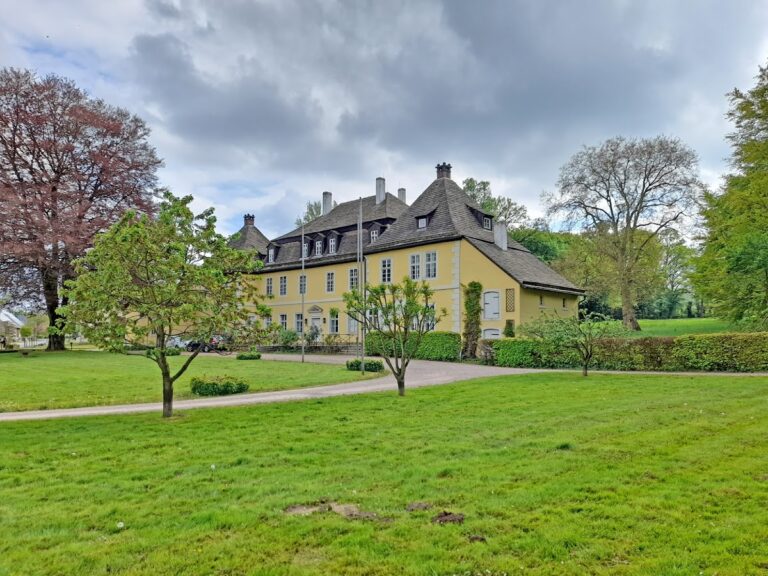
Three Baroque wings were added to the convent between 1710 and 1746. These buildings now contain the Bible museum and church-model exhibition operated by the Coptic Orthodox Church. Their present use connects the restored Baroque section with the monastery’s modern Coptic identity.
Coptic worship space
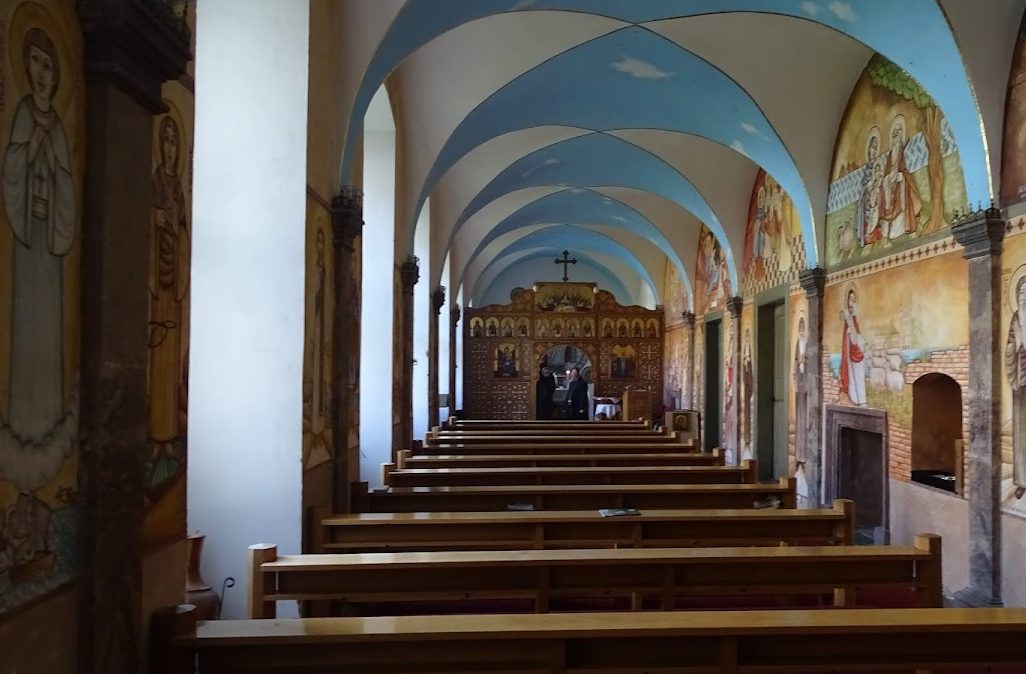
One cloister wing has been adapted as a Coptic worship space. During the restoration, the walls were finished with a white paint made from lime and quark. The Coptic monastery also contains a cross exhibition, while the restored rooms and former convent spaces accommodate its religious and museum functions.