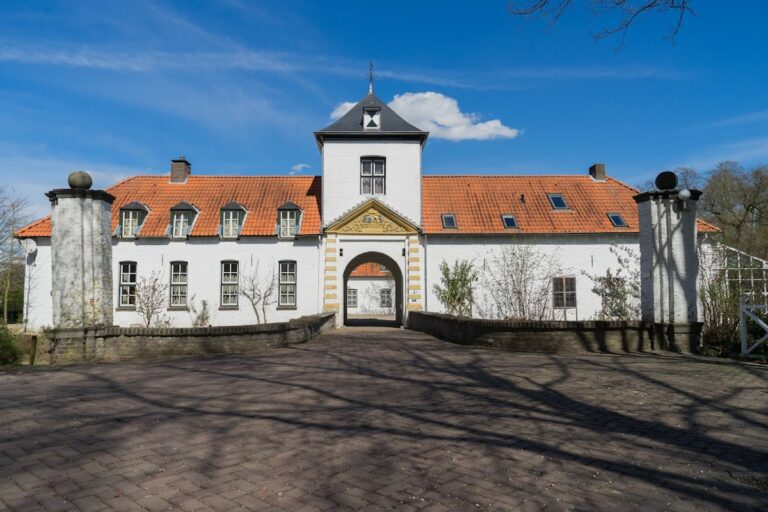
Exaten Castle: A Jesuit Institutional Estate in the Netherlands


Site at a Glance
- Rating
- 4.1
- Popularity
- Very Low
- Country
- Netherlands
- Primary era
- Early Modern
- Eras represented
- Early Modern, Modern
- Civilizations
- Dutch, Habsburg
- Site type
- Military
- Remains
- Castle
On this page14 sections
History
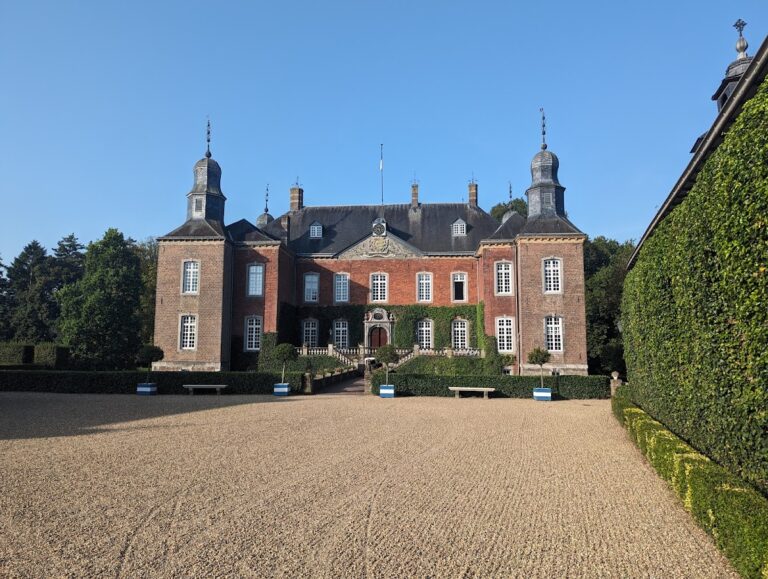
Exaten Castle is a sixteenth-century castle and estate in the Netherlands, southeast of Baexem. Mentioned in 1329 as “Ixaten,” it was probably rebuilt in 1556 and enlarged around 1593. Its later history was shaped especially by the German Jesuits, who made Exaten a central institutional base during their exile from Germany.
From medieval reference to early modern castle
Exaten was first mentioned in 1329 under the name “Ixaten.” A probable rebuilding followed in 1556, and the property was expanded around 1593. A stone above the entrance carries the date 1593 together with the alliance arms of the Pollart and van Loon families.
During and after the period of French rule and administration in the Netherlands in the late eighteenth and early nineteenth centuries, the castle fell into serious disrepair. In 1872, Count Theodore de Geloes d’Elsloo lent the property to German Jesuits expelled under Germany’s anti-Jesuit legislation. These measures formed part of the Kulturkampf, a conflict between the German state and the Catholic Church.
Jesuit exile and institutional expansion
From 1872 to 1885, Exaten served as a novitiate, an institution for training new members of the Jesuit order. Georg Michael Pachtler was associated with the estate, and Erich Wasmann encountered the Jesuits there. After the order purchased the estate in 1886, its activities expanded considerably.
The property then accommodated a philosophate, a stage of clerical education focused on philosophy, as well as the administrations and editorial offices of the German Jesuit journals Stimmen aus Maria Laach and Katholische Missionen. The provincial leadership of the German Jesuits was also established there, and Exaten was the regular residence of the German provincial superior from 1885 to 1919.
A Jesuit juvenate, which provided formation for younger candidates, operated at Exaten from 1894 to 1910. Novices returned after fire damaged the Jesuit house at Blijenbeek, and a Third Probation, a later period of Jesuit spiritual formation, was established at Exaten in 1910. Portuguese Jesuits exiled from their country also arrived that year. Ninety-five Jesuits were buried in the estate cemetery.
Franciscan, state, and contemporary uses
After the Jesuits returned to Germany, the estate passed to the Franciscans on 23 March 1927. From 1946 to 1957, it housed a youth-care institution run by the Dominican Sisters of Bethany. The sisters moved to Horn in 1959, after which the Franciscans returned.
A training school for the Dutch state police was established at Exaten in 1967, including instruction for the Mobile Unit. The estate came into the possession of the foundation Het Limburgs Landschap in 1973 for the protection of nature and landscape. Exaten has been legally protected as a Dutch national monument, or rijksmonument, since 1968. In 1997, the castle was sold to the Centraal Orgaan opvang asielzoekers and became an asylum-seeker reception centre.
Twentieth-century interventions altered the stream-valley landscape. The Haelense Brook was canalised in 1950, a drinking-water pumping station was commissioned in 1958, and the N68 was built in the early 1970s. In 2002, part of the brook was returned to a natural course through remeandering.
Remains
Exaten consists of the castle and a 141-hectare estate southeast of Baexem. The grounds extend across the valley of the Haelense Brook and higher sandy ground to the south. Historic buildings, farmsteads, ponds, woodland, heath, and stream-valley meadows occupy the transition between these two types of terrain.
Castle buildings
Sixteenth-century castle
The castle originated in the sixteenth century and probably took its present early modern form through rebuilding in 1556 and expansion around 1593. The enlarged structure was rectangular, with small towers at the corners on one side. The entrance stone dated 1593 bears the alliance arms of the Pollart and van Loon families.
Neo-Romanesque chapel
A new building with a large Neo-Romanesque chapel was added during the nineteenth-century development of the estate, after the Jesuits purchased Exaten in 1886. Neo-Romanesque architecture uses nineteenth-century forms derived from Romanesque buildings, including heavy masonry and rounded arches. The property lent to the Jesuits in 1872 consisted of the castle and five hectares of park and garden.
Historic farmsteads
Stockxhof
Stockxhof is one of the estate’s two old farmsteads and dates from the seventeenth century. It stands at the transition between higher sandy soils and the damp soils of the stream valley.
Exatenhof
Exatenhof is the second old farmstead and dates from the nineteenth century. A deed indicates that two farmsteads already stood in the stream valley around 1500. The local brown plaggen soils around the farms were formed through centuries of fertilisation with animal manure and sods.
Stream valley and sandy ground
Haelense Brook valley
The stream valley contains meadows, several small poplar groves, and seven ponds for amphibians. In places, a steep edge several metres high marks the transition to the higher sandy ground. The Haelense Brook was canalised in 1950, while a natural course was restored through remeandering in 2002.
Heath and woodland
The higher sandy ground originally consisted of heath and drifting sand. Conifers were planted there between 1930 and 1960, and the woodland now has an understorey of wild rowan and silver birch. Two fens on the boundary with Beegderheide contain heath vegetation and wetland plants and provide habitat for the moor frog. The open woodland supports the viviparous lizard, tree pipit, and yellowhammer, while the transition to the sandy ground also provides habitat for the yellowhammer.
Nearby sites