St. Christopher’s Cathedral: Cathedral of the Diocese of Roermond


Site at a Glance
- Rating
- 4.6
- Popularity
- Low
- Country
- Netherlands
- Primary era
- Medieval
- External website
- Open
- Eras represented
- Medieval, Early Modern
- Civilizations
- Holy Roman Empire, Spanish
- Site type
- Religious
- Remains
- Cathedral
On this page10 sections
History
St. Christopher’s Cathedral is a Roman Catholic cathedral in Roermond, the Netherlands, dedicated to Saint Christopher and serving as the principal church and episcopal seat of the Diocese of Roermond. Construction began in 1410 on a late-Gothic church intended to replace an older parish church outside the city walls. The original plan called for a basilica on a cruciform layout, but the design changed substantially during the fifteenth century, and the building was completed during the sixteenth century.
Construction and Rebuilding
The fifteenth-century revisions transformed the intended design. The choir became a three-aisled hall choir, whose side aisles were approximately the same height as its central space, while the nave was widened from three aisles to five. The church was almost completely destroyed in the Roermond city fire of 1554 and was subsequently rebuilt. Further damage followed during the 1566 Iconoclasm, a wave of attacks on religious images and church furnishings during the Reformation-era Netherlands.
In 1572, troops commanded by William of Orange, a leading figure in the Dutch revolt against Spanish rule, plundered the church. The vault collapsed in 1591, and a storm damaged the building in 1614. These events formed part of a long history of repair and alteration rather than a single uninterrupted building phase.
Cathedral and Diocesan Church
The Diocese of Roermond was established in 1559. St. Christopher’s became its cathedral in 1661, after the no-longer-extant Church of the Holy Spirit had briefly held that position. A cathedral is the principal church of a diocese and contains the bishop’s official seat. A cathedral chapter, the body of clergy attached to the church for institutional and liturgical functions, was established there and continues to function. Priestly ordinations and the installation of a new bishop are among the major diocesan events held in the cathedral.
Twentieth-Century Damage and Conservation
The tower spire burned in 1892 and collapsed during a storm in 1921. During the Second World War, the church suffered severe damage when German troops blew up its tower one day before Roermond was liberated by Allied forces. The destroyed tower was described as 78 metres high and was rebuilt after the war in an altered form. An earthquake in the Roermond region on 13 April 1992 caused further substantial damage.
Renovation and reordering began in 2001, partly in response to changes in liturgical use, and was almost complete by 2016. A comprehensive renovation also took place from 2005 to 2007. Since 20 April 1971, the cathedral has been a Dutch Rijksmonument, a nationally protected heritage monument, under monument number 32552.
Remains
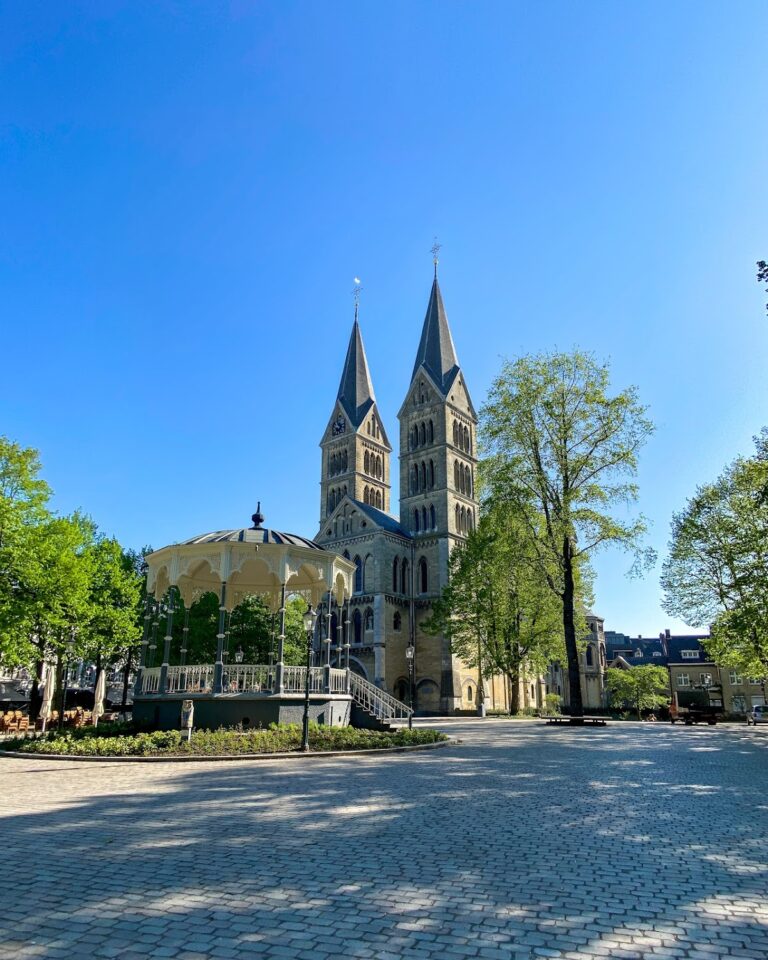
The cathedral stands on Roermond’s market square, near the Meuse and one of its former channels. It is a Gothic church with a broad five-aisled nave, a three-aisled hall choir, and a tower incorporated into the western part of the nave. Architectural data gives the tower a height of 85 metres, while the tower destroyed in 1945 was described as 78 metres high. A gilded statue of Saint Christopher crowns the tower. The saint, traditionally associated with travellers and with carrying the Christ Child, is represented by a statue 3.57 metres high.
Tower and Bells
The original gilded statue was cast by Theodorus Cox and installed in 1894. Successive versions followed damage caused by the storm, fire, and wartime destruction. The present statue was made by the coppersmith Jos Claessens, who had also created the earlier figure destroyed during the war.
Five bells hang in the tower. The largest, Maria, was cast in 1894 by Petit & Gebr. Edelbrock of Gescher and weighs 4,612 kilograms. The other bells were made by the Eijsbouts bell foundry in Asten in the Netherlands.
Windows and Interior Art
The cathedral’s stained-glass windows were made by Joep Nicolas, Max Weiss, Huub Kurvers, Jean Paul Raymond, Leo Reihs, Diego Semprun Nicolas, and Annemiek Punt. Above the seventeenth-century choir stalls hang Jan van Scorel’s Descent from the Cross, dated 1544, and a painting of Saint Honoratus dated 1625.
Altars and Devotional Objects
Near the entrance to the visitor centre is the Dalheim Cross, a fourteenth-century wooden forked cross. It came into the cathedral’s possession in 1804 after the secularization of the Dalheim Cistercian convent. The cross is especially venerated in connection with illness and misfortune.
In the left side aisle, a large natural-stone sacrament altar made by Peter van Aecken in 1595 has a three-towered structure containing a tabernacle, the container for consecrated Eucharistic bread, and a bronze cross. The bronze was made from melted parts of a bell and of the former Saint Christopher statue from the tower. Reliefs or images above the altar represent the Last Supper and the Apostles Peter and Paul, followed by Christ the King and, at the top, Mary.
Saint James Chapel and Memorials
A window niche visible from outside contains a forearm relic of Saint James, one of Jesus’s apostles and a saint closely associated with pilgrimage to Santiago de Compostela. It is described as the largest relic of the saint outside his tomb. In the chapel above the niche stands a 90-centimetre limestone statue of James as a bearded pilgrim with a hat, scallop shell, bag, and staff. The staff is no longer present. Scientific examination attributes the statue to Champagne in France and dates it to the late fifteenth century. It was originally covered in several colours, traces of which remain visible, and it was acquired in 2005.
An 1884 epitaph to Johanna van Randenraeth is set into the south wall. An epitaph is a memorial inscription, often accompanied by an image, commemorating a deceased person. Van Randenraeth died in 1684 and was reputed to have predicted the Christian victory at the 1683 Ottoman siege of Vienna. Her vision is depicted on the epitaph, while her remains lie beneath a white floor tomb slab several metres in front of it.
Organ
The organ was built in 1957 by L. Verschueren. It has 51 speaking stops, sets of pipes producing distinct sounds, together with a transmission to the pedal, across three manuals and pedal. During renovation begun in 2014, its original electro-pneumatic action, the mechanism connecting the keys to the pipes, was replaced by mechanical action and a new console. The wind machine was renewed, the pipework was re-regulated, and the pine framework was replaced. A playable smaller version was assembled during the work, and the largest organ pipe returned in March 2016 after being blessed by Bishop Frans Wiertz.
Nearby sites