Ensenbroek: A Former Castle in the Netherlands
Site at a Glance
- Rating
- 4
- Popularity
- Very Low
- Country
- Netherlands
- Primary era
- Early Modern
- External website
- Open
- Eras represented
- Medieval, Early Modern
- Civilizations
- Holy Roman Empire
- Site type
- Military
- Remains
- Castle
On this page8 sections
History
Ensenbroek was a castle in Oler, Netherlands, whose estate originated in 1116 and whose castle was probably built during or before the sixteenth century. The estate began when Sigewidis donated her allodial property, land held outright rather than as a feudal tenancy, to the Abbey of Saint Servatius in Maastricht. The estate was later divided, and a Groot-Ensenbroeck is recorded in 1487.
Estate and noble residence
During the sixteenth century, Ensenbroek belonged to the De Pas laathof in Panheel. A laathof was a manorial court and administrative estate serving a lord or ecclesiastical institution, in this case the Abbey of Saint Servatius. The castle was inhabited by the noble Roost van Ensenbroek family. Hendrick Roost van Ensenbroeck is the earliest family member identified by name, appearing in records around 1550.
Inheritance and ownership dispute
In the first half of the seventeenth century, Johan Diederik Roost and his sister Emerentiana lived at Ensenbroek. Emerentiana married Dirk Waldgraff van Cortils, and their three children inherited the house in 1645. They sold it to Don Gabriel d’Yvora, a captain in the Spanish army. His wife, Elisabeth van Dursdal, was related to the Roost family through her mother.
The sale caused a dispute over ownership. In 1662, the Court of Guelders, a high judicial and administrative court for the historical territory of Guelders, ruled that Ensenbroek had to be returned to the Roost family. Two sons of the Roost family later married daughters of Don Gabriel.
The last robber knights
During the first half of the eighteenth century, the cousins Hendrik and Werner Roost van Ensenbroek lived at the castle. They became involved in theft and violent acts in the surrounding area and were consequently remembered as the last “robber knights” of Limburg. The term refers to nobles accused of using fortified residences as bases for robbery, violence, or extortion.
Ensenbroek was demolished around 1779, reportedly on the orders of the abbess of Thorn. An abbess was the female superior of an abbey or convent. The demolition was said to have been intended to end the Roost family’s robberies. Local tradition also tells of a cruel Spanish knight who imprisoned a traveling musician in the castle dungeon, where the man died from exhaustion. The legend says that the knight was cursed, lost his possessions through drinking and feasting after his wife’s death, and was eventually strangled by the devil, who carried his soul to hell.
Investigation and commemoration
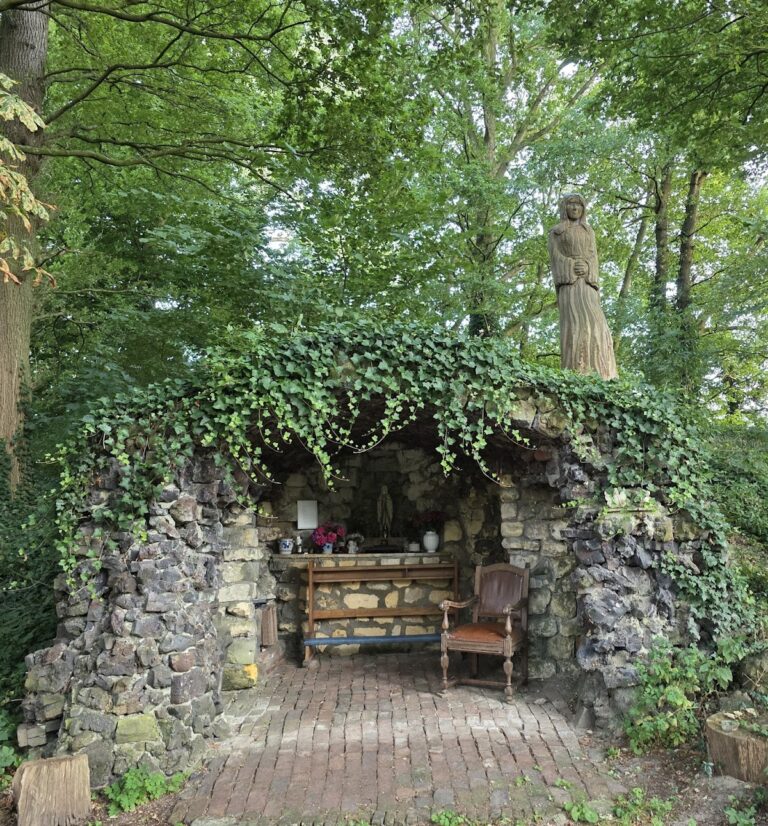
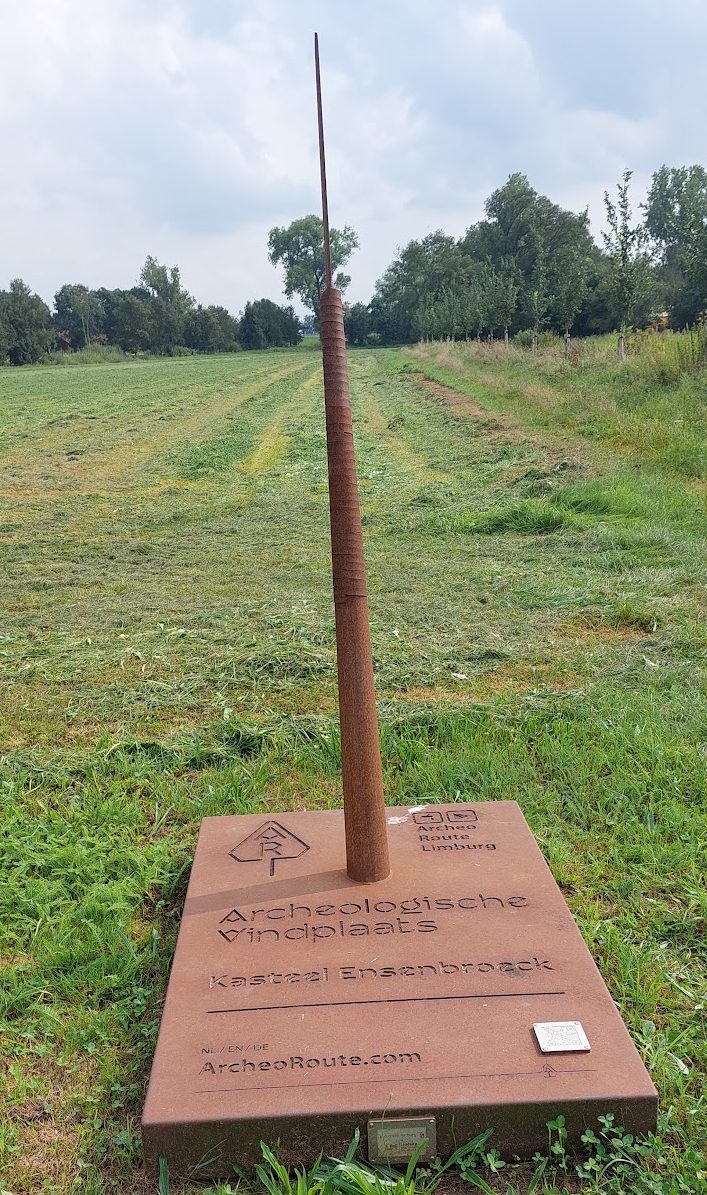
In 1874, Franssen, the parish priest of Ittervoort, investigated the former castle and recorded its arrangement. A small investigation in 1948 later uncovered foundations and wall remains. The last remnants of the moat were filled in during 1957. In 2019, a memorial was erected at the former castle site using surviving remains of Ensenbroek.
Remains
Moats and castle layout
The castle stood within a surrounding moat supplied with water from the Rhijdtbeek. A plan made in 1874 shows the course of the moats and the positions of the buildings, providing evidence for the former layout of the estate. The moat formed the principal surviving outline of the castle site until its final remnants were filled in during 1957.
Foundations and reused masonry
Investigations in 1948 revealed foundations and sections of wall built from Maas river cobbles and marlstone. Material from the demolition was reused in the bridge over the Panheelderbeek and later helped pave the road between Kelpen-Oler and Grathem around 1900. Surviving castle material was incorporated into the memorial erected at the former site in 2019.
Nearby sites