Château de La Boissière: A Medieval Fortified Château in France


Site at a Glance
- Rating
- 4.9
- Popularity
- Very Low
- Country
- France
- Primary era
- Medieval
- External website
- Open
- Eras represented
- Medieval
- Civilizations
- Unclassified
- Site type
- Military
- Remains
- Castle
On this page11 sections
History
From watchtower to fortified château
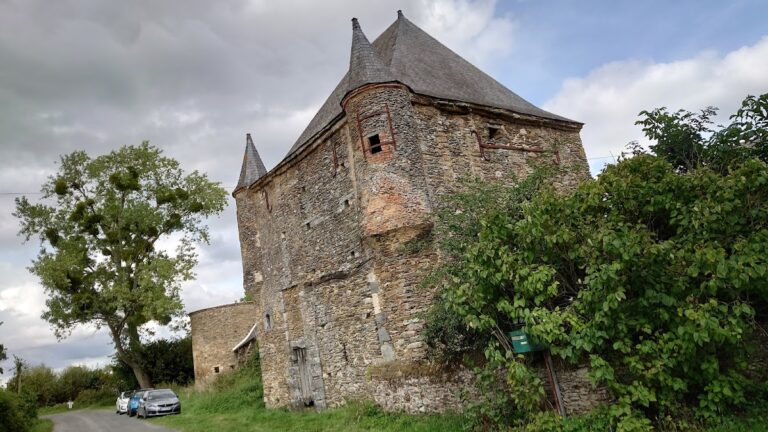
Château de La Boissière is a medieval fortified château in France, near the village of La Boissière in Mayenne. The site developed in the twelfth century from a watchtower beside a ford across the Chéran, where soldiers defended the Duchy of Anjou against the Duchy of Brittany. In the fourteenth century, a southern section was added, transforming the tower into a château. A second tower followed near the end of that century and completed the building’s square plan.
The château was one of the strongholds occupied by the English between 1356 and 1361. It was also visited several times by members of the d’Angennes family. Jacques d’Angennes was present there on 7 June 1550. The name “tower of Saint-Christophe of La Boissière” probably referred to the château, while the parish was sometimes known as Saint-Christophe-de-La Boissière.
The lordship and its holders
The lordship of La Boissière was attached to the château and held from the châtellenie of Savonnières by liege homage, a particularly binding feudal obligation of loyalty to a superior lord. Although La Boissière was described as a châtellenie, a territorial lordship organized around a castle and its judicial or administrative authority, it had neither fairs nor seals for contracts. In 1764, the lordship was incorporated into the châtellenie of Coulonges in Châtelais.
The succession of lords included Jean de la Roche and Jean II d’Angennes, known as Sapin, who resumed a legal action in 1462. Charles I d’Angennes, Lord of Rambouillet, married Marguerite de Couesmes in 1491. He was followed among the recorded holders by Jacques I d’Angennes, Lord of Rambouillet and seneschal of Maine, a high administrative and judicial officer, and by Nicolas d’Angennes in 1567.
Philippe d’Angennes was killed at the Siege of Lavardin in 1590 while serving with the royal forces. Charles d’Angennes was recorded as lord in 1612. After 1647, Charles left only one daughter as heir, and she was a nun at Port-Royal, a major Jansenist religious institution in early-modern France. Jean-François Paul de Gondi, Cardinal de Retz, inherited part of the succession. The lordship had already been pledged in 1647 to François de la Roussardière, the husband of Charlotte d’Héliand.
Another portion of the châtellenie, consisting chiefly of rents in Saint-Michel-de-la-Roë, had been acquired by François Coquille, secretary to the king. He resold it to Gatien Galiczon before 1658. Later holders included François de la Roussardière, his son Louis-François de la Roussardière, and Gabriel de Scépeaux, who acquired the estate in 1698. Pierre-Martin-Gabriel de Scépeaux died in 1756. Paul-René de Scépeaux, Count of Scépeaux and a brigadier, a senior rank in the French army, followed him, and Marie-René-Louis de Scépeaux obtained the land of La Boissière through a licitation, a court-supervised procedure for dividing or selling property, in 1781.
Estate administration and modern ownership
From the seventeenth century, the château was occupied by its castellan or tenant farmer rather than necessarily by its lord. Renée Marcillé, Lady of Malaunay, died there in 1612. Simon Gasset and Renée Guillon were tenant farmers in 1631, followed by René Vallot, Sieur du Mesnil, in 1699.
In the eighteenth century, the immediate domain comprised the Boissière farm, the Chapellière mill, the Bois-Robert coppice, and the Queille pond, whose area was given as 12 journaux. A journal was an old French land measure that varied by locality. The estate also carried feudal rights including escheat, rights over property in specified circumstances, confiscation, lordship over the fiefs of Bignon and Morandière, and cens, recurring payments owed by dependent landholders. It retained the customary honorary rights of founding and patron lords.
The estate later passed to the Pasqueraie du Rouzay family, which held the manor and its dependencies until the beginning of the twentieth century. The Bosset family owned it from 1915 to 1980, followed by Michel Aubry and Gérard Roussiez from 1981 to 2021. Claude Jolly and Isabelle Jolly, née Bardou, have held it since 2021. The Aubry-Roussiez period included a first restoration campaign, while the Jolly period brought a second. Château de La Boissière has been protected as a registered historic monument since 16 January 1987, a French legal category recognizing historical or architectural interest.
Remains
Fortified layout and water defenses
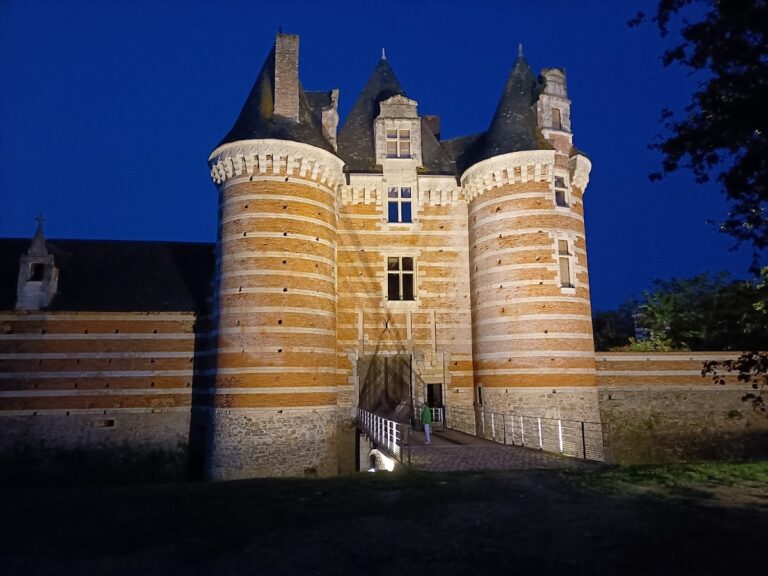
Château de La Boissière retains a very tall building whose form reflects its development from a defensive tower into a square-plan château. The structure stands beside the former ford of the Chéran, and its upper levels were reached by interior ladders. Broad surrounding moats formed part of its defenses and remain visible on one side of the site.
An older rampart adjoining the château was levelled in the seventeenth century to permit the construction of a farm building. This alteration linked the changing agricultural use of the estate with the surviving fortified complex.
Medieval building phases
The original watchtower
The earliest structure was a watchtower built at the level of the ford. Its military purpose was reflected in the internal ladders that provided access to the upper floors. The tower formed the core of the later château.
The southern section
A southern addition made in the fourteenth century supplied one large room on each floor. It also contained a large staircase housed within a turret, expanding the original defensive structure into a more substantial residence.
The later tower
A further tower was added near the end of the fourteenth century. It completed the château’s square outline and included latrines, contributing both to the building’s plan and to its domestic facilities.
Archaeological evidence near the château
A megalithic enclosure was discovered around 1860 in the Fontenelles field near the château. René-Jean Pommerais, a justice of the peace in Craon, made the discovery. The enclosure provides archaeological evidence for activity in the landscape before the medieval building phases.
Nearby sites