Château de Foulletorte: A Renaissance Château in France


Site at a Glance
- Rating
- 3.7
- Popularity
- Very Low
- Country
- France
- Primary era
- Early Modern
- Eras represented
- Early Modern
- Civilizations
- French
- Site type
- Domestic
- Remains
- Castle
On this page14 sections
History
Château de Foulletorte is a Renaissance château near Saint-Georges-sur-Erve in France, built around 1570 on the site of a medieval fortified stronghold. The earlier settlement stood on a motte, a raised earthwork for a fortified residence, beside a pond crossed by the Erve River. The present building replaced that former fortified castle while retaining the defensive landscape of moats, ditches, and controlled access.
Medieval Lords and the Vassé Family
The estate has medieval associations reaching back to Robert de Folletorte, who was recorded in the late eleventh century. Guillaume de Foulletorte appears in records from 1168 and 1250 in connection with donations involving Savigny Abbey and the cartulary of Champagne. Jean de Vassé was associated with Foulletorte in 1314, after which the estate was linked for a period with the Neuville family. Guillaume de Vassé, Jean’s younger son, was recorded in 1387.
Jean de Vassé recovered rights over Foulletorte in 1468 and remained connected with the estate into the 1470s. His son Charles de Vassé married Jeanne Nepveu in 1531, rendered a feudal acknowledgment for Foulletorte to the abbot of Évron in 1541, and was still living in 1554. From the fourteenth century until the early eighteenth century, the estate was principally associated with the Vassé family.
Renaissance Construction and Religious Foundations
The current château was constructed around 1570 during the Renaissance, a European period that revived interest in classical forms and influenced French architecture. Its construction was associated with Antoine de Vassé, a knight of the king’s order. Antoine became lord of Foulletorte at about this time and died soon after the château was captured in 1590.
A chapel known as Royault, or the Chapel of the Three Kings, existed by at least the fifteenth century. Its revenues came from grain tithes and other feudal income. Among its chaplains were René de Vassé, who died in 1572, Christophe de Vassé in 1578, Louis-François de Vassé from 1656 to 1683, André Serveau of Évron from 1723 to 1729, and Charles de l’Île-du-Gast from 1730 to 1747.
Wars and Political Unrest
In 1571, René Bourré, lord of Jarzé, occupied the château. During his occupation, inhabitants of Villaines came there to commend themselves to him. In 1590, during the conflict that followed the French Wars of Religion, Antoine de Vassé was besieged at Foulletorte by René de Bouillé, acting on the orders of the king and the Prince of Conti. The siege formed part of the turbulent military history surrounding the château at the end of the sixteenth century.
The defensive character of Foulletorte was still described in 1643. At that time, the complex was referred to as a fortified house with a walled courtyard, towers, moats, ditches, and a drawbridge. A drawbridge provided controlled access across the surrounding defensive excavations. The account also mentioned the motte, which was itself enclosed by moats and ditches.
From the Vassés to the Pinons and Malherbes
Antoine de Vassé’s son Annibal inherited the estate in 1591 under benefit of inventory, a legal arrangement that limited an heir’s responsibility for debts to the value of the inherited property. Jacques de Vassé, a gentleman of the king’s chamber, held Foulletorte in 1619 and 1656. In 1700, Pierre de Vassé, who used the title Marquis of Saint-Georges, was lord of the estate.
In 1709, the abbé Louis-François de Vassé, Jacques’s son and the last member of the family associated with Foulletorte, sold the estate to the abbé Hardy. Hardy bequeathed the domain in 1711 to Paul-Louis Pinon d’Avor, a maître des requêtes, a senior official who handled petitions and took part in judicial or administrative affairs. The Pinon family then remained associated with Foulletorte.
Anne-Louis Pinon de Quincy, Marquis of Saint-Georges, was imprisoned during the Reign of Terror, the period of intense political repression during the French Revolution. His son Anne-Louis Pinon de Saint-Georges emigrated in 1791, later lived at Foulletorte, and died there in 1850. His daughter Marie-Louise-Nathalie married Armand de Malherbe in 1826. Their son Raymond de Malherbe, a senator of the Oise, inherited the château in 1873.
The later family holders included Louis Paul Christian de Malherbe, René de Malherbe, an aviator, and Patrice de Malherbe. Château de Foulletorte remains the property of the Malherbe family. The eldest family member is Florence Mollinger-de Malherbe, born in 1943 and described as Raymond de Malherbe’s great-great-granddaughter.
Revolutionary Occupation and Heritage Protection
In February 1795, during the French Revolutionary period, a group of Chouans occupied the château. The Chouans were royalist insurgents who fought the revolutionary government in western France during the 1790s. General Gency ordered the commander of the Évron canton to search Foulletorte, describing it as a “den of brigands” and one of their arsenals.
Foulletorte was listed as a historic monument by an order dated 2 January 1929, with portions later classified separately. The façades, roofs, and grand staircase with its loggias were classified in 1974. The surrounding 11-hectare site was separately listed in 1943. These protections recognize both the château’s architectural fabric and the historic domain around it.
Remains
Residence and Loggia Pavilion
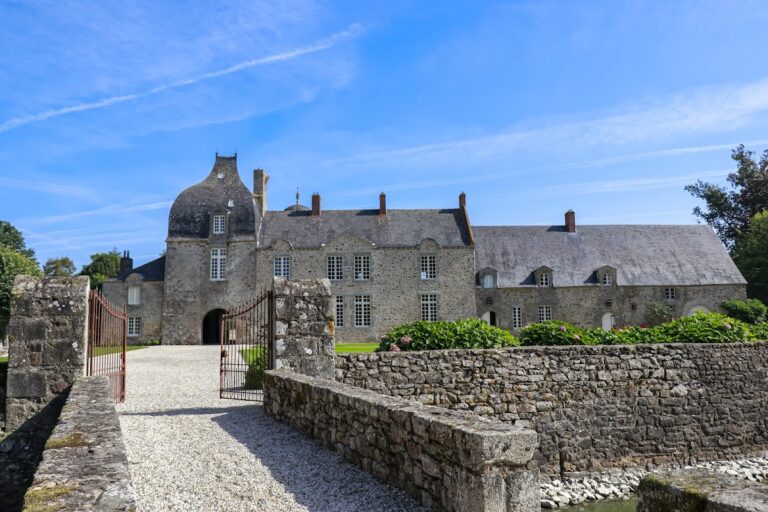
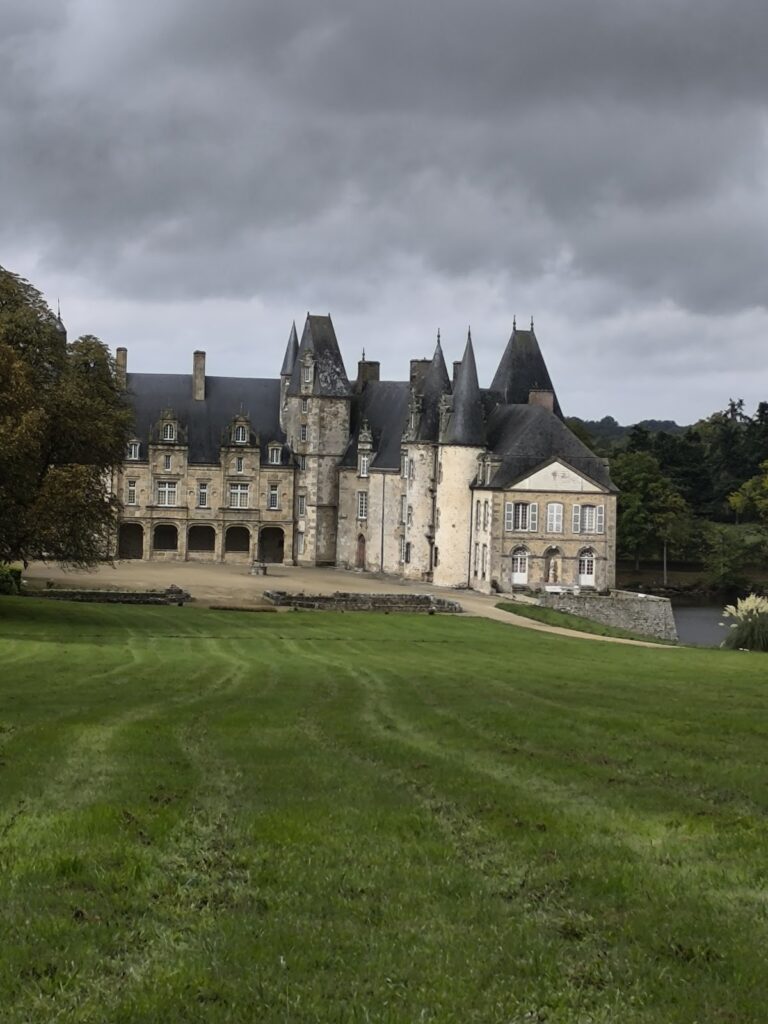
Château de Foulletorte is formed by two residential wings arranged at right angles. Dressed granite gives the building a solid, substantial character. The main façade is focused on a central loggia pavilion. A loggia is an open or partly open gallery integrated into a building and supported by columns. At Foulletorte, the pavilion is reached by a double flight of steps and contains the grand staircase with its loggias.
Central Pavilion
Two entablatures enrich the central pavilion. An entablature is the horizontal architectural assembly placed above columns. The pavilion therefore combines the formal language of the Renaissance with the practical role of providing access to the principal staircase. Its position gives the façade a clearly organized centre within the two-wing plan.
Residential Wings
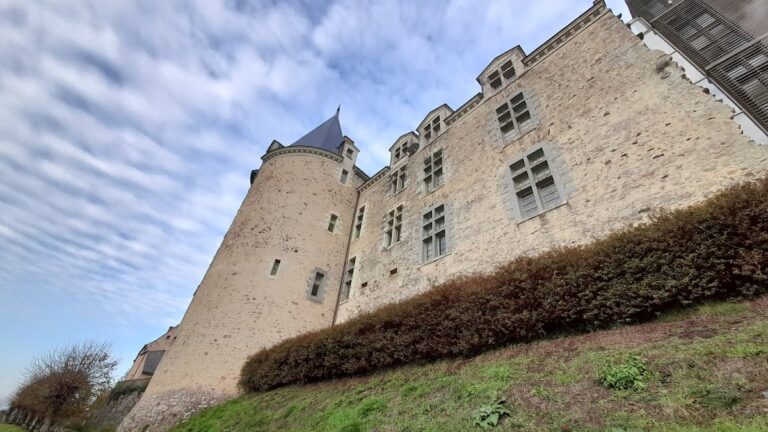
A prominent cornice with modillions runs around the large residential wings. Modillions are projecting ornamental blocks beneath a cornice. Above the cornice are arched dormers and mullioned dormers with triangular pediments decorated with vases. Mullions are the vertical members that divide a window. The design emphasizes massive construction, limited openings, and restrained ornament, a character that may reflect the insecure conditions during construction, when solidity could have been preferred to elegance.
Moats, Pond, and Defensive Setting
The château stands beside a pond crossed by the Erve River. The moats are exceptionally broad and deep, and the course of the river was diverted into them. Together with the ditches, walled enclosure, towers, and drawbridge described in 1643, these features preserve the physical logic of the earlier fortified complex around the Renaissance residence.
The former domain also included the Bois des Haies, which was recorded in 1643 as measuring 100 journaux, a historical land measure. The water system and wooded domain formed part of the wider estate associated with Foulletorte.
Associated Features and Material Evidence
Royault Chapel Stone
A stone reportedly taken from the Royault chapel was reused in a house beside the road. It bears a carved divided shield. The right side carries the arms of the Vassé family, while the left has a band accompanied by a crescent above and a bird below. A granite stoup, a vessel used for holy water, lies at the foot of the wall.
Dovecote
A dovecote stands on a small peninsula. This structure was used for keeping pigeons and contains 800 nesting compartments, traditionally called boulins. Its position on the peninsula places it within the water-shaped landscape of the former domain.