Reijmersbeek Castle: Seat of a Historic Lordship in the Netherlands

Site at a Glance
- Rating
- 4.2
- Popularity
- Very Low
- Country
- Netherlands
- Primary era
- Early Modern
- External website
- Open
- Eras represented
- Early Modern
- Civilizations
- Duchy of Brabant, Habsburg, Holy Roman Empire
- Site type
- Domestic
- Remains
- Castle
On this page10 sections
History
Medieval origins and estate development
The origins of Reijmersbeek Castle in Nuth, Netherlands, probably date to the fourteenth century, when Jonker Barthelomeus van Reijmersbeek, a member of the untitled nobility, is mentioned. The castle maintained longstanding connections with the village of Schinnen, belonged to the parish there, and was held as a fief from the feudal court of Terborgh Castle. A fief was land held under the authority of a superior lord and subject to associated obligations.
The estate expanded gradually. The farmstead Groot Breinder was often described as being “by Reijmersbeek,” and the castle’s owners held many tenant properties in Schinnen. They also acquired possessions from the feudal court of Merkelbeek and the tenant court of Nieuwenhof at Nuth. A tenant court administered leasehold properties and the obligations attached to them.
From 1479, the owners of Reijmersbeek possessed their own altar, choir, and burial vault in Saint Dionysius Church at Schinnen. These arrangements reflected the family’s established religious and social position in the surrounding community.
The lordship of Nuth
The castle and its chapel were lost through wartime violence. In 1626, Nuth was separated from the main judicial district of Klimmen and became an independent lordship under the Van Eynatten family, the lords of Reijmersbeek. A lordship was a territory in which a lord exercised specified judicial and administrative rights. From that time, Reijmersbeek Castle served as the seat of the lordship.
Karel Theodoor van Eynatten, the last family member associated with Reijmersbeek, married Balduina Amelia Walburgis, Baroness of Rolshausen. He became lord of Nuth and Reijmersbeek in 1782.
The Lekens and Michiels van Kessenich families
In 1809, Karel Theodoor van Eijnatten sold the castle to Paul Lekens, a jurist from Maastricht. His son, Paul August Lekens, married Henriette de Montaigne, became mayor of Nuth in 1813, and later succeeded his father as owner of Reijmersbeek.
Paul August Lekens’s daughter, Maria Louisa Paulina Josephina Augustina Lekens, married Baron Alphonse Hilaire Joseph Hubert Michiels van Kessenich. They lived at the castle until their deaths. Michiels van Kessenich was a major landowner and represented Limburg in the First Chamber of the States General from 1899 to 1922. The First Chamber is the upper house of the Dutch national parliament.
Preservation and twentieth-century associations
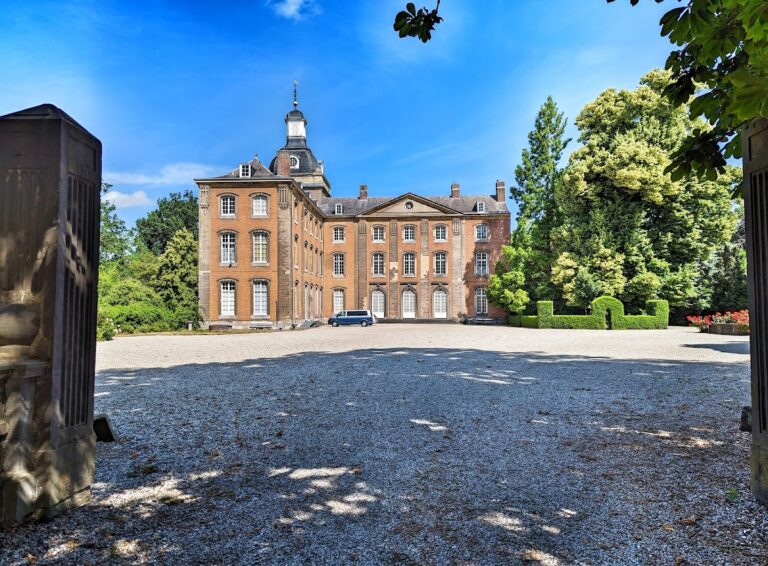
Reijmersbeek Castle is a Dutch national monument, a designation that places a building or site under the Netherlands’ highest level of statutory heritage protection. The site was restored in 2001. During the work, white plaster was removed from the main building, revealing its horizontal bands once again.
The castle is also said to have been a meeting place for the so-called Reijmersbeek Circle. Church historians have argued that this group played an important part in the appointment of Joannes Matthijs Gijsen as bishop of Roermond in 1968. The circle supposedly brought together influential Roman Catholics, including members of the nobility, regents, and clergy who were concerned about the democratic direction of the Limburg church province from the 1960s onward.
Remains
Main building
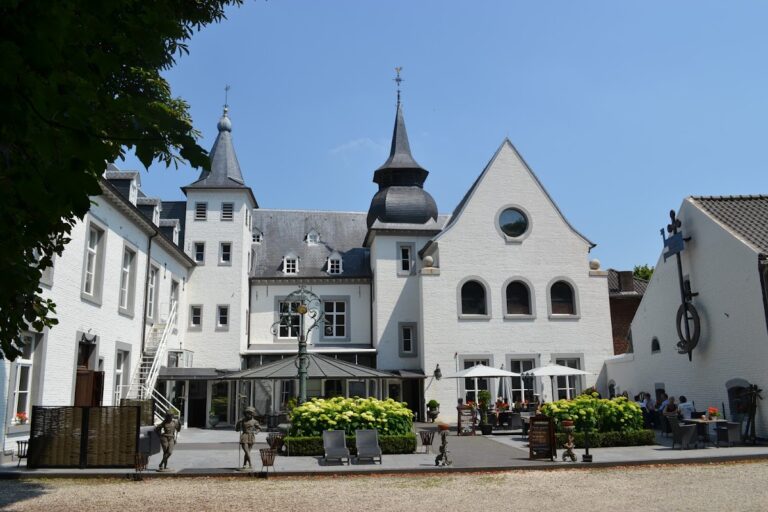
The present castle dates from the sixteenth century, although most of its current appearance belongs to the eighteenth century. It is a two-storey brick building marked by horizontal bands and covered by a mansard roof, whose lower slopes are steeper than its upper slopes. A heavy, eight-ribbed cross vault survives in the cellar.
A sixteenth-century corner tower forms part of the building. Its Austrian-style onion-shaped spire was added in 1970. The front facade has a small pediment, while the right side may originally have ended in a scroll gable rather than conventional gable ends. A rounded marlstone block in the right gable has been cited in support of that interpretation. Inside the manor house is a room in the Louis XVI style, a late-eighteenth-century neoclassical style associated with the reign of Louis XVI of France.
Landscape and estate buildings
Fishponds
The castle grounds were once enclosed by fishponds supplied by the Geleenbeek. One pond remains within the landscaped park, preserving part of the water system that formerly surrounded the estate.
Castle farm
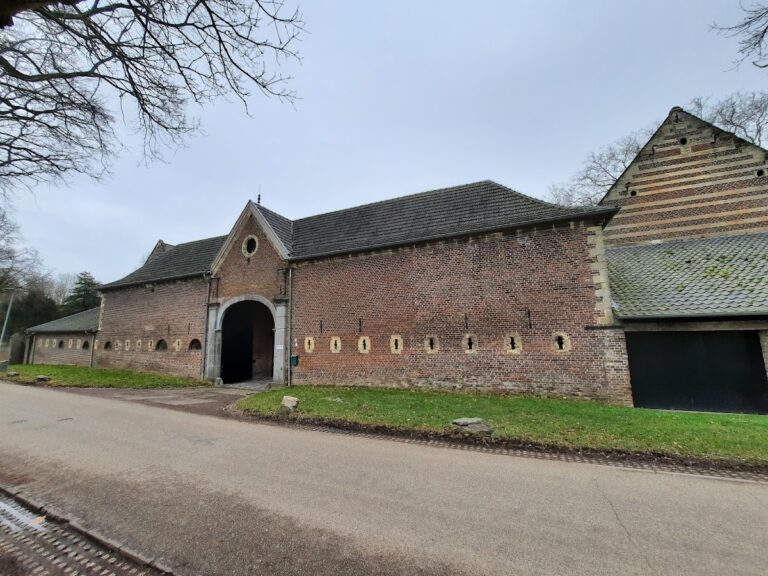
South of the castle stands a large U-shaped castle farm dating from the seventeenth and eighteenth centuries. Two parallel side wings with hipped roofs, which slope downward on all sides, are joined by a low front facade. This facade contains a gatehouse topped by a tent roof, whose roof planes rise to a single point.
Reijmersbeek Castle’s architectural character closely resembles that of Schaesberg Castle and Puth Castle, linking its design to a wider group of historic castles in the region.
Nearby sites