St. John’s Church: A Historic Catholic Parish Church in Hoensbroek


Site at a Glance
- Rating
- 4.6
- Popularity
- Very Low
- Country
- Netherlands
- Primary era
- Medieval
- External website
- Open
- Eras represented
- Medieval, Early Modern, Modern
- Civilizations
- Habsburg, Holy Roman Empire
- Site type
- Religious
- Remains
- Church
On this page10 sections
History
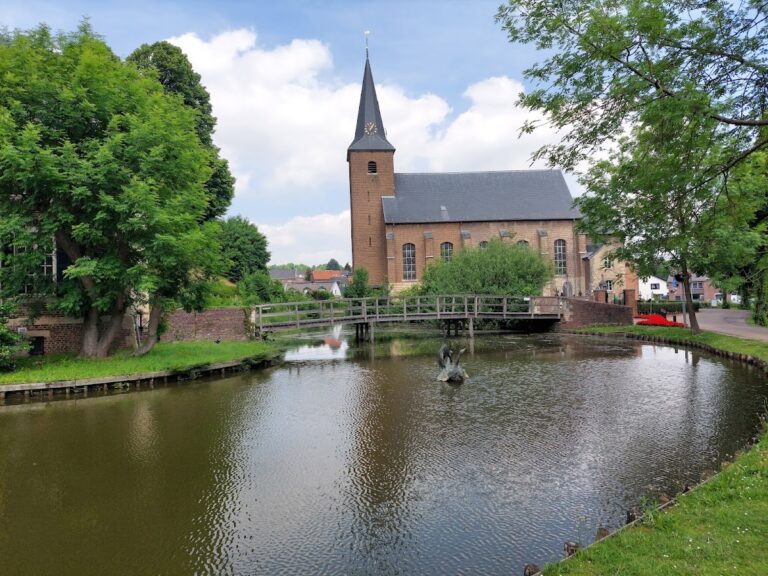
St. John’s Church is a small Catholic parish church in Hoensbroek, Netherlands, dedicated to John the Baptist and affiliated with the Diocese of Roermond. Its origins are uncertain, but construction around 1137 is generally considered plausible, while the Cultural Heritage Agency of the Netherlands places the first construction or addition of the nave at around 1150. The church developed after Hoensbroek separated from the parish of Heerlen, or possibly replaced an earlier church on the same site.
Medieval parish development
The tower was probably built around the time of Hoensbroek’s separation from Heerlen. It could serve as a refuge for local residents, although the early structures of nearby Hoensbroek Castle provided stronger protection. A 1398 church-rent register still described St. John’s as a chapel, even though its separation from the older parish had occurred several years earlier.
The building was enlarged in stages during the fourteenth, fifteenth, sixteenth, and seventeenth centuries, but it remained a relatively small church. A later tower probably dates from around 1300, while the chancel was likely added between 1300 and 1520. These successive changes created the form of a parish church that continued to serve the local Catholic community.
Alterations and restoration
Major changes took place in the seventeenth and early eighteenth centuries. A sacristy, the room used to store liturgical objects and prepare for worship, was built in 1630. The existing chancel was raised in 1680, and a new brick sacristy was attached to the church in 1725.
After centuries of insufficient maintenance, the church had fallen into serious disrepair. Restoration began around 1900, followed by further work in 1909–1910 and a third restoration completed in 1990. The later campaign repaired bullet holes in the walls that probably dated from the Second World War. Thirteen windows made by Jacques Vonk were installed in 1958. St. John’s has been a Dutch national monument since 21 February 1967 and continues to host daily Catholic liturgical celebrations.
A local identity
The church is locally called the “small St. John” to distinguish it from the larger Church of St. John the Evangelist across the road. The two buildings are also known as the small and large St. John. This distinction reflects the church’s continuing place within the central area of Hoensbroek, now part of the municipality of Heerlen.
Remains
St. John’s Church stands in a small park between Juliana-Bernhardlaan, Hoofdstraat, and the Markt. Its walls are built from marlstone blocks, a relatively soft limestone-rich building stone. The surviving complex brings together a nave, a medieval tower, a later chancel, and the brick sacristy added in 1725.
Church building
Nave and chancel
The nave forms the main body of the church and is associated with the first construction phase, dated broadly to around 1150. The chancel, the section associated with the altar and clergy, was probably added between 1300 and 1520 and was raised in 1680. During the restoration of 1909–1910, Neo-Gothic windows were installed, reflecting the nineteenth- and early twentieth-century revival of medieval Gothic forms. The roofs over the side aisles were also restored as shed roofs, each formed by a single sloping surface.
Tower and bells
The later tower probably dates from around 1300 and contains a bell frame, the structure from which bells are hung. Two bells remain in the church. One was made by Peter van Tier in 1414 and measures 99 centimetres in diameter. The other was cast in 1840 by the Belgian founder François-Alexandre Gaulard and measures 78 centimetres. Both bells are operated by a mechanical tower clock with electric winding.
1725 sacristy
The sacristy built against the church in 1725 survives as a brick structure beside the marlstone walls. Its purpose was to provide a working and storage room for Catholic worship, while its contrasting material distinguishes it from the older parts of the building.
Former cemetery and commemorative features
A small former cemetery surrounds the church. The grounds are no longer used for burials, but twenty-one grave crosses and six cast-iron gravestones remain, with some dating back several centuries. Near the entrance stands a Sacred Heart statue from 1920, a Catholic devotional image representing Jesus’ love and compassion.
A memorial beside the entrance was erected and inaugurated in 2015 for the historian and former mayor Egidius Slanghen, who was probably buried at the site. Behind the church, opposite the present market, stands a Hoensbroek war memorial installed in 1953. Together with the grave markers, these commemorative features preserve the churchyard’s continuing connection with local religious and civic memory.