Château Filhot: A Classified Sauternes Winery in France


Site at a Glance
- Rating
- 4.6
- Popularity
- Very Low
- Country
- France
- Primary era
- Modern
- External website
- Open
- Eras represented
- Early Modern, Modern
- Civilizations
- French
- Site type
- Domestic
- Remains
- Elite Residence
On this page10 sections
History
Château Filhot is a winery in Sauternes, France, within the Sauternes appellation, a legally defined designation controlling geographical origin and production standards, in Bordeaux’s Gironde wine region. Its vineyard tradition dates to approximately 1630–1650, while Romain de Filhot acquired several plots in 1709 and commissioned the estate’s first buildings. The property later became a Deuxième Cru Classé, or Second Growth, in the 1855 Bordeaux classification, a ranking system that placed prominent estates into growth categories below the Premier Cru levels.
The Filhot family estate
Romain de Filhot (1641–1710), a member of the Parlement of Bordeaux, assembled several properties on the south-facing slopes of the former vins de Langon area. The Parlement was a high court and governing institution under France’s ancien régime, rather than the country’s modern national legislature. Romain is associated with the formation of the Sauternes appellation, where sweet white wines are traditionally made from grapes concentrated by noble rot, a beneficial fungal infection that shrivels ripe berries and intensifies their sugars and flavors.
The estate remained with the Filhot family for almost a century. It passed first to Romain’s son, Jean-Jacques, and then to his grandson, Jean François-Xavier. Both continued the family’s connection with the Parlement of Bordeaux. During the fourth generation, Gabriel Barthélémy Romain de Filhot (1746–1794), who became president of the Parlement, brought the property to a period of prosperity.
In May 1787, Thomas Jefferson described Filhot’s wine as a first-class Sauternes, placing it in a price range comparable with Château d’Yquem. Jefferson was then the United States minister to France, and his assessment connected the estate with the highly regarded sweet white wines of Bordeaux. Gabriel de Filhot acquired Château Coutet in 1788, but six years later he was executed during the French Revolution, the period of political upheaval that ended France’s monarchy and transformed its institutions. His only daughter, Marie Geneviève Françoise Joséphine de Filhot, was still very young at the time.
The Lur-Saluces period and nineteenth-century rebuilding
Marie’s marriage to Antoine Marie Henry Amédée de Lur-Saluces in 1807 brought Château Filhot, Château d’Yquem, Château Coutet, Château de Malle, and Château de Fargues into the same family holdings. In 1840, Romain Bertrand de Lur-Saluces enlarged the estate by purchasing Pineau de Rey. The château was redesigned that year, and the present estate building was erected in 1845 on the model of the Petit Trianon, the neoclassical château at Versailles associated with Louis XV and Marie Antoinette. Its grounds were arranged as an English-style park by Louis-Bernard Fischer.
Château Filhot received the rank of Deuxième Cru Classé in 1855. It was later marketed under the name Château Sauternes, but the name Filhot returned in 1901. The period of the name change coincided with a broader twentieth-century crisis, and the estate entered a long decline. Its vineyard area contracted from approximately 120 hectares to fewer than 20 hectares by the 1930s. For much of that period, the estate only rarely maintained the quality associated with its classification. Its wine is sometimes described as having been unfairly left outside the Premier Cru category, and it is characterized as drier than Château d’Yquem and unusually high in alcohol for a Sauternes.
Twentieth-century management and renewed production
In 1935, Marquis Bertrand de Lur-Saluces sold the estate to his sister, Thérèse-Marie, and her husband, Comte Étienne Durieu de Lacarelle. Their grandson, Comte Henri de Vaucelles, managed Château Filhot from 1974 to 2015. The Vaucelles family then continued to run the property, with Gabriel de Vaucelles, Henri’s son, taking charge.
The family invested in restoring Château Filhot’s position as a quality estate. In 1995, old plastic fermentation vessels were replaced with temperature-controlled stainless-steel tanks. The wines were subsequently matured in barriques, small oak barrels traditionally holding about 225 litres, after fermentation. The estate now produces the classified Grand Vin Château Filhot, a second wine introduced in the 1970s under the name Château Pineau du Rey, and a small quantity of dry white wine called Château Pineau du Rey Sec. Wines that do not meet the standards of either principal wine are sold anonymously as wine in barrels.
Remains
Château and park
The present château
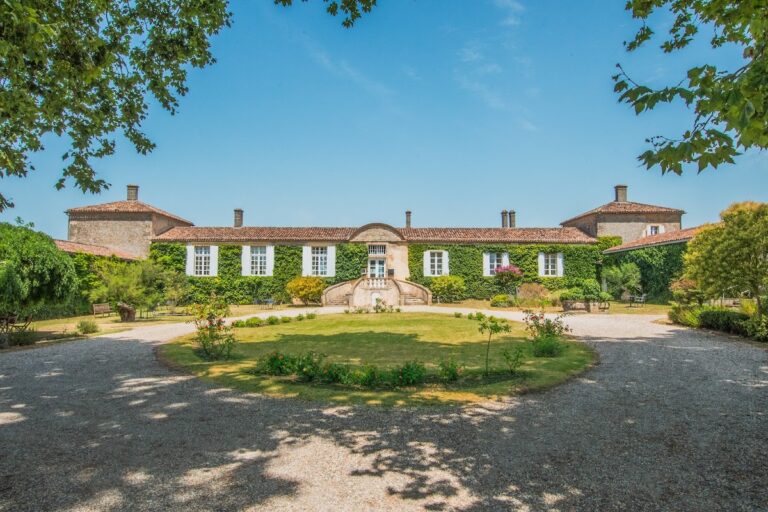
The present Château Filhot is the estate building erected in 1845 after the redesign begun in 1840. Its form follows the Petit Trianon, an eighteenth-century neoclassical residence within the grounds of Versailles that became a model for elegant country houses. The building forms the architectural centre of an estate covering approximately 350 hectares.
The English-style park
The château is accompanied by an English-style park designed by Louis-Bernard Fischer. The park belongs to the nineteenth-century reorganization of the estate and provides the landscape setting for the building erected in 1845.
Vineyard landscape
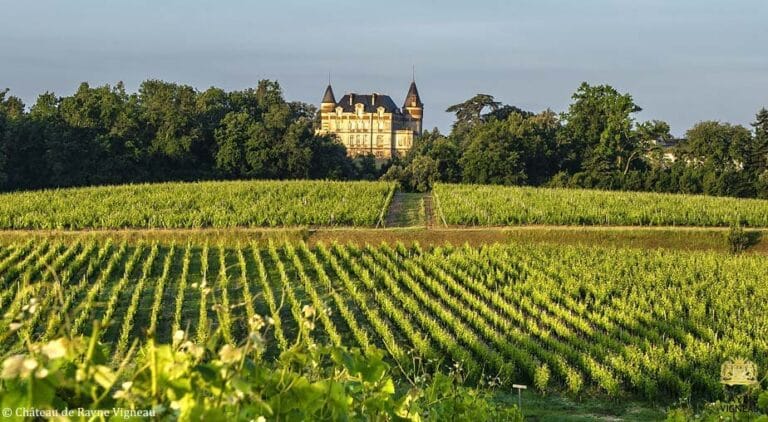
The vineyard parcels lie northwest of the main estate buildings. They cover 62 hectares within the approximately 350-hectare property and occupy soil composed of gravel, clay, and sand over a limestone plateau. The vines have an average age of about 35 years and produce approximately 15–18 hectolitres per hectare. Plantings consist of 60 percent Sémillon, 36 percent Sauvignon Blanc, and 4 percent Muscadelle.
Harvest and wine production
Harvesting is carried out by hand in three to six successive passes. This allows berries affected by noble rot to be selected as they reach the required concentration. Fermentation takes place in temperature-controlled stainless-steel tanks for approximately 12–20 days.
After fermentation, individual wine lots are matured separately in wooden barrels for ten months and then filtered. Blending follows four months later, after which the wine undergoes a further twelve months of maturation in oak barriques. Approximately one-third of the barriques is replaced each year, and bottling takes place about 24 months after fermentation. Château Filhot produces nearly 60,000 bottles of its Grand Vin annually.