Château de Reverseaux: An Eighteenth-Century Estate in France


Site at a Glance
- Rating
- 4.5
- Popularity
- Very Low
- Country
- France
- Primary era
- Early Modern
- Eras represented
- Early Modern
- Civilizations
- French
- Site type
- Domestic
- Remains
- Castle
On this page8 sections
History
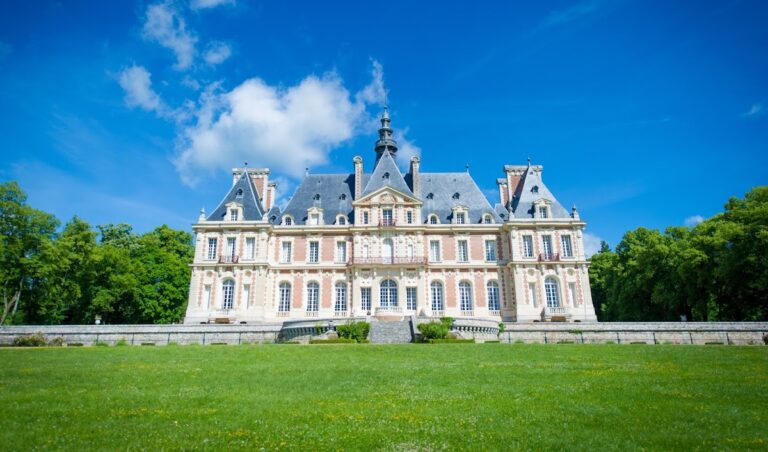
Château de Reverseaux is an eighteenth-century château in France, near Les Villages-Vovéens, whose present building was constructed between 1725 and 1753 as part of a major rebuilding of the estate. The property record gives 1715 as a foundation date. Its history is closely associated with the Guéau and Gravelle families and later with Marshal Laurent de Gouvion-Saint-Cyr.
The Guéau and Gravelle succession
The Reverseaux estate belonged to the Guéau family from the second half of the fifteenth century. Jacques Guéau, a merchant and bourgeois of Chartres active during the mid-sixteenth century, is the earliest known owner. After his death, the estate passed to his second son, Cardin Guéau, and then successively among Cardin’s children.
Ownership eventually came to Geneviève Guéau, the fifteenth and last of Cardin’s children. Her marriage to Christin de Gravelle, receiver-general of the ecclesiastical décimes for the Diocese of Chartres, brought the Gravelle name into the estate’s history. The décimes were taxes collected from the clergy, while the receiver-general administered their collection for the diocese.
The couple’s fifth child, Marin de Gravelle, entered the Church, becoming a priest, doctor of theology, and royal chaplain. Although he served close to the king, he inherited the title of lord of Reverseaux. On 14 December 1717, he transferred the estate to his nephew Philippe Guéau. The agreement required Philippe to adopt the de Gravelle name and arms and to pass Reverseaux through the male line by primogeniture.
The eighteenth-century rebuilding
Philippe’s son, Jacques-Étienne Guéau de Gravelle de Reverseaux, inherited the estate in 1725 and undertook the rebuilding that produced the present château. The earlier residential building, described as very dilapidated, was demolished along with the other structures then standing on the estate. The replacement formed part of a new ensemble constructed during the first half of the eighteenth century.
Jacques-Étienne was an advocate in the Parlement, a high sovereign court in pre-Revolutionary France, secretary to the king in the Great Chancery, and counsellor to the Duke of Orléans. He married Marie-Angélique Le Noir in 1738 and died in Paris on 19 April 1753. His official responsibilities, like those of earlier lords of Reverseaux, meant that he and his predecessors lived at the estate only from time to time, while their residence in Paris and Versailles became increasingly important.
His son, Jean-Jacques-Philippe-Isaac Guéau de Gravelle de Reverseaux, continued the renovation and added ancillary buildings. He later became president of the Grand Council, a high royal judicial and administrative body, and received the title Marquis of Reverseaux through letters patent in July 1766. Letters patent were formal documents issued by the French monarch to grant or confirm a title or legal status.
From the nineteenth century to the present
Marshal Laurent de Gouvion-Saint-Cyr acquired the château in 1807. He retired to Reverseaux in 1819 and remained there until his death in 1830. The property has continued in the Gouvion Saint-Cyr family. Part of the château has been classified as a historic monument under French law since 27 December 1966, a status used to protect buildings and sites valued for their historical or architectural importance. Reverseaux lies in the former commune of Rouvray-Saint-Florentin, incorporated into Villages Vovéens in 2016.
Remains
Entrance ensemble
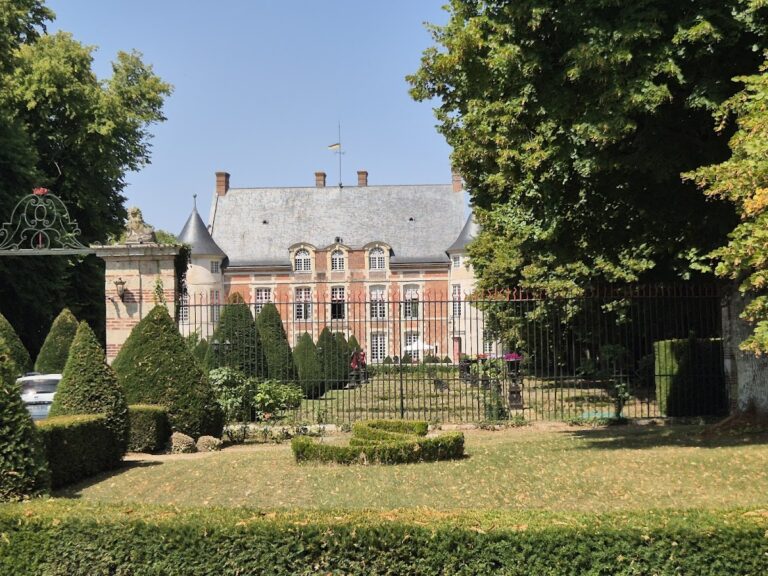
The château belongs to an ensemble created during the first half of the eighteenth century. Approached from the south, the layout proceeds through an avenue, a forecourt, and a main courtyard. A moat encloses the courtyard, while a wrought-iron gate controls its entrance.
Louis XIII-style pavilions
Two pavilions flank the main courtyard. They are in the Louis XIII style, an architectural language associated with seventeenth-century France that combines formal classical planning with steep roofs, pavilion forms, and restrained ornament. Their position gives the entrance court its balanced arrangement.
Principal château
The southern front has a central architectural motif framed by flat pilasters and finished with a rounded pediment. The northern facade repeats the same general treatment with a broadly comparable composition. Together, these elevations form the principal surviving expression of the rebuilding carried out under Jacques-Étienne Guéau de Gravelle de Reverseaux.
Nearby sites