Château d’Yquem: A Historic Sauternes Wine Estate in France


Site at a Glance
- Rating
- 4.7
- Popularity
- Low
- Country
- France
- Primary era
- Early Modern
- External website
- Open
- Eras represented
- Early Modern
- Civilizations
- French
- Site type
- Domestic
- Remains
- Castle
On this page12 sections
History
Château d’Yquem is a historic wine estate in France, occupied by a fortress by the twelfth century and later shaped into one of the best-known properties of the Sauternes wine region. Its position once dominated the Ciron valley. The site’s history extends from English and French rule through the rise of its sweet wine, the Lur-Saluces family’s ownership, and its modern transformation as a major Bordeaux estate.
From fortress to family estate
The area belonged to the English crown from 1152 until 1453. In that year, Bordeaux and the surrounding region passed to the French crown under Charles VII. By then, a fortress already occupied the site, reflecting its position above the Ciron valley.
On 8 December 1593, Jacques Sauvage, a local notable, became tenant of Yquem and rebuilt the château. His descendant Léon de Sauvage d’Yquem acquired the fief in 1711, bringing the estate into full family ownership. The present château still consists of buildings dating from the sixteenth and seventeenth centuries.
In 1785, Françoise-Joséphine de Sauvage d’Yquem, the family’s last heiress, married Louis-Amédée de Lur-Saluces. After his death in 1788, she managed the estate. Under her direction, Yquem helped establish the international reputation of its wine.
The development of Yquem’s sweet wine
During the eighteenth century, wines from Sauternes were generally sweet white wines, but they were not yet identical to the highly concentrated wine associated with Yquem today. Late harvesting, sometimes continuing until the end of November, increased sweetness. The practice of repeatedly selecting grapes affected by noble rot also developed during this period, influenced by comparable methods in the Rhineland and Hungary.
Noble rot is the beneficial form of infection by the fungus Botrytis cinerea. It shrivels ripe grapes, concentrating their sugars and adding distinctive aromas when weather conditions prevent the infection from becoming destructive. At Yquem, this method became central to the character of the estate’s wine.
Thomas Jefferson, United States ambassador to France from 1785 to 1789, visited the château and promoted Sauternes in America. He ordered 250 bottles of the 1784 vintage for himself and additional bottles for George Washington. The wine Jefferson drank predated the development of Yquem’s noble-rot practice and was therefore less sweet than later vintages.
The Lur-Saluces family and international recognition
Antoine Marie Henri Amédée de Lur-Saluces, the son of Françoise-Joséphine, became chamberlain to Napoleon in 1810 but refused the title. He was ordered to serve in the Russian campaign, where Cossacks captured him in 1812. He later served as aide-de-camp to the Duke of Angoulême and died of yellow fever in 1823.
Romain Bertrand de Lur-Saluces succeeded to the family title and took over the estate after Françoise-Joséphine’s death in 1851. Four years later, Yquem received the rank of Premier Cru Supérieur, or Superior First Growth, the highest level in the 1855 classification of Bordeaux wines. It was the only Sauternes estate to receive that rank.
The estate’s reputation grew further in 1859, when Grand Duke Constantine, brother of the Russian tsar, bought a barrel of the 1847 vintage for 20,000 gold francs. Yquem subsequently became highly regarded at the courts of the Russian tsars.
Defining the Sauternes appellation
Bertrand de Lur Saluces directed Château d’Yquem during the early twentieth century and played an active role in defending and promoting Sauternes wine. As president of the Syndicat viticole des vins de Sauternes et Barsac, founded in 1908, he helped establish the legally defined Sauternes appellation. Under the 1919 law, 17 communes were removed from the appellation area through 26 lawsuits conducted over 15 years.
Bertrand served in both world wars. He was wounded and gassed at the Chemin des Dames in 1917. In 1939, he was recalled as an artillery captain, captured with his regiment, and held in prisoner-of-war camps for two years. He died in Bordeaux in 1968 without descendants, having designated his nephew Alexandre de Lur Saluces as his successor.
Modern management and changing ownership
Under Alexandre de Lur Saluces, the estate modernized its agricultural and cellar operations. Tractors replaced horses, collapsing cellars were renovated, and unused acreage was planted. After the 1973 oil crisis, demand and prices fell sharply, although they recovered during the 1980s.
LVMH Moët Hennessy-Louis Vuitton, a French luxury-goods group with interests in wines and spirits, acquired a major shareholding in Château d’Yquem between 1996 and 1999. The acquisition followed a dispute within the Lur-Saluces family and prolonged legal proceedings. Alexandre de Lur Saluces retired from management in 2004 and was replaced by Pierre Lurton, who also managed Château Cheval Blanc.
Since 1959, the estate has also produced Y, formerly called Y de Lur-Saluces, a dry white wine. It was originally made only in selected years, but production became annual from 2004. Because it is not a sweet wine, Y is classified as Bordeaux rather than Sauternes.
Château d’Yquem sometimes declines to release a vintage under its own name when the harvest fails to meet its quality standards. The entire crop was sold anonymously rather than under the château name in 1910, 1915, 1930, 1951, 1952, 1964, 1972, 1974, 1992, and 2012.
The château entered the French register of historic monuments in 2003 because of its architectural decoration and painted interiors. In 2019, Bernard Arnault announced the estate’s conversion to biodynamic viticulture, an agricultural system that treats the vineyard as an interconnected ecological unit and uses cultivation practices based on biodynamic principles.
Yquem also appears in Alphonse Daudet’s novel Numa Roumestan, published in 1881. The scene describes nineteenth-century consumption of Yquem with oysters, a pairing different from later practice. The origin of the château’s name remains uncertain, although it may derive from the Germanic elements aigan and helm, which later developed through forms such as aighelm and Ayqem.
Remains
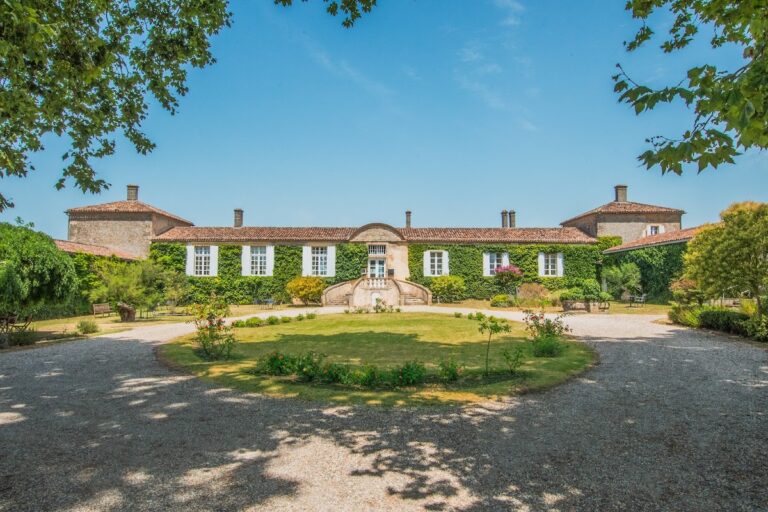
Château d’Yquem is a vineyard property in the Sauternes area of the Bordeaux wine region, within the wider Graves region. The present château is formed by sixteenth- and seventeenth-century buildings arranged as a quadrilateral around a large courtyard. Its historic interiors include painted decoration in the principal residential building and frescoes and fireplaces in the chapel.
Château buildings and historic interiors
Residential building
The principal residential building forms part of the quadrilateral surrounding the central courtyard. Its historic interior includes painted decoration, contributing to the architectural character for which the château entered the French register of historic monuments in 2003.
Chapel
The chapel contains frescoes and fireplaces among its surviving historic features. These interiors preserve part of the château’s religious and domestic architectural fabric within the larger courtyard arrangement.
Vineyard and production landscape
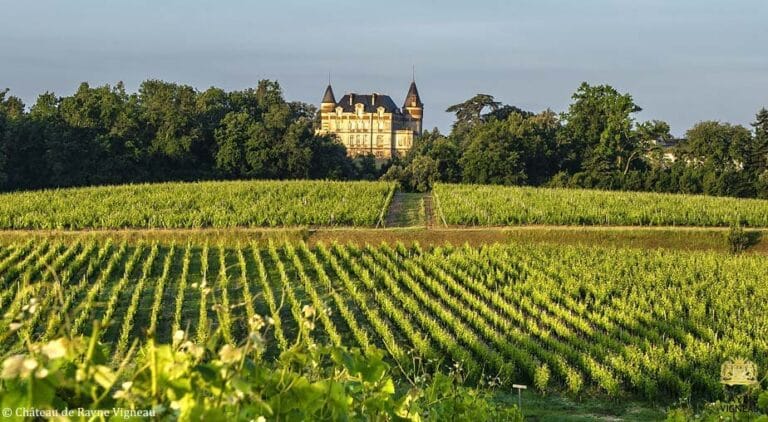
The grounds cover approximately 130 hectares, with roughly 100 hectares in productive use. Young vines and recently replanted areas remain out of production. The vineyard lies on gravel over clay-rich subsoil, with sand and limestone also present. The nearby Ciron contributes autumn morning fog, while dry, sunny afternoons and water-retaining clay soils encourage the desirable form of Botrytis cinerea.
The vineyard is planted exclusively with the white grape varieties Sémillon and Sauvignon blanc. Sémillon makes up approximately 75 to 80 percent of the plantings. Its thick skins help it withstand rot, while Sauvignon blanc accounts for approximately 20 to 25 percent and ripens earlier. Two to three hectares are grubbed up each year and left fallow for about one year before replanting. Grapes from newly planted vines are not used for Yquem for approximately five to seven years.
Harvesting and cellar work
Harvesting takes place by hand, berry by berry, in successive selective passes through the vineyard. A selective pass, or try, takes only suitably ripe or botrytized grapes. The harvest normally involves about five or six tries, while difficult years may require as many as ten passes extending into December. Average yield is approximately nine hectolitres per hectare.
Only botrytized grapes meeting the required quality are selected. Their must may contain approximately 300 to 600 grams of sugar per litre, with a potential alcohol level of about 18 to 30 percent, depending on the year. The grapes are pressed soon after picking, generally in three or four successive pressings. The first yields approximately 75 percent of the juice, the second about 15 percent, and later pressings extract further juice from the pressed grape material. The resulting musts are combined in new oak barrels.
Fermentation is difficult because of the must’s high sugar concentration. It generally lasts two to three weeks and may continue for as long as six weeks, ending naturally at approximately 13.5 percent alcohol. The wine then matures in oak barrels for about three years, with weekly topping-up, clarification, and racking approximately every three months. Final blending and bottling take place around the fourth spring after harvest, and the finished wine is not filtered.
Yquem’s sweet wine retains high residual sugar, aromas associated with Botrytis cinerea, and relatively high acidity that balances its sweetness. Properly stored bottles may mature for a century or more. Y is made from Sémillon and Sauvignon blanc in approximately equal proportions, using grapes from the estate’s vineyard, but its dry style places it within the Bordeaux classification rather than the Sauternes appellation.