Niżankowice Palace: A Historic Estate in Ukraine


Site at a Glance
- Rating
- 4.4
- Popularity
- Very Low
- Country
- Ukraine
- Primary era
- Modern
- Eras represented
- Modern
- Civilizations
- Habsburg
- Site type
- Domestic
- Remains
- Elite Residence
On this page7 sections
History
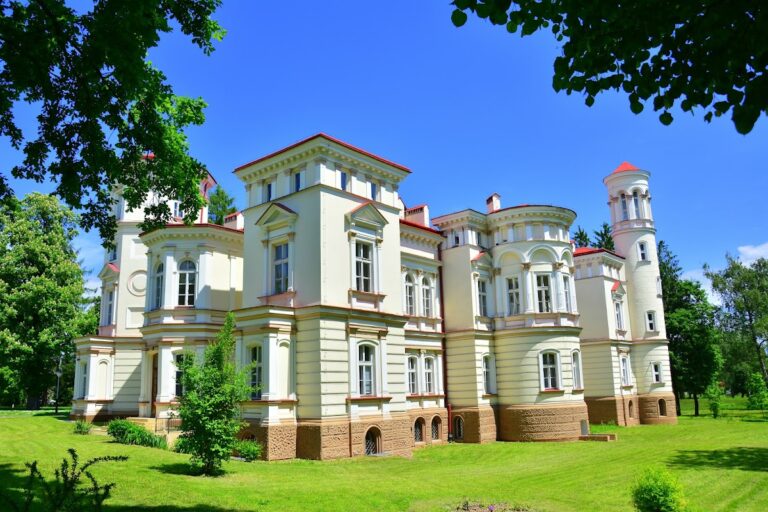
Niżankowice Palace is a historic estate building in Nyzhankovychi, Ukraine, originally associated with the former village of Zabłotce. It was built around the turn of the nineteenth and twentieth centuries, although its exact construction date is uncertain. The building is described variously as Neoclassical, a style based on classical Greek and Roman forms, and Art Nouveau, an international style known for flowing lines and organic ornament.
The estate and its owners
The estate was associated with the Lubomirski family, a Polish aristocratic landowning family, before a woman of the Lubomirski family gave the palace to her relative, Count Potocki. The title of count was a hereditary aristocratic rank. Potocki reportedly used the property for hunting and later gave the palace to Anna Grim, his Austrian-born companion. She lived there until the beginning of the Second World War, when she moved to Vienna.
Another recorded succession identifies Count Potocki as an earlier owner and the Kozłowski family as later owners of Zabłotce. Ownership passed through Antoni Kozłowski, his son Antoni, Anastazy Kozłowski, Róża Kozłowska, Zygmunt Kozłowski, and Włodzimierz Kozłowski, who held the estate until his death in 1917. The estate was divided between an upper section containing the palace and a lower section containing the farmstead. The farmstead employed many peasants in agriculture, crop cultivation, and animal husbandry.
Later use and survival
The palace now accommodates the library of the Niżankovice vocational lyceum. Workshops and dormitories occupy the lower area of the former farmstead. The palace and its park are in a neglected condition and require restoration.
A family burial chapel associated with the Kozłowski family was destroyed at the end of the Second World War. The sarcophagi and coffins inside it were also destroyed. A separate crypt used for the burial of former farmstead owners is said to survive in present-day Poland, several dozen metres from the Ukrainian border. Local tradition also claims that the palace contains a hidden entrance leading to the Herburts’ castle at Dobromil.
Remains
The palace stands on a hill in an old park at the centre of the former village of Zabłotce, now within Nyzhankovychi. It is a two-storey building whose original form included a hipped roof. Later additions created a more complex composition, with a tower on the left, a projecting wing on the right, and an arcaded passage joining the two elements.
Tower and entrance
The two-storey tower contains the main entrance and is covered by its own tower roof. A pediment at the top bears the Kozłowski family coat of arms. Each storey has a balcony with a steel balustrade. The heraldic emblem remains visible on the palace pediment and tower. It is described as a crown surmounted by a hawk, together with a horseshoe motif. The Jastrzębiec coat of arms is a Polish heraldic emblem traditionally associated with a horseshoe and a bird of prey.
Projecting wing and passage
The projecting wing on the right ends at the front in a three-sided apse, a projecting polygonal termination. It is crowned by a tympanum, the framed field above a classical façade or entrance. Within it is a cartouche decorated with vegetal motifs, the Kozłowski family’s Jastrzębiec coat of arms, and the Latin motto “UNGUIBUS ET ROSTRO CONTRA HOSTEM ARMA,” meaning “With all our strength we will defend ourselves against enemies.” An arcaded passage connects this wing with the tower.
Burial sites
A family burial chapel was built on a hill behind the manor by Zygmunt Kozłowski near the end of his life. He died in 1893 and was buried in its crypt. The chapel stood in the area now belonging to Malhowice in Poland, on the Polish side of the present Ukrainian-Polish border. Its destruction at the end of the Second World War forms part of the surviving history of the estate and its Kozłowski owners.
Nearby sites