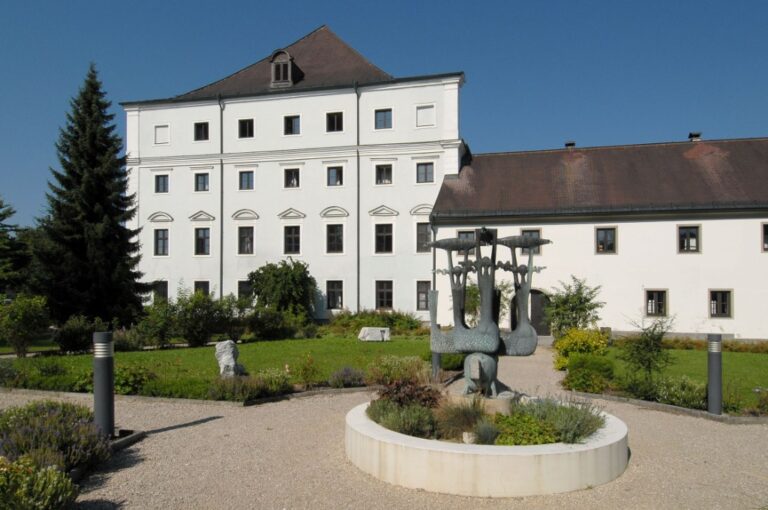
Schloss Starhemberg, Haag am Hausruck: A Renaissance Castle Complex


Site at a Glance
- Rating
- 4.7
- Popularity
- Very Low
- Country
- Austria
- Primary era
- Early Modern
- External website
- Open
- Eras represented
- Medieval, Early Modern, Modern
- Civilizations
- Holy Roman Empire
- Site type
- Domestic
- Remains
- Castle
On this page14 sections
History
Schloss Starhemberg, Haag am Hausruck, is a Renaissance-style castle complex in Austria, whose first stone castle was built before 1236 by Gundaker IV of Steyr. Gundaker was a medieval ministerial, an official or knight who served a ruler or ecclesiastical lord in military and administrative roles. The site enters surviving records in 1246, while a thirteenth-century land register from Passau calls it “Storchenberch.”
Medieval lordship
Gundaker served King Ottokar I Přemysl and later adopted the castle’s name. Starhemberg was held as a fief of the Bishopric of Passau, an ecclesiastical principality ruled by the bishop of Passau. At the same time, the Starhemberg family exercised high jurisdiction as a fief of the Schaunberg family. A fief was land or jurisdiction held from a superior lord in return for service, so the castle stood within overlapping structures of ecclesiastical and noble authority.
During the early fourteenth-century struggle for the German kingship between Frederick the Fair and Louis the Bavarian, the castle was captured in 1322 by Grams of Uttendorf, a field commander serving Louis. The Bavarians ceded it to Dukes Albert II and Otto IV ten years later. The Starhembergs continued to occupy their ancestral castle until 1379 because they maintained their claims to the Passau fief. Duke Albert III eventually compensated them with 3,000 pounds of silver, after which the castle was usually administered by stewards or assigned as a pledge. A pledged holding was property temporarily given to a creditor or political beneficiary until an obligation was fulfilled.
Changing holders in the fifteenth and sixteenth centuries
Reinprecht II of Walsee became the castle’s pledge-holder in 1414. The Starhembergs recovered the lordship as pledged property during the first half of the fifteenth century, but the Anhanger family soon replaced them, followed later by the Jörger family. Starhemberg was pledged to the Starhembergs again in 1461 and 1491.
In 1498, King Maximilian I sold the lordship and its regional court to Christoph Jörger. Jörger remodeled the still castle-like residence to make it more comfortable. His successor, Helmhard, Baron von Jörger, was born at Starhemberg and became one of the leaders of the Protestant aristocratic uprising of 1620. He was placed under an imperial ban, and his possessions were confiscated.
War, revolt, and the Passau administration
Emperor Ferdinand II first pledged Starhemberg to the city of Wels and then sold it in 1627 to the Bishopric of Passau. The bishops appointed stewards to administer the property. During the Upper Austrian Peasants’ War of 1626, rebels commanded by Achaz Willinger captured the castle, destroyed its archive, and looted its armory.
Another peasant uprising broke out in the Innviertel, a historical region of Upper Austria, in 1632. Six leaders were executed, and the remains of those quartered were publicly displayed in Grieskirchen, Hofkirchen, and Haag. During the War of the Spanish Succession, the European conflict fought from 1701 to 1714 over the Spanish succession, the Bavarian general Litzelburg besieged and occupied Starhemberg.
From state property to private ownership
When the secular territories of Passau were transferred to secular administration in 1803, Starhemberg returned to the Austrian state and was administered by the Court Chamber. Napoleon spent a night at the castle in 1805 while traveling toward Austerlitz. In 1809, the complex became a French military hospital. Haag and the Innviertel belonged to Bavaria from 1810 to 1816.
The Austrian state privatized the lordship in 1836. Its new owners were Michael Fink of Braunau and Franz Seyrl of Ried, and Seyrl became sole owner in 1847. The Austrian army used the castle as a military hospital from 1915 to 1916. Hugo Seyrl sold it to Hans Hatschek in 1916, and Hatschek carried out major alterations and restorations between 1923 and 1925, substantially changing the complex’s appearance.
During the Second World War, Starhemberg served as a transit camp for refugees. The Hatschek family continues to own and occupy the property. The former brewery now houses the Haag Local History Rooms, also known as the Haag Local History Museum.
Remains
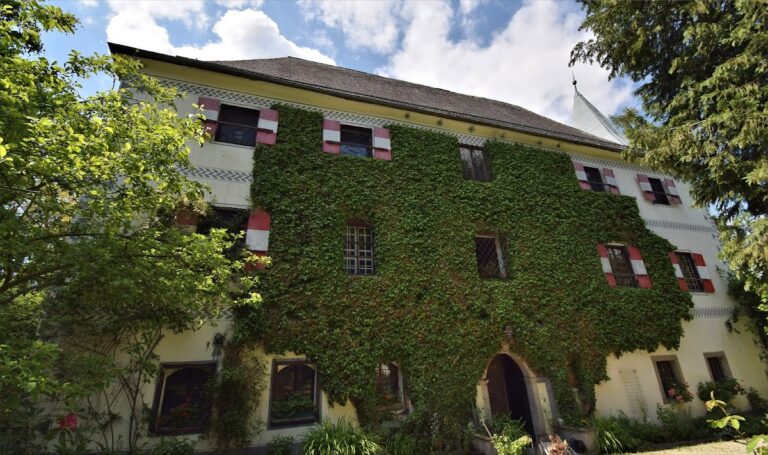
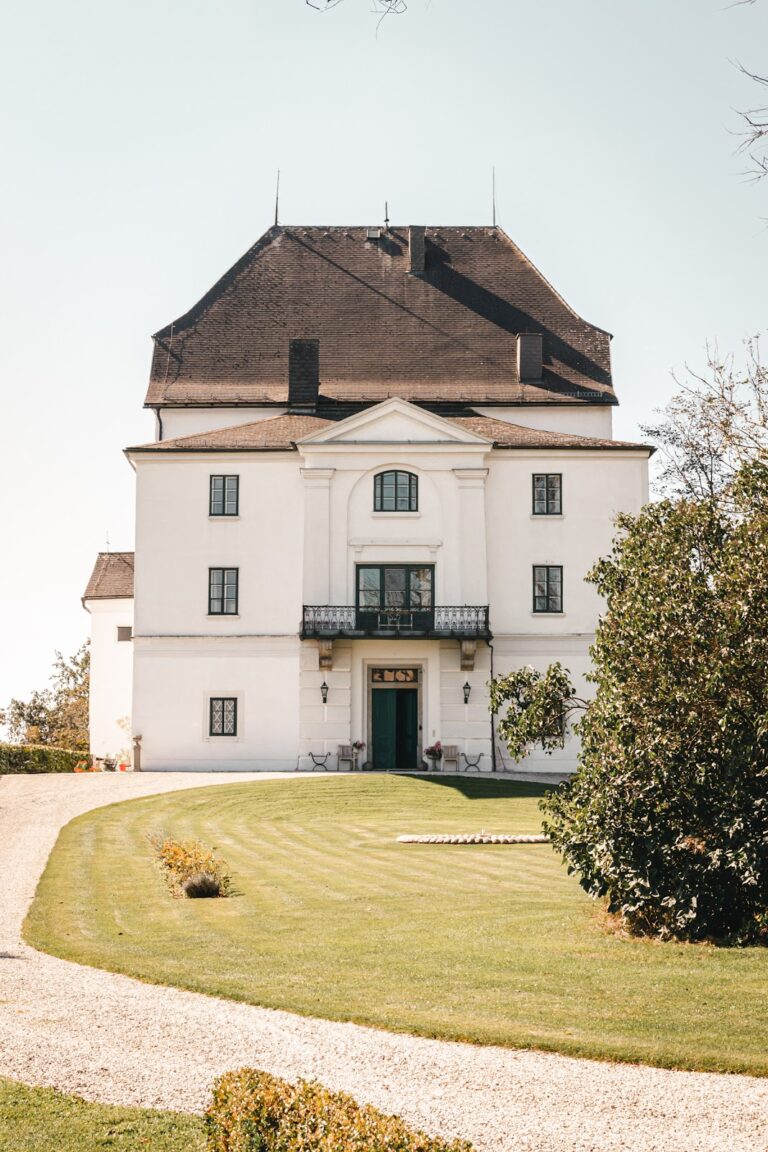
Schloss Starhemberg stands on a wooded hill north of the marketplace of Haag am Hausruck. Its elongated group of buildings derives mainly from the sixteenth century and survives in an excellent state of preservation. Later buildings overlay older wall lines, so the present complex no longer visibly resembles the earlier castle. Its current appearance is strongly shaped by the alterations undertaken between 1923 and 1925.
Gate and defensive structures
Gate building
The entrance is formed by a Renaissance gate building, beside which stands a narrow pedestrian gate. Openings for the rollers of the former drawbridge remain visible in the gate structure. The moat and bridge have disappeared, leaving the surviving roller openings as physical evidence of the earlier approach to the castle.
Main tower
The main tower was substantially heightened during the restoration and alteration work of 1923 to 1925. The towers flanking the gate building were considerably reduced during the same intervention, giving the complex a different external profile from its earlier form.
Courtyard and architectural groups
Nepomuk fountain
The front part of the picturesque courtyard contains a notable Nepomuk fountain. It is associated with John of Nepomuk, a fourteenth-century Bohemian priest and martyr who became a prominent saint in Central European religious art.
Chapel
A chapel stands at the far end of the courtyard. It was newly built during the 1923 to 1925 restoration, making it part of the twentieth-century reshaping of the complex rather than a surviving element of the earlier castle arrangement.
Arcaded galleries
One side of the courtyard has three-story arcaded galleries. An arcade is a passage or gallery formed by a series of arches. The arcades on the lower two floors were walled up during the nineteenth century, while the upper arrangement remains part of the courtyard’s architectural character.
Interior spaces and north wing
Some rooms in the older southern section have barrel vaults with lunettes, a continuous vaulted ceiling with curved recesses formed by transverse openings or intersecting vault sections. Other rooms retain timber-beamed ceilings, providing a contrast between masonry vaulting and wooden construction within the older part of the complex.
The former brewery occupies the north wing. Its rooms contain the Haag Local History Rooms, which give the building a continuing local historical function within the preserved castle complex.
Nearby sites