Schloss Wildenwart: A Bavarian Castle and Wittelsbach Residence


Site at a Glance
- Rating
- 4
- Popularity
- Very Low
- Country
- Germany
- Primary era
- Early Modern
- External website
- Open
- Eras represented
- Medieval, Early Modern, Modern
- Civilizations
- Holy Roman Empire
- Site type
- Domestic
- Remains
- Castle
On this page8 sections
History
Schloss Wildenwart is a historic castle in Germany, in Wildenwart within the municipality of Frasdorf, Bavaria. Its predecessor was established in the twelfth century to secure a crossing of the Prien, with construction around 1135 attributed to the Lords of Greimharting. The site developed through several noble dynasties before becoming a residence of the Wittelsbach family, the dynasty that ruled Bavaria for centuries and provided its kings until the monarchy ended in 1918.
Medieval Lords and Ducal Possession
The castle was successively associated with the Lords of Greimharting, the Lords of Falkenstein, and the Wildenwart family. The Wildenwart line died out in the fifteenth century, after which the Lords of Aschau at Hirnsberg held the castle. The dukes of Bavaria owned the estate from approximately 1400 until 1501, when it was sold to the Hofer family, wealthy mining proprietors from Rattenberg.
From 1508 to 1512, Wildenwart temporarily belonged to Matthäus Lang von Wellenburg. He later became a cardinal, a senior dignitary of the Roman Catholic Church, and archbishop of Salzburg, the head of a large church district. The Lords of Freyberg zu Hohenaschau held Wildenwart from 1540 to 1608. Pankraz von Freyberg zu Hohenaschau also held the lordship of Hohenaschau and served as a senior official at the ducal court. He regulated the forests and alpine pastures associated with Aschau and Wildenwart.
The Preysing Lordship
The Freybergs were followed by the Tyrolean Barons Schurff, also styled Schurff von Tann. In 1771, the Schurff family sold the lordships of Hohenaschau and Wildenwart to the Counts of Preysing. The Preysings retained the property until their male line became extinct in 1853. Until 1806, the lordship possessed high jurisdiction, meaning the authority to hear serious criminal cases and impose severe penalties, including death sentences. After 1806, the property passed to the dukes of Bavaria-Landshut.
Modena-Este and the Bavarian Royal Family
Archduke Franz V of Modena-Este and his wife, Adelgunde of Bavaria, acquired the castle in 1862. Following the Second War of Italian Independence and Italian unification, the Modena family lived in exile between the Castello del Catajo, Palazzo Modena in Vienna, and Wildenwart. Franz V died in 1875. Since the couple had no children, Wildenwart passed by inheritance to Maria Theresa, a granddaughter of the last Modenese duke and the wife of Prince Ludwig, later King Ludwig III of Bavaria. Maria Theresa and her family regularly spent the summer at the castle.
The Bavarian Revolution of November 1918 ended the monarchy, and the royal family’s flight from Munich made Wildenwart its residence and a new home for the Wittelsbach family. Queen Maria Theresa died there in early 1919. Ludwig III returned from Swiss exile to Wildenwart in April 1920 and spent much of his remaining life at the castle. After his death at Schloss Nádasdy in Sárvár, Hungary, on 18 October 1921, his body was transported to Bavaria by rail and taken to Wildenwart. The last Bavarian royal couple lay in state in the castle chapel until their transfer to Munich on 4 November 1921.
Ludwig III’s daughters Hildegard and Helmtrud continued to live at Wildenwart. Hildegard died in 1948, while Helmtrud died in 1977. Maria Josepha of Saxony, the mother of the last Austrian emperor, also died at Wildenwart in 1944. After Helmtrud’s death, the castle underwent extensive renovation. Following a general renovation, Max, Duke in Bavaria, moved into Wildenwart with his family in 1979. He was head of the Bavarian line of the Dukes in Bavaria and, after his brother Franz, the second-ranking male member of the Wittelsbach house. The current owner is identified as Max Emanuel von Wittelsbach, Duke in Bavaria.
Schloss Wildenwart is listed as a protected architectural monument and as an archaeological monument. The archaeological designation includes underground medieval and early-modern remains associated with the castle, its predecessor buildings, and the service yard.
Remains
Castle Complex and Landscape
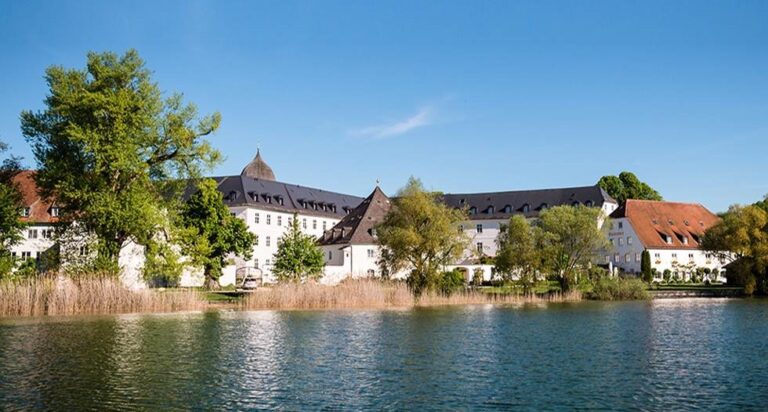
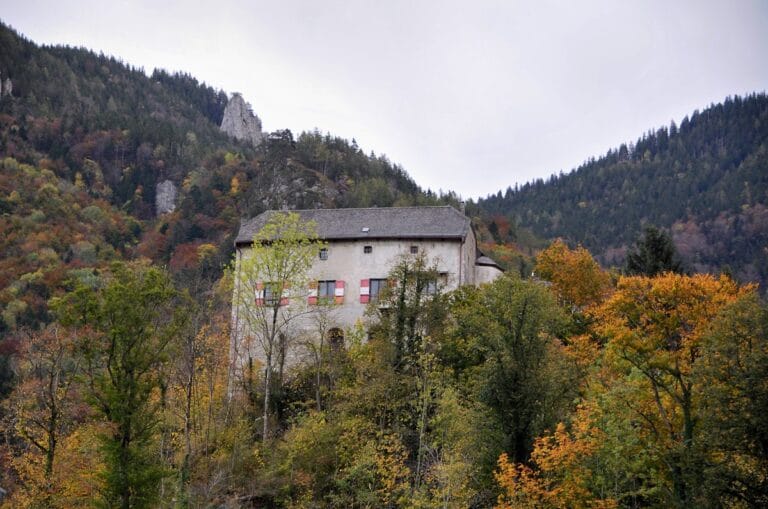
The castle stands high above the valley of the Prien. Its medieval core was a small ring castle, a fortified enclosure formed by a circuit of walls. Only limited wall remains from that phase survive. The present form was created around 1600 as a four-wing complex with a corner tower surrounding an inner courtyard. The courtyard is enclosed by arcades, a series of arches forming a passage or gallery around the court. At the same time, a garden was laid out in the former castle moat. Much of the existing castle dates from the sixteenth and seventeenth centuries.
Until the end of the nineteenth century, Wildenwart consisted mainly of the castle and its ancillary buildings, the castle inn, and the blacksmith’s estate. Most farms in Wildenwart and its surroundings were subject to the castle lordship. These buildings and dependent properties formed the settlement associated with the estate, whose surviving archaeological remains also include underground traces of the earlier castle phases and service yard.
Memorial Church and Burial Ground
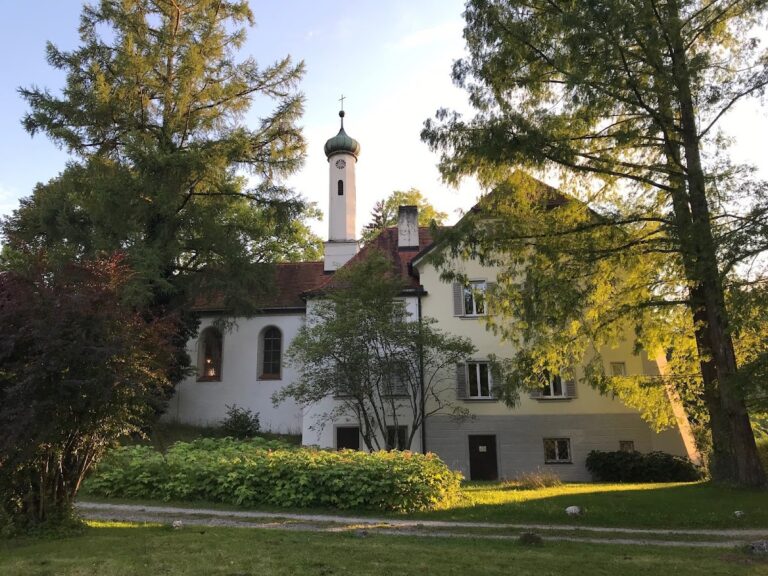
A pastoral and memorial church for Ludwig III and Queen Maria Theresa of Bavaria was built in 1933 and 1934. Its design echoes local Baroque architecture. The high altar depicts King Ludwig and Queen Maria Theresa paying homage to Christ the King. The castle chapel was used in 1921 to lay out the royal couple before their transfer to Munich.
A cemetery associated with the village was established in 1952. Together with the memorial church and the castle chapel, it forms part of the later religious and commemorative features connected with Wildenwart and the Bavarian royal family.
Documentary and Archaeological Evidence
The Village Museum of Frasdorf preserves numerous finds, images, and written materials concerning the Wildenwart estate and the Bavarian royal family. These materials complement the surviving castle complex and the archaeological remains beneath and around it, preserving evidence for the site’s medieval beginnings, its early-modern development, and its later role as a Wittelsbach residence.