Frauenchiemsee Convent: A Benedictine Abbey on Fraueninsel


Site at a Glance
- Rating
- 4.6
- Popularity
- Medium
- Country
- Germany
- Primary era
- Medieval
- External website
- Open
- Eras represented
- Medieval, Early Modern
- Civilizations
- Carolingian, Duchy of Bavaria, Holy Roman Empire
- Site type
- Religious
- Remains
- Monastery
On this page14 sections
History
Frauenchiemsee convent is a Benedictine women’s abbey on Fraueninsel in Lake Chiemsee, Germany, founded in the late eighth century during the Carolingian period. Local tradition attributes its foundation to Tassilo III, the last Agilolfing duke of Bavaria, and his wife Liutberga. The convent and its church were consecrated on 1 September 782, a date once considered too early but now supported by historical and archaeological investigations. The abbey belongs to the Archdiocese of Munich and Freising.
Foundation and Carolingian connections
After Tassilo was deposed in 788, Bavaria came under the direct control of the Carolingian rulers. Frauenchiemsee was probably transformed into an imperial abbey, a monastery directly associated with the ruler rather than subject to an ordinary territorial lord. Around 857, King Louis the German, who also ruled Bavaria from 826, appointed his daughter Irmingard as abbess.
Medieval references to a Chiemsee convent do not always distinguish Frauenchiemsee from the neighbouring abbey of Herrenchiemsee. After Irmingard came to be venerated as a blessed abbess, pilgrimage to her tomb was probably encouraged. Her association with the convent helped preserve the memory of its early Carolingian history.
Fires, jurisdiction, and medieval survival
The convent buildings were destroyed by fire in the early tenth century. Internal tradition connects the event with a Hungarian raid in 907, and the monastery is also described as suffering during the Hungarian incursions. A further major fire, archaeologically attested, occurred around 1300 and led to extensive renovation. Later fires are recorded in 1491 and 1572.
Frauenchiemsee was transferred to the Archdiocese of Salzburg in 1062, losing its status as an imperial abbey, but the change was reversed in 1077. It returned to Salzburg in 1201. In 1254, the Bavarian dukes acquired the protective jurisdiction known as the Vogtei, a secular lord’s authority to safeguard and administer a religious institution. The abbey retained the title “Royal Foundation” as a remnant of its former imperial immediacy until the Bavarian secularization of 1803.
Reformation and early modern rebuilding
The convent survived the disturbances of the Reformation under Benigna Preiß, who served as administrator from 1565 to 1569, and Margareta Leitgeb, abbess of Niederschönfeld, who served from 1569 to 1575. During the Thirty Years’ War, a major European conflict from 1618 to 1648, Abbess Maria Magdalena Haidenbucher governed Frauenchiemsee from 1609 to 1650. The convent provided refuge for other Bavarian women’s convents affected by the war.
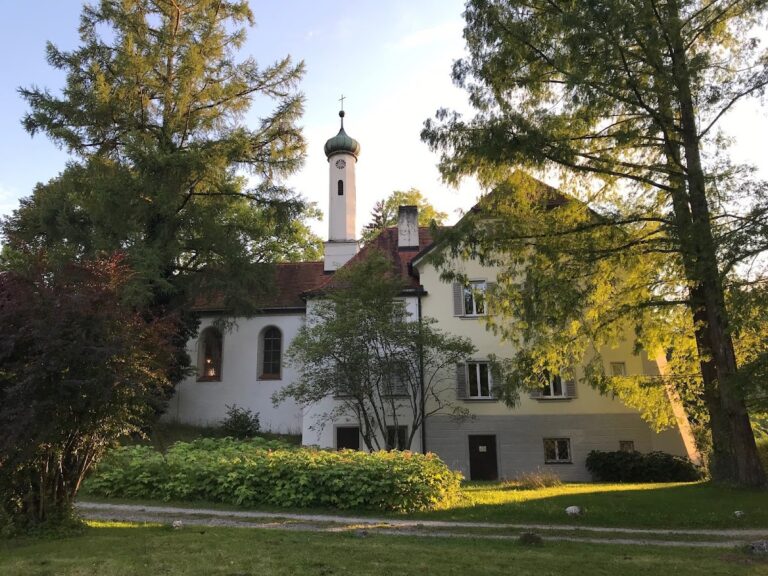
Abbess Irmengard II von Scharfstedt directed a complete rebuilding of the convent buildings between 1721 and 1730. The church and the Carolingian gate hall were the only major structures to remain from the earlier complex. The convent was administered as a priory from 1801 until its dissolution in 1803 and again from 1837 until 1901. In 1901 it was raised once more to abbey status.
Suppression, restoration, and education
The Bavarian secularization of 1803 dissolved the convent, but the existing community of nuns continued. Since no buyer could be found for the buildings, the nuns were allowed to remain. King Ludwig I of Bavaria re-established the convent in 1836 on the condition that the Benedictine nuns open schools.
From 1837, the nuns provided girls’ education. Their work included the Irmengard Gymnasium, which offered boarding facilities until 1982, and from 1983 the Irmengard vocational school, formerly a preparatory seminary for women’s social professions. The nuns operated the vocational school until 1995, and the convent also functions as an educational center.
After the suppression, the Carolingian gate hall served for a time as a school for island inhabitants and, during the second half of the nineteenth century, as a studio for Chiemsee painters. Its Carolingian date was recognized in 1961, after which the building was restored. The convent’s long institutional history therefore continued through religious life, education, and the preservation of its early architectural fabric.
Remains
The surviving complex brings together an eleventh-century Romanesque church, a free-standing medieval bell tower, the Carolingian gate hall, and eighteenth-century convent buildings. Romanesque architecture is characterized by massive masonry and rounded forms, while later Gothic and Baroque additions altered the church’s interior. Excavations have clarified the earlier arrangement of the monastery, whose first buildings stood north of the church on the site of the present cemetery before probably being moved to the south side in the eleventh century.
Church and bell tower
Church of the Presentation of Mary
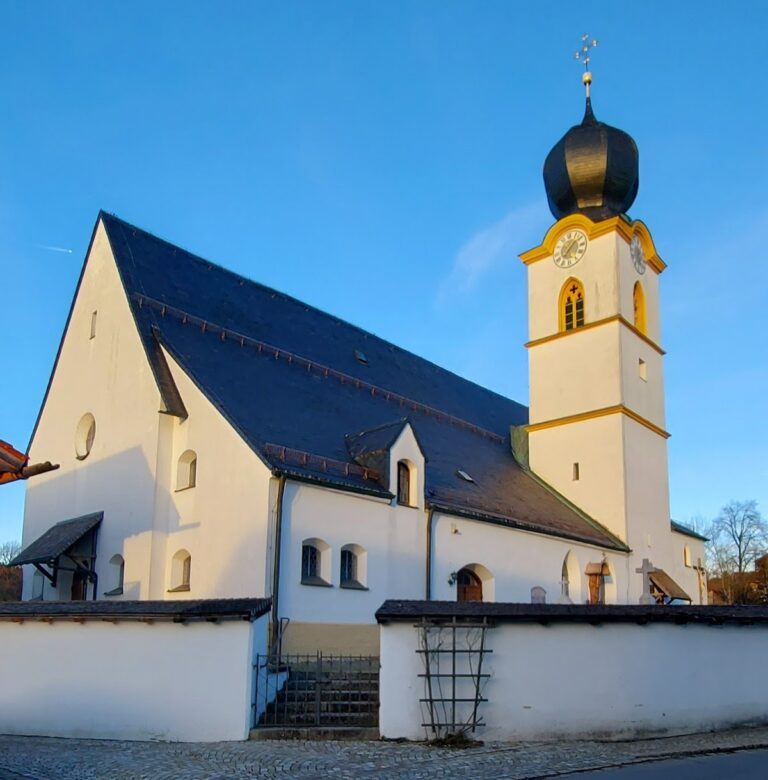
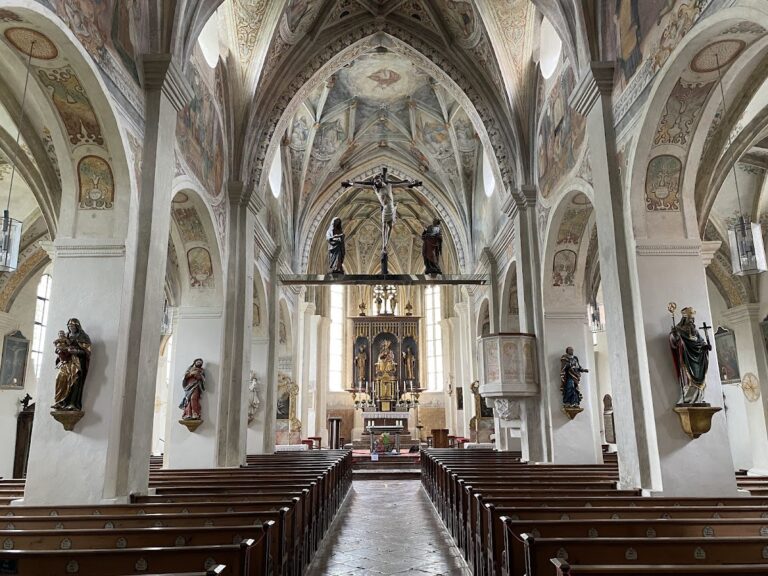
The Church of the Presentation of Mary is an eleventh-century Romanesque building erected on the foundations of a single-nave Carolingian predecessor. It was newly built in a three-nave form and has largely retained that configuration. Its later history is visible in the combination of architectural periods: the vaults are Gothic, a net-rib vault was inserted between 1468 and 1476, and the altar furnishings are Baroque.
Between 1688 and 1702, the church received altar retables that remain preserved. Romanesque frescoes were discovered in 1954 on the high walls of the sanctuary. These paintings, together with the surviving structure and later furnishings, reveal the successive phases through which the church developed.
Free-standing bell tower
The free-standing bell tower stands northwest of the church and probably originated in the twelfth century. It is regarded as a landmark of the Chiemgau. Its onion dome dates from 1626, giving the medieval tower a clearly later upper termination.
Carolingian gate hall
Passage and Saint Nicholas chapel
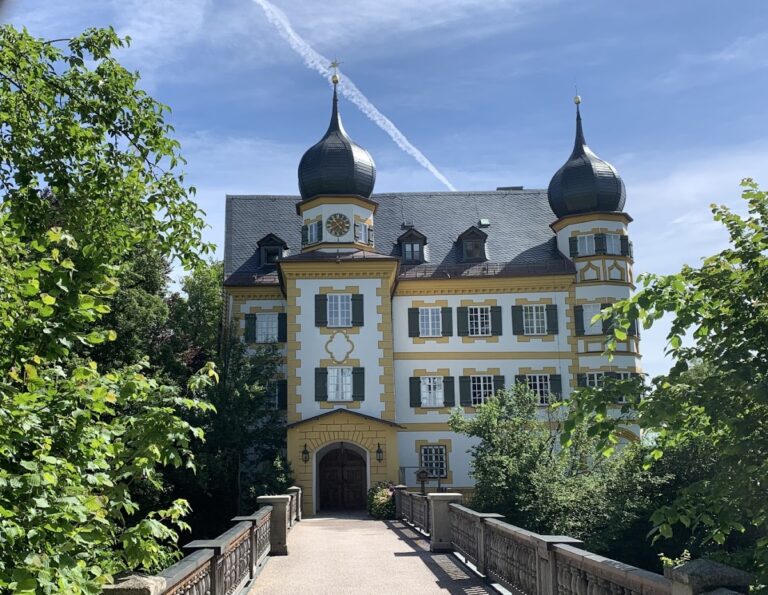
The surviving Carolingian gate hall formed part of the original monastery complex associated with Tassilo’s foundation. Its ground floor contains a central passage into the convent. From the eleventh century, the eastern part of this level also contained a chapel dedicated to Saint Nicholas of Myra.
Representative upper room
The upper floor contains a representative room that originally had an expensive imported stone pavement from the Mediterranean region. It served as a representative building for the monastery’s founder. Its exact purpose remains uncertain, although it may have been used for the administration of justice by the Bavarian duke or his representative.
Archangel chapel
A smaller room beside the representative upper room contained a chapel. Five partially preserved paintings of archangels were found beneath later wall plaster in 1928. They date from the foundation period and display Byzantine artistic influences. The paintings were probably begun at that time but left unfinished, possibly because Tassilo was deposed only a few years after the convent’s foundation and no later financier supported their completion.
Saint Michael chapel and exhibition rooms
Probably from the High Middle Ages, the upper floor was used as a chapel dedicated to Saint Michael. It underwent several renovations and alterations into the modern period. Building-historical research in 1963 reversed these changes and established a permanent exhibition of the Bavarian Archaeological State Collection.
Nearby sites