Schloss Seisenegg: A Castle-Palace Complex in Austria


Site at a Glance
- Rating
- 4.3
- Popularity
- Very Low
- Country
- Austria
- Primary era
- Medieval
- External website
- Open
- Eras represented
- Medieval, Early Modern
- Civilizations
- Duchy of Austria, Habsburg, Holy Roman Empire
- Site type
- Domestic
- Remains
- Castle
On this page8 sections
History
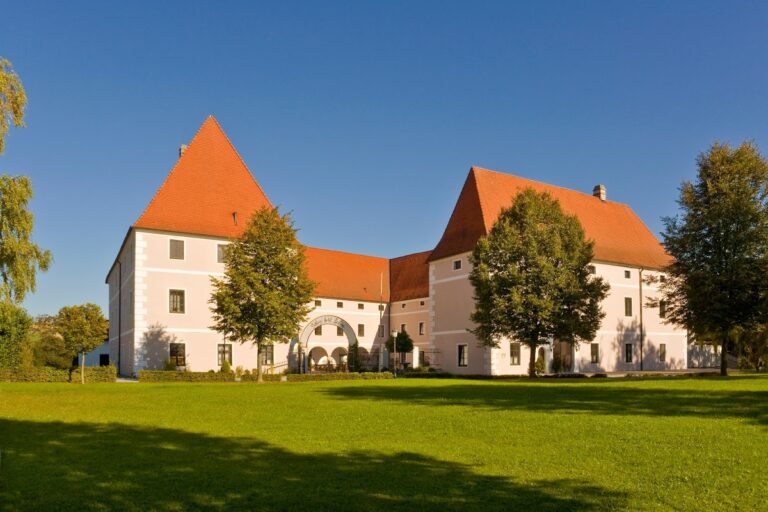
Schloss Seisenegg is a castle-palace complex in Austria, in the municipality of Viehdorf near Amstetten. Its origins lie in a double-castle complex documented from the thirteenth century, positioned at an important transport junction between the Danube and the Ybbsfeld. A Lilienfeld document from around 1267 records a man named Heinrih de Sisaneke.
The Walsee period
In 1303, the knightly Payn, or Paiger, family sold its shares in the castle to Heinrich I von Walsee. At about the same time, Konrad, the son of the outlawed Konrad von Summerau, sold the adjacent allodial castle site of Seuseneck to the Walsee family. Allodial property was land held as private hereditary property rather than as a feudal tenure.
On 25 January 1350, a division of the Walsee inheritance assigned the fortress of Sewsenekk, along with Schloss Scharnstein, estates around Enns, and other possessions, to Reinprecht I von Walsee. Together with his sons Rudolf I, Reinprecht II, and Friedrich V, he established the Walsee branch of Seuseneck. Until the family line ended in 1483, appointed custodians managed the castle and its estates on behalf of the owners. During this period, the complex was considerably enlarged, including the powerful keep and the two-storey chapel with its extensive fresco cycle.
Later noble owners
In 1483, the heiress Barbara von Wallsee brought Seisenegg to the counts of Schaunberg. Andreas “Krobath,” Knight of Lappitz, became lord in 1499, after having served as the castle’s custodian from 1484. His grandson, the jurist Ulrich von Lappitz, was lord of Weitenegg, Leiben, and Seisenegg until his death in 1531.
Christoph von Schallenberg married Margaretha Marusch Lappitz von Seisenegg in 1588. He became regent of the Lower Austrian lands in 1594 and commander of the Danube fleet in 1595. In 1598, Johann Linsmayer, a Vienna jurist and councillor in the imperial financial administration, acquired Seisenegg Castle. He entered the hereditary nobility as Edler von Greiffenberg in 1602 and received the title of baron in 1608.
From medieval fortress to residential palace
During the seventeenth century, the medieval castle was transformed into a more residential palace. Through the poet Catharina Regina von Greiffenberg, and through its connection with Schallaburg near Melk, Seisenegg became an important centre of Protestant culture in Lower Austria and a setting for Baroque aristocratic culture. Catharina Regina von Greiffenberg was a German-language Baroque poet whose literary and religious activity was closely associated with the complex.
The Imperial barons of Risenfels owned the castle from the seventeenth into the twentieth century. Melanie von Risenfels, who lived from 1898 to 1984, was married to Archduke Franz Salvator of Austria-Tuscany. A collapse disaster in 1923 damaged the medieval upper castle and parts of the Renaissance structure. These sections then deteriorated gradually, although the complex continued to be inhabited.
Restoration and present ownership
Restoration of the castle-palace ensemble began under Thomas Wassibauer in 1991 and continued from 2005 under Maximilian Mautner Markhof. Since 2005, the privately owned complex has housed a cultural centre and a registry office, as well as providing a setting for concerts and weddings. Most parts of the architectural ensemble are protected as historic monuments, while its constituent buildings are held by different owners.
Remains
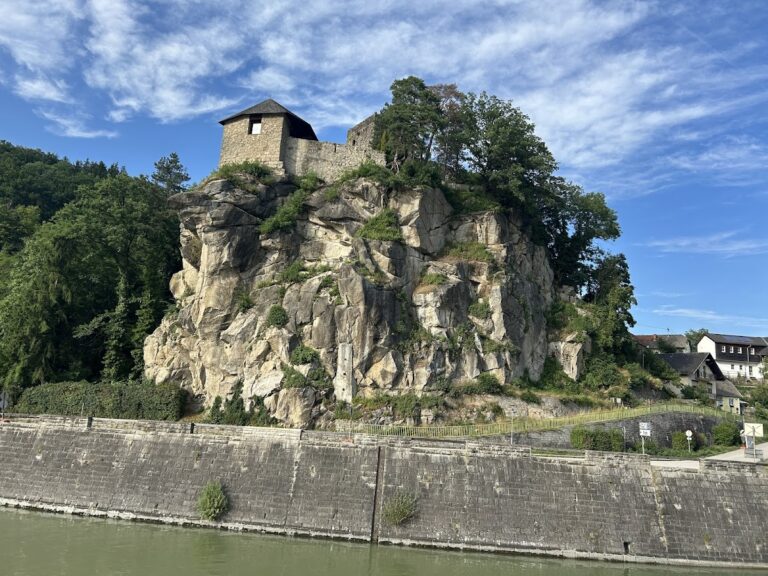
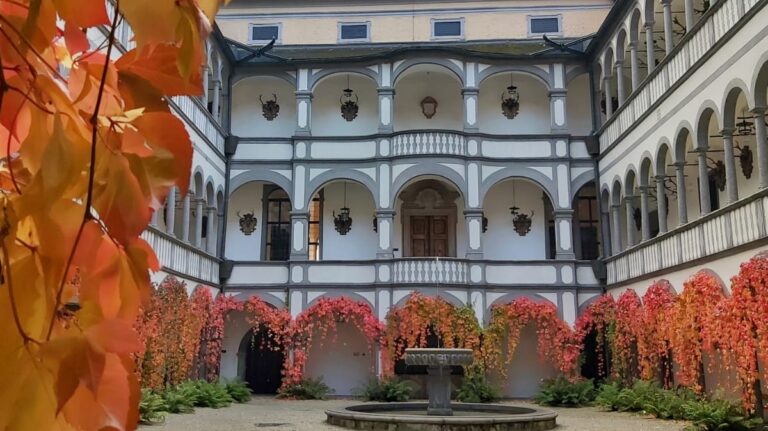
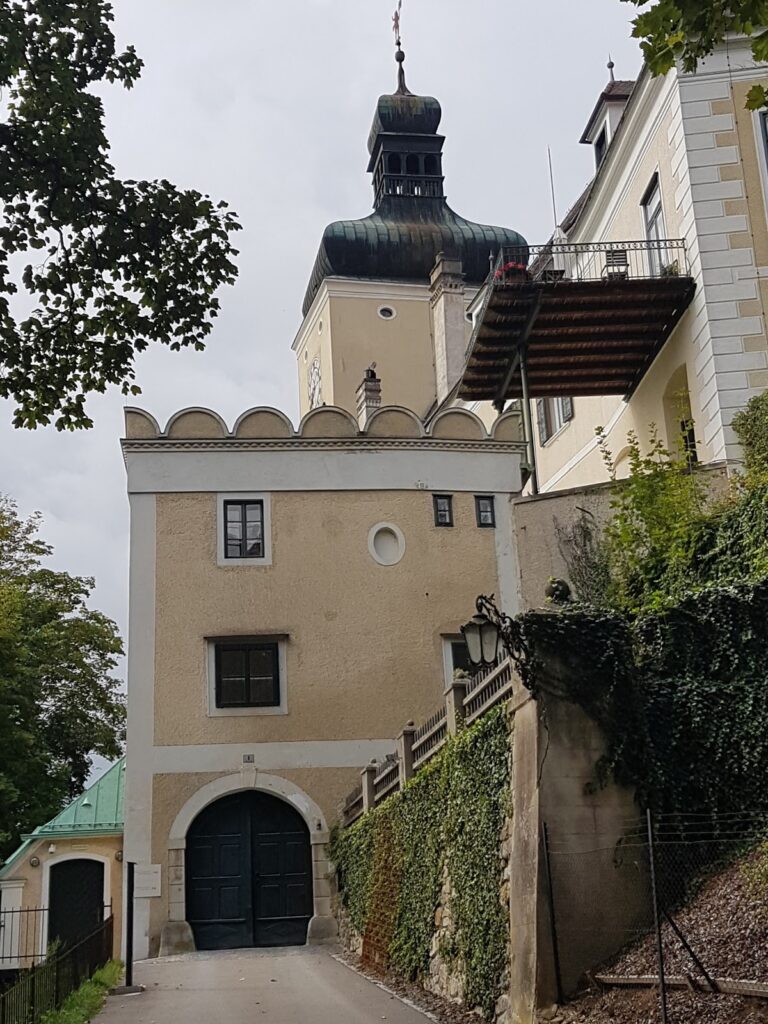
Schloss Seisenegg occupies a narrow rocky ridge. The site originated as a double-castle complex and is classified as a castle-palace, combining defensive elements with residential and representative functions. Its historic ensemble included the castle-palace, the manorial Meierhof, a granary, a press house, the Gräfenstöckl former guesthouse, and the castle tavern. Together, these buildings formed an economic unit. The renovated complex is approached and viewed from its southeast, west, northeast, and northwest sides, with a gate on the south side.
Castle-palace and chapel
The medieval expansion is represented by the powerful keep and the two-storey castle chapel, which was decorated with an extensive fresco cycle. The medieval upper castle and sections of the Renaissance building were damaged in the 1923 collapse and subsequently entered a period of gradual decay. Restoration has returned the castle-palace ensemble to use, while the surviving buildings preserve elements from its medieval defensive phase and later residential transformation.
Manorial and agricultural buildings
The Meierhof, or manor’s agricultural and administrative farm complex, belonged to the historic economic group surrounding Seisenegg. The Gräfenstöckl, formerly a guesthouse, the castle tavern, the granary, and the press house were also architecturally associated with the castle-palace. A granary stored agricultural produce, while a press house contained equipment for pressing grapes or other produce. These buildings remain connected to the architectural identity of Seisenegg, although the ensemble’s individual components now have different owners.
Nearby sites