Greinburg: A Late-Medieval Residential Castle in Austria


Site at a Glance
- Rating
- 4.6
- Popularity
- Low
- Country
- Austria
- Primary era
- Medieval
- External website
- Open
- Eras represented
- Medieval, Early Modern
- Civilizations
- Habsburg, Holy Roman Empire
- Site type
- Military
- Remains
- Castle
On this page10 sections
History
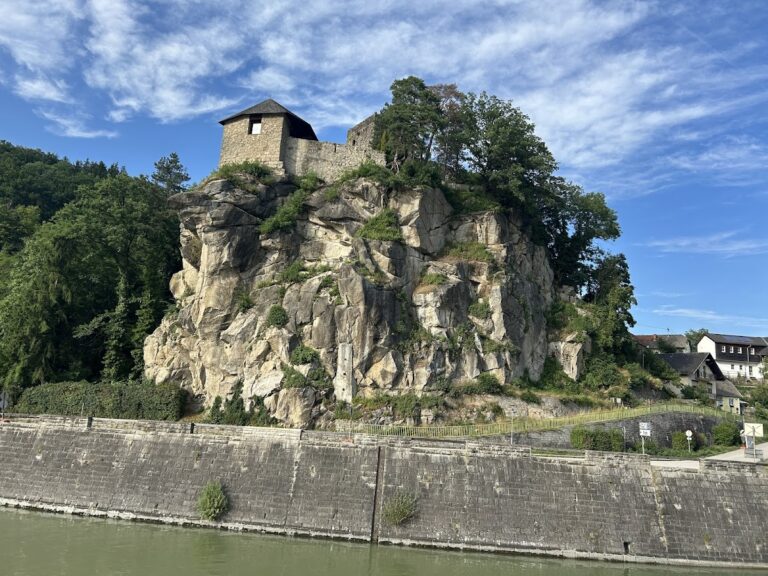
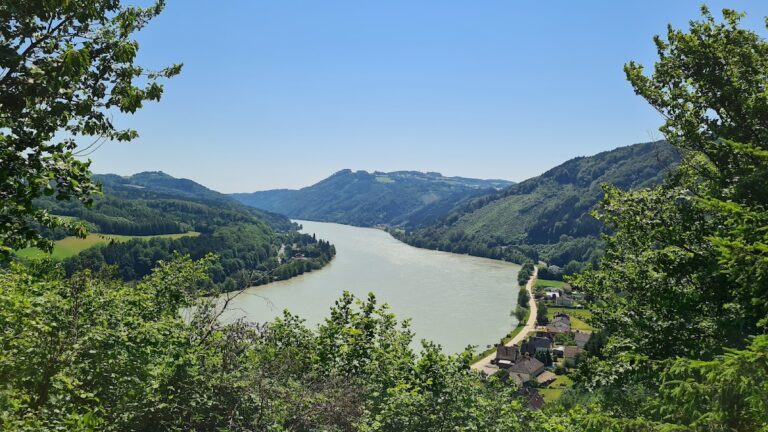
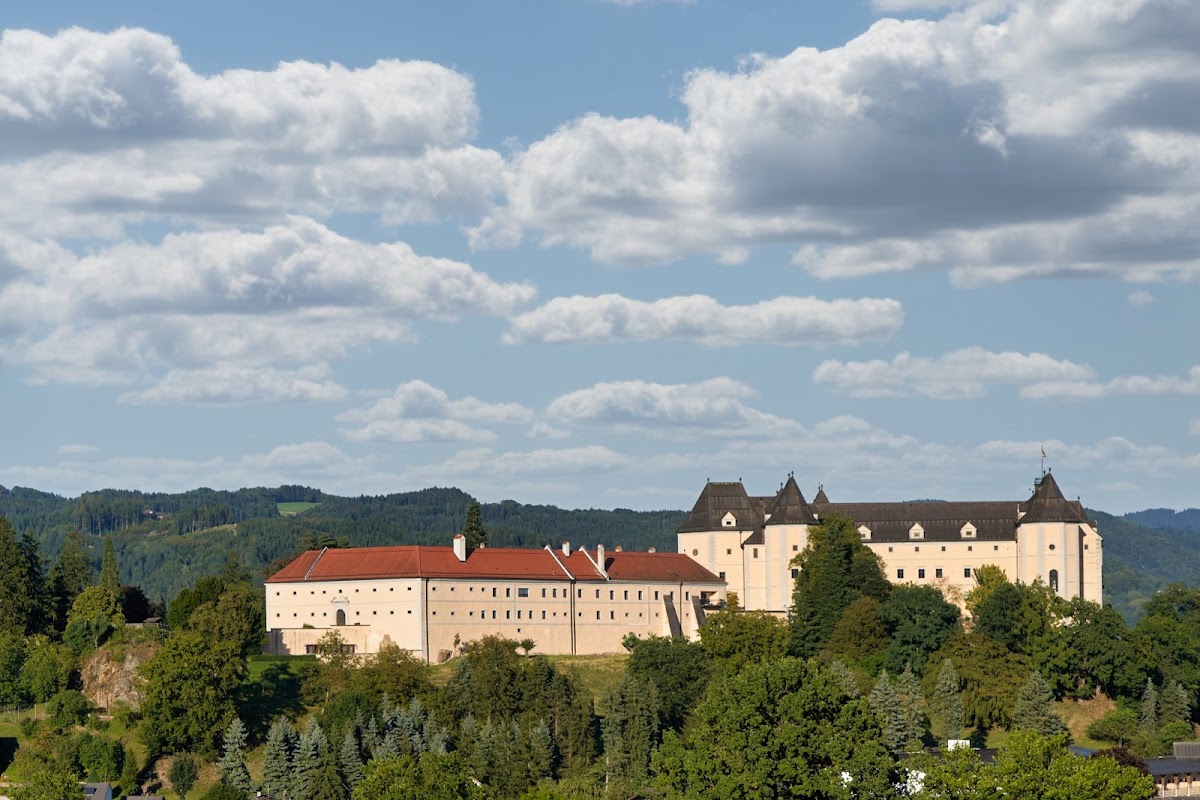
Greinburg is a late-medieval residential castle in Austria above Grein on the Danube, built between 1488 and 1493 on the steep granite rock of Hohenstein. Authorized by Emperor Frederick III, a Habsburg ruler and Holy Roman Emperor, the castle was intended to secure the Machland against incursions from Bohemia, Hungary, and Turkish forces. It is regarded as Austria’s oldest residential castle and remains a landmark of Grein.
Foundation and changing names
In 1488, Frederick III granted Heinrich and Siegmund Prüschenk, Barons of Stettenberg, permission to construct the castle. The completed complex was initially called Stettenfels, became known as Heinrichsburg in 1504, and has been called Greinburg since 1533. Around 1495, the brothers acquired the County of Hardegg and adopted the titles Counts of Hardegg and in the Machland.
Administrative centre of the Machland
Greinburg became the seat of important regional offices during the sixteenth century. In 1533, the Machland regional court was transferred from Mitterberg Castle to the lordship of Grein. The Struden administrative and judicial office followed in 1572. These changes made Grein an administrative centre for the lower Machland and the Strudengau.
Changes of ownership and Renaissance expansion
Greinburg passed to the imperial paymaster Johann Loeble in 1534. After his death on 21 May 1560, the castle came through his daughter’s marriage to Rudolf von Sprinzenstein and remained with that family until Rudolf sold it to Count Meggau in 1621. Under Count Leonhard Helfried von Meggau, the castle was enlarged in the Renaissance style, which revived classical forms and proportions in European architecture. Through Meggau’s daughter Anna and her marriage to Sigmund Ludwig von Dietrichstein, it later passed to the Dietrichstein family.
Franz Ferdinand Count of Salburg acquired Greinburg in 1709. In 1810, inheritance brought it to Josef Karl, Prince of Dietrichstein, who sold it to the military supplier Michael Fink in 1817. From that year, the lordship also included the original Maria Theresa-era privilege of log driving on the Naarn River, a system for transporting felled timber by releasing logs or rafts into a river.
The Saxe-Coburg and Gotha period
Duke Ernst I of Saxe-Coburg and Gotha acquired Greinburg and its lordship in 1823. He was succeeded by his sons Ernst II and Albert, Prince Consort of Queen Victoria. After Albert’s early death, Victoria also became a co-owner. Through Greinburg, and from 1826 through Walterskirchen Castle in Lower Austria, the House of Saxe-Coburg and Gotha held an hereditary seat in the House of Lords of the Austrian Empire until 1918. The House of Lords was the upper chamber of the Austrian Imperial Council.
Greinburg is now privately owned by the family foundation of the ducal House of Saxe-Coburg and Gotha, which finances its maintenance. Ownership rests with descendants of Victoria and Albert’s fourth son, Leopold, Duke of Albany. The current head of the house is Hubertus, Prince of Saxe-Coburg and Gotha, born in 1975. Greinburg is included among Austria’s listed heritage objects, and its historical importance also lies in the transition from medieval castle architecture to the Renaissance palace.
Wartime use and preservation
From summer 1944, a branch plant of Voigt & Haeffner operated in the castle. Between 2 and 19 February 1945, the Grein satellite camp of Mauthausen concentration camp, a branch camp administered by the major Nazi concentration camp complex in Austria, operated there for construction work in and around the castle. After the Second World War, the Soviet Army occupied Greinburg. The family foundation received it back in 1958.
The Upper Austrian Shipping Museum opened at Greinburg on 13 June 1970 with loans from the Upper Austrian State Museums. It was then the only shipping museum in Upper Austria and closed in autumn 2025. A comprehensive renovation of the castle and adjoining service building took place between 1976 and 1987. Afterward, the historic ceremonial rooms were made accessible through guided visits.
Remains
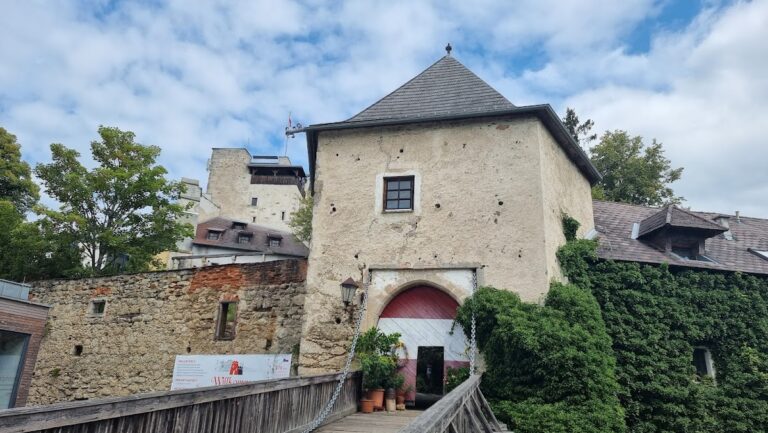
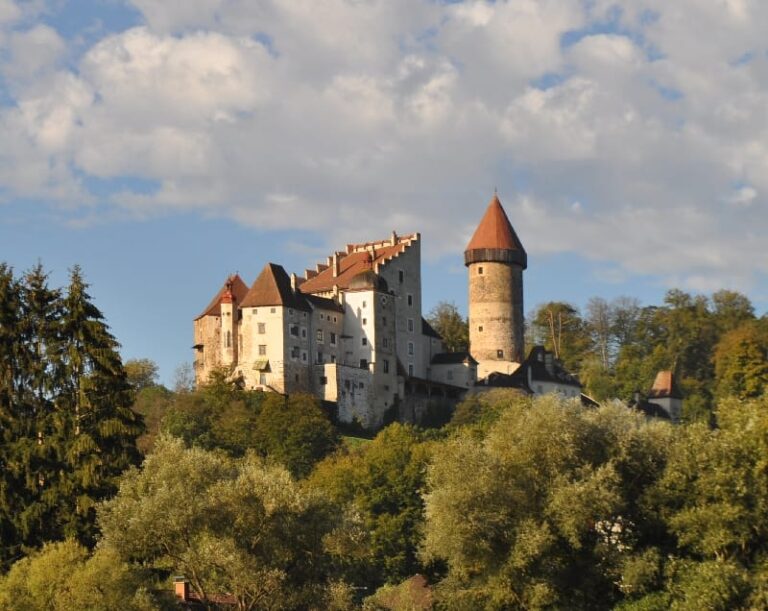
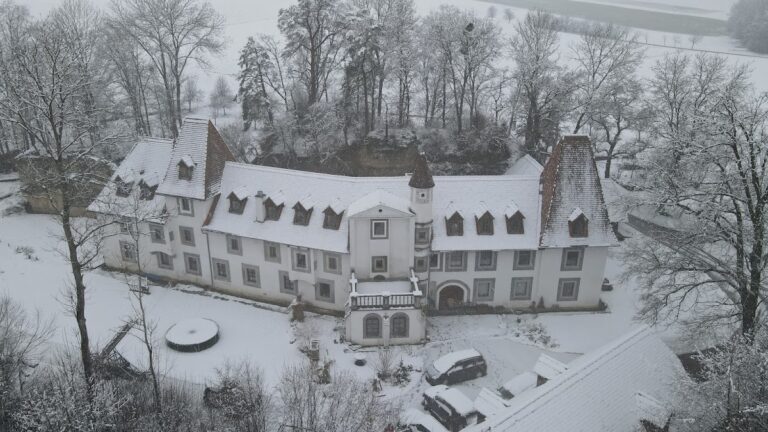
Greinburg occupies the granite rock of Hohenstein above Grein and the Danube. The complex was planned as a unified four-tower castle with an additional gate tower, a principal residential and representative building called a palas, and a chapel. Its regular ground plan is described as the first completely coherent palace plan north of the Alps to use this arrangement. The present appearance combines the late-medieval complex with alterations made during the sixteenth and seventeenth centuries.
Courtyard and ceremonial interiors
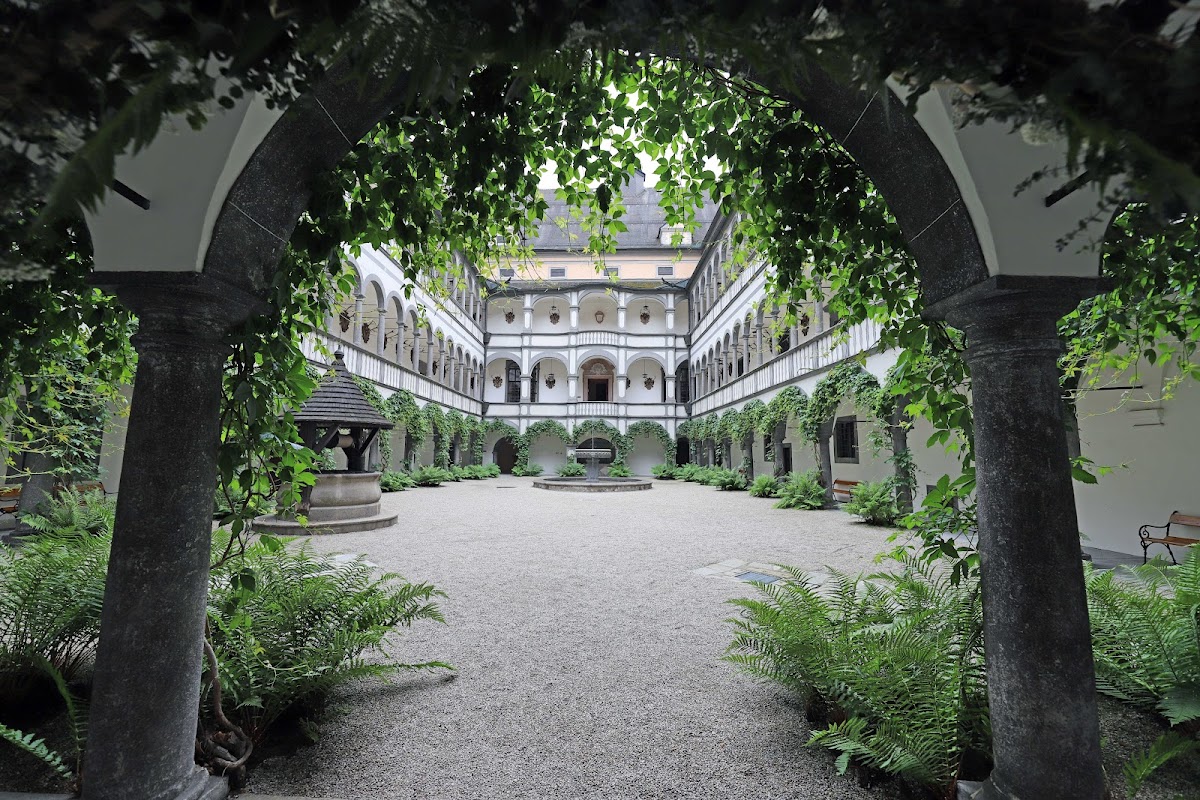
An arcaded courtyard forms part of the architectural ensemble, together with the late-Gothic Diamond Vault. Late Gothic was the later medieval Gothic style, known for complex vaulting and elaborated forms. The Great Knights’ Hall measures 30 metres in length, 16 metres in width, and 14 metres in height. The castle chapel contains an early-Baroque Christmas altar.
Sala terrena and Coburg rooms
The Sala terrena, a ground-level ceremonial hall often used for social and representational purposes, is decorated completely with pebble mosaics. On the second upper floor, the Coburg ceremonial rooms contain antique furniture and a portrait gallery from the possessions of the ducal family of Saxe-Coburg and Gotha.
Shipping museum displays
The former Upper Austrian Shipping Museum used the castle’s rooms to present the history of inland navigation on the Danube and its tributaries, including the Inn, Salzach, Enns, and Traun. Its displays included detailed models, rafts, a model of the first Danube steamer, Maria Anna, and models of historic towns in Upper Austria.
In the Danube Hall, which occupies the Small Knights’ Hall, the museum displayed a 15-metre-long model of a ship train, a connected or sequential formation of vessels used to transport goods along a river. The museum objects were loans from the Upper Austrian State Museums.
Nearby sites