Schloss Zeillern: A Moated Castle and Music Education Center in Austria


Site at a Glance
- Rating
- 4.2
- Popularity
- Low
- Country
- Austria
- Primary era
- Early Modern
- External website
- Open
- Eras represented
- Medieval, Early Modern, Modern
- Civilizations
- Habsburg, Holy Roman Empire
- Site type
- Military
- Remains
- Castle
On this page12 sections
History
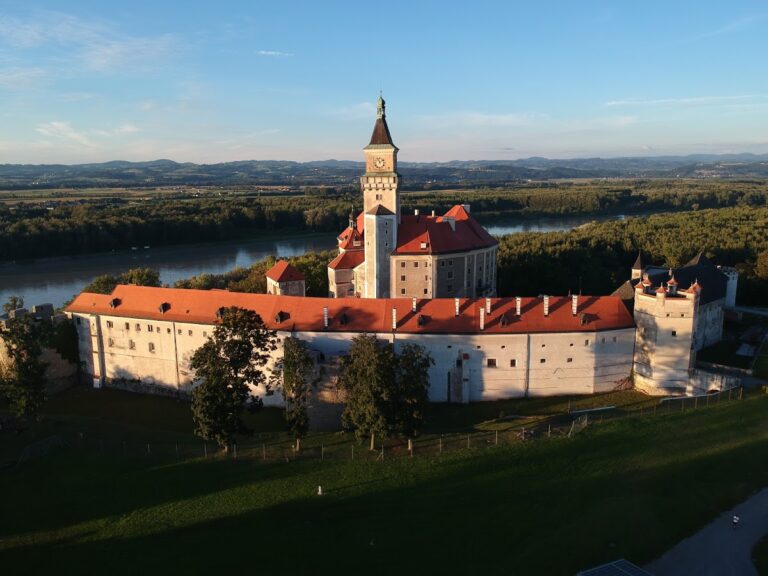
Schloss Zeillern is a medieval castle complex in Zeillern, Austria, whose history reaches back to a moated stronghold recorded in the eleventh century. The site later became a Renaissance-style residence, a refuge during Ottoman incursions into Central Europe, a convalescent home, and a center for music education.
Medieval lordship
In 863, King Louis the German, the Carolingian ruler of East Francia, donated the surrounding area to Niederaltaich Abbey, a Benedictine monastery in Bavaria. A person named Chuno von cidelaren was recorded in 1052 as possessing a moated castle on the site of the present Schloss Zeillern.
The castle belonged to the Abensperg and Traun family from 1239 to 1329. Hartnit von Traun, whose activities are documented between 1239 and 1280, is the earliest verifiable secular owner of Zeillern. After Otto the Younger von Traun died in 1329, the lordship was sold to Jans von Capell. Ulrich von Kremsdorf was recorded as lord of Zeillern in 1361, and in 1380 Duke Albert III enfeoffed Bernhard von Seisenegg with the lordship.
Renaissance transformation
Johann Baptist von Lappitz acquired the castle in 1532. Albrecht von Enenkel bought it in 1577, and Philipp Jakob von Grünthal acquired it in 1582 before enlarging the complex with two wings.
Wolf Friedrich Baron von Tattenbach purchased the castle and lordship in 1605. He remodeled the building in the Renaissance style, an architectural movement that revived classical forms and proportions, creating the appearance shown in Matthäus Merian’s 1649 engraving. During the Ottoman incursions, the military advances of the Ottoman Empire into Central Europe, the fortified complex provided refuge for the civilian population.
Conrad Balthasar Count Starhemberg acquired Zeillern in 1664. Under the Starhemberg family, the castle increasingly fell into disrepair. It later passed through several civil owners. Franz Kirchweger, the last private estate and castle owner, sold most of the associated land to local farmers.
Institutional use and renovation
In 1898, the building was acquired in equal shares by the Association of Vienna Cooperative Health Insurance Funds and the General Workers’ Health and Support Fund. It served as a convalescent and recuperation home until 1976. During both world wars, it was used as a military hospital. Soviet occupation authorities used the castle from 1945 to 1955, and extensive renovation was then required before it could return to use as a convalescent home.
In 1970, the building no longer met increased requirements and was sold to Franz Eichinger of Vienna. Eichinger sold it to the municipality of Zeillern in 1976 for three times the purchase price. From 1984, the castle underwent comprehensive renovation at the initiative of Josef Leeb, president of the Austrian Wind Music Association, with support from the Province of Lower Austria and the federal government. Since 1988, it has served as the training center of the Lower Austrian Wind Music Association.
The castle was leased in 2006 and has since operated as Schloss Hotel Zeillern. It houses the office of the Lower Austrian Wind Music Association and functions as a seminar hotel, primarily for music seminars organized by the association, the Lower Austrian music-school administration, and the Lower Austrian Jazz Academy.
In August 2023, the government of Lower Austria approved approximately 1.4 million euros in support for renovation work planned for 2023 to 2025. The project was estimated to cost approximately 8.4 million euros and included an event hall for 250 people together with new teaching and rehearsal rooms. Operations began at the end of November 2024 after the remodeling phase, with 62 hotel rooms and a restaurant area. In June 2025, Governor Johanna Mikl-Leitner officially opened the music education center and castle hotel at a formal ceremony.
Remains
Castle complex and water defenses
Four-wing complex
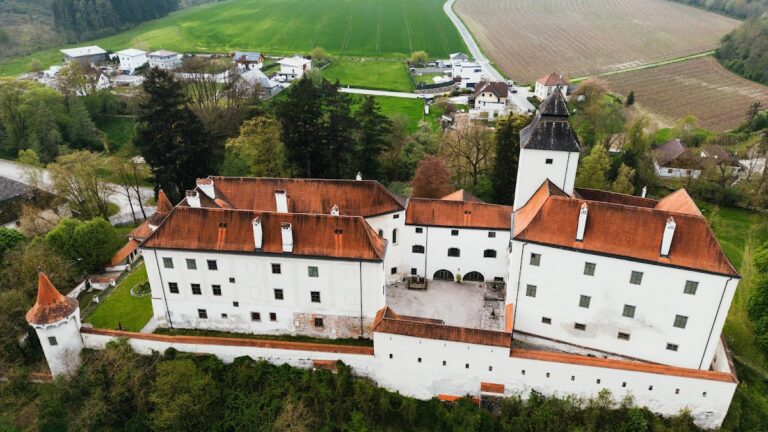
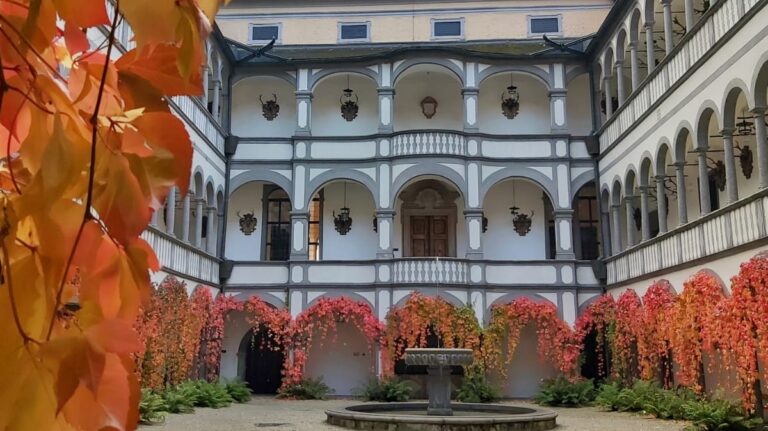
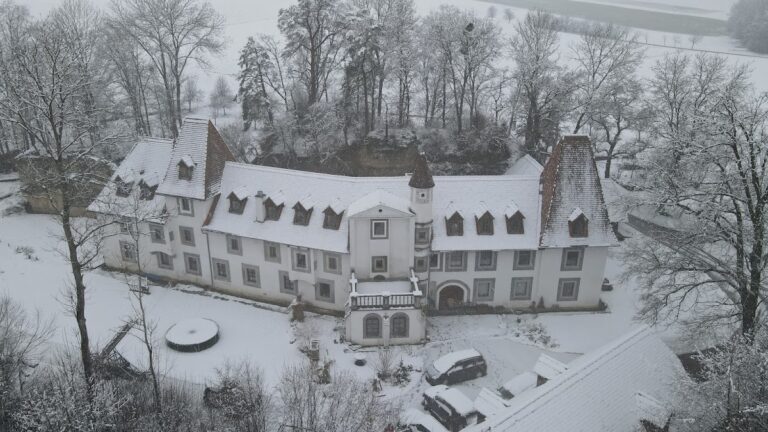
Schloss Zeillern is a two-story, four-wing complex arranged as a typical Mostviertel square-plan castle, or Vierkanter, a four-sided building group organized around an enclosed inner courtyard. Comparable forms are found at Schloss Scheibbs and Schloss Ernegg near Steinakirchen am Forst. The northwest corner was demolished during the nineteenth or twentieth century, leaving that side open toward the courtyard and the arcade passage in the east wing. The four wings carry steep hipped roofs, and the upper-story arcades were bricked up during the second half of the nineteenth century.
Gate and moats
The former moated castle originally had four moats, two of which survive. The gate still preserves the slots for the rollers of the former drawbridge, which provided the castle’s sole access. A square park adjoining the west side is surrounded by a water moat reaching up to 16 meters in width, forming an island.
Interior rooms
Festival hall
The large festival hall on the first floor of the south wing has a seventeenth-century stucco ceiling. Stucco is molded or modeled plaster used for architectural decoration. The festival hall and the rooms on the ground floor have barrel vaults, continuous curved ceilings formed by extending an arch along a room’s length. The interior layout was substantially altered when the building was converted into a seminar center.
Renaissance entrances
Renaissance-period carved doors survive inside the castle, together with stone portal surrounds finished to resemble marble. These elements preserve parts of the building’s sixteenth- and early seventeenth-century interior character.
Hunting room
The hunting room on the first floor of the north wing has a stucco ceiling dating to around 1600. Its decoration shows dogs, foxes, and hares, along with a lion placed among ornamental motifs.
Nearby sites