Palace of Archanes: A Minoan Palace and Settlement in Greece


Site at a Glance
- Rating
- 3.9
- Popularity
- Low
- Country
- Greece
- Primary era
- Bronze Age
- Eras represented
- Bronze Age
- Civilizations
- Minoan
- Site type
- Civic
- Remains
- Palace
On this page10 sections
History
The Palace of Archanes is a Minoan palace and settlement in Greece, in the town of Archanes on Crete. It was built around 1900 BC, during the period when the major Minoan palaces of the wider region were established. The original Minoan name of the complex is unknown, so its modern designation comes from the town that grew around it.
Construction and destruction
Earthquakes destroyed the palace around 1700 BC and again around 1600 BC. After each disaster, the complex was rebuilt, continuing the pattern of renewal found at major Minoan centres. A final destruction occurred around 1450 BC, although occupation probably continued until the Mycenaean post-palatial period, approximately 1200 BC. This was the phase after the mainland Greek Mycenaean palace systems had declined, when some Cretan settlements remained in use.
A wider ceremonial and funerary landscape
The palace stood in the same location as the nearby Fourni cemetery, described as the most important known Minoan cemetery to date. The wider area also included the Anemospilia sanctuary and another sanctuary on the summit of Mount Juktas. Together, these places show that Archanes formed part of a landscape combining settlement, administration, burial, and religious activity.
Excavation and interpretation
Archaeological investigation began under Arthur Evans, the British archaeologist whose work at Knossos helped establish the modern study of Minoan Crete. Systematic excavations began in 1964 under Giannis Sakellarakis and Efi Sapouna, later known as Efi Sapouna-Sakellaraki.
Much of the complex lies beneath the modern town and remains covered by buildings, preventing a full excavation. For this reason, the identification of the building as a palace in the complete sense of the term has been questioned. Its large scale, palace-like architecture, and evidence for administrative, commercial, and religious functions nevertheless support its interpretation as a palace.
Remains
Layout and construction
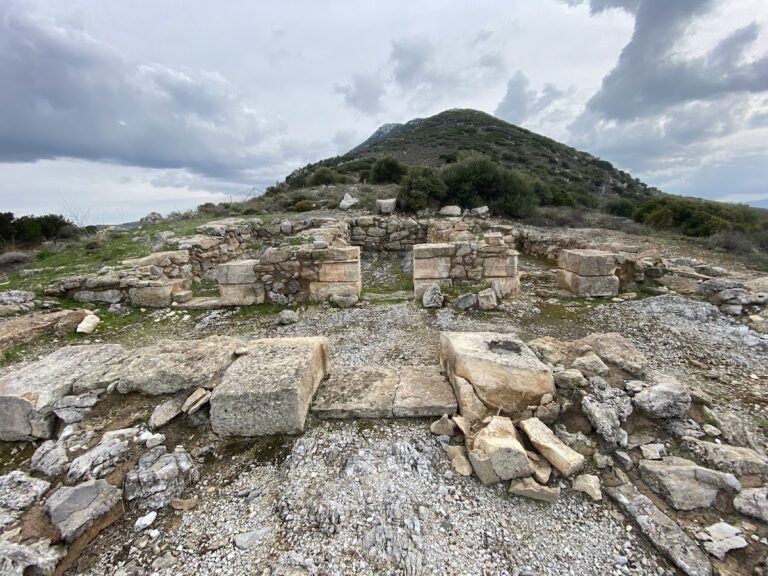
The ruins lie beneath modern Archanes, with the principal investigated area in Upper Archanes, in a district known as the Turkish Quarter. Additional remains have been identified elsewhere in the town. The complex is estimated to have been comparable in size to the palaces of Knossos and Phaistos and stood approximately 8 kilometres south of Knossos. The building probably had two levels, included a central courtyard, and was decorated with frescoes.
Excavated architectural features
Monumental entrance and rooms
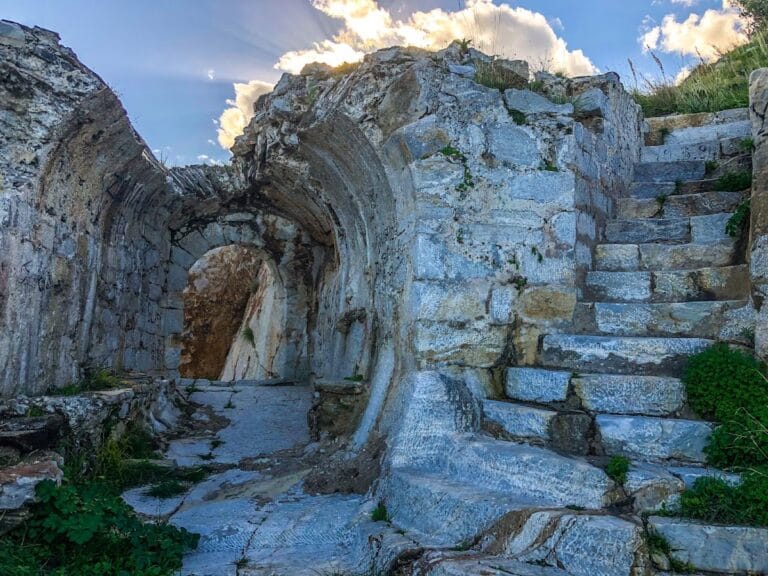
The principal excavated area includes a monumental entrance with a propylaeum, a formal entrance structure leading into a larger complex. Several rooms, staircases, and a light well reveal the organization of the palace interior. Storage areas and part of the palace walls also survive among the excavated remains.
Water and performance areas
Other identified features include water reservoirs and part of an ancient theatre. An area used to store the palace archives has also been found, adding to the evidence for administrative activity within the complex.
Finds and inscriptions
Objects recovered from the ruins include clay vessels, ritual objects, ivory figurines, and a clay model of a Minoan house. Tablets bearing inscriptions in Linear A, an undeciphered writing system used in Minoan Crete, provide further evidence of the palace’s administrative practices. Finds from the site are exhibited at the Archaeological Museum of Archanes.