Archaeological site of Archanes: A Minoan Palace Complex in Greece
Site at a Glance
- Rating
- 5
- Popularity
- Very Low
- Country
- Greece
- Primary era
- Bronze Age
- External website
- Open
- Eras represented
- Bronze Age
- Civilizations
- Minoan
- Site type
- Civic
- Remains
- Palace
On this page14 sections
History
The Archaeological site of Archanes is a Minoan palace complex in Greece, within the modern town of Archanes in central-northern Crete. The Minoans were a Bronze Age civilization centred on Crete. The palace was probably constructed around 1900 BC during the Old Palatial period, an early phase of Minoan palace construction and use, and its remains show that Archanes was an important administrative and residential centre.
The Old Palatial palace
The oldest excavated building remains in the Tourkogitonia quarter belong to the second millennium BC. Kamares-style pottery, a ceramic tradition especially associated with the earlier palatial period, indicates that the palace was established around 1900 BC. Minor alterations followed before an earthquake destroyed the building around 1700 BC. It was rebuilt, but another earthquake destroyed it roughly a century later.
In 1912, the Greek archaeologist Stephanos Xanthoudides drew attention to the archaeological importance of Archanes. Arthur Evans, the British archaeologist associated with the excavation of Knossos, excavated a Minoan water basin about 40 metres northwest of the palace centre. In 1922, he recognized palatial features in the walls and proposed that Archanes had been a summer palace of the kings of Knossos. Limited investigations by Spyridon Marinatos and Nikolaos Platon later produced no notable results.
Excavation and later Minoan phases
Excavations directed from 1964 by Jannis Sakellarakis and Efi Sapouna-Sakellaraki revealed palatial buildings beneath the modern town. Their dimensions, orientation, architecture, and use of valuable building materials resembled the palaces of Knossos and Phaistos. The complex served both administrative and residential purposes.
Archanes prospered from about 1600 to 1450 BC during the Neopalatial period, the later major phase of Minoan palace use. After 1450 BC, Mycenaean rule, meaning the period when mainland Greek political and cultural influence predominated in Crete, brought a final period of prosperity. Mycenaean remains were later found within parts of the palace that had originated in the Old Palatial period.
Archanes in its wider landscape
Archanes stands more than 300 metres above sea level in a basin east of the Giouchtas range. In ancient Greek myth, Giouchtas was regarded as the tomb of Zeus, the chief god of Greek religion and mythology. A Minoan peak sanctuary, a religious site on a mountain or hilltop, stood at Psili Korfi about 1.5 kilometres away. The cemetery of Phourni, probably associated with Archanes, lay about 950 metres north and was connected with the settlement by an ancient paved road. The Minoan sites of Anemospilia and Vathypetro lay approximately 2.5 kilometres northwest and 3 kilometres south. Archanes was just over 11 kilometres from Crete’s northern coast and 6.8 kilometres from Knossos, the presumed centre of Minoan culture.
Only a small part of the original settlement has been excavated. Much of it lies beneath the present town and cannot be investigated without demolishing existing houses. Minoan remains have also been found at four other locations in Archanes, including the church of Agios Nikolaos. Jannis Sakellarakis considered the palace complex only slightly smaller than the palace of Knossos, a view that would place it as the second-largest palace of Minoan culture.
Remains
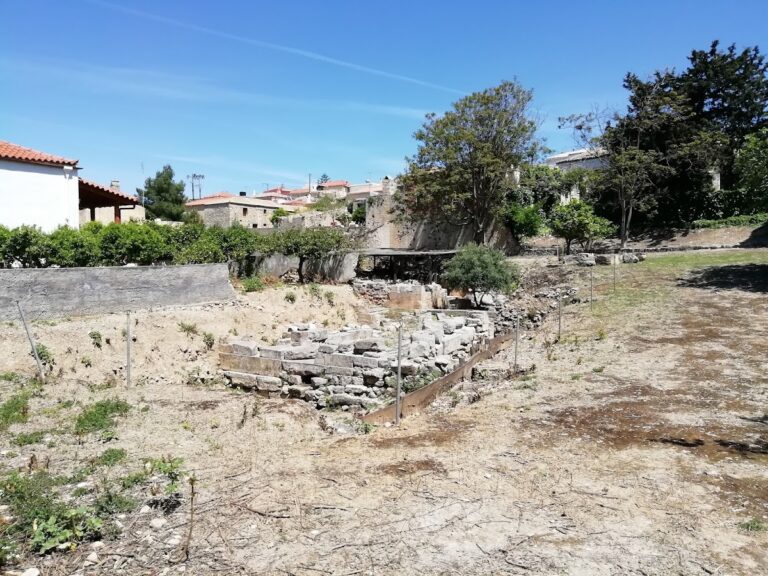
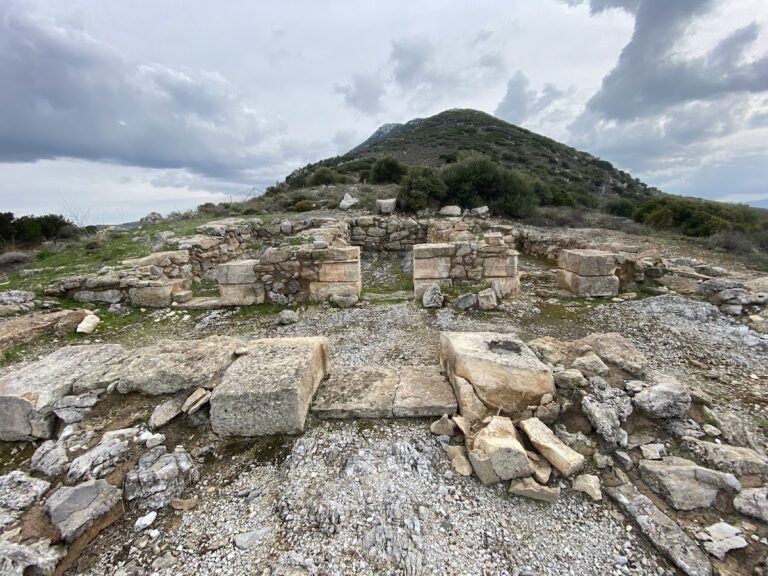
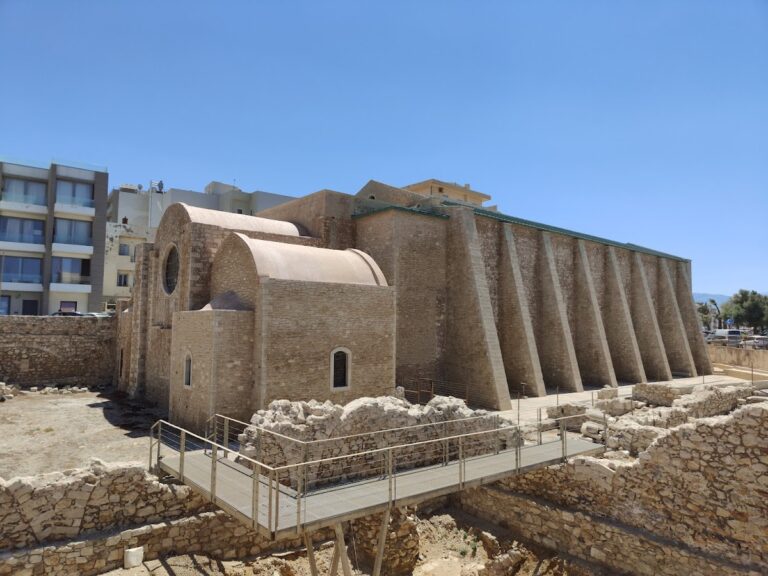
The excavated area at Tourkogitonia occupies the centre of the palace complex. It contains a monumental entrance structure, or propylon, sanctuaries, spacious halls, and staircases. Most of the exposed structures belong to the Neopalatial phase. Walls survive to approximately 2 metres in places and use ashlar masonry, carefully cut stone blocks. Their considerable thickness suggests that the building may have risen to several storeys, possibly three. Several kinds of stone were used, interior surfaces carried wall paintings, and some floors were finished with coloured mortar.
Central palace and ritual area
Courtyard and altar
The palace courtyard lay on the southeastern side of the excavated area. An entrance between two columns led to a platform with an altar. Sherds from ritual vessels and animal bones were found with a drain that ran southwest. The drain carried sacrificial blood and cleansing water, identifying this area as a place of ritual sacrifice.
Sacred and residential spaces
A room west of the entrance contained sacred equipment, including vessels and offering tables. These objects probably stood originally on an upper floor. The upper storeys of the western sector probably served residential purposes, linking domestic use with the ceremonial and administrative spaces of the palace.
Workshops and administrative evidence
Workshop rooms
The westernmost excavated areas probably contained palace workshops. Pottery wheels were found there. Another room held pottery together with unworked pieces of rock crystal, obsidian, and steatite, a soft stone often used for carved objects. These materials and tools indicate craft activity within the complex.
Palace archive
A Linear A tablet led to the interpretation that the palace archive lay in the southeastern part of the palace centre. Linear A was an undeciphered Minoan writing system, and an archive containing its tablets would have served administrative record-keeping. Mycenaean and later deposits destroyed this area, limiting the surviving evidence for its use.
Associated remains and model
Water basin
A Minoan water basin was excavated about 40 metres northwest of the palace centre. Its position provides evidence for water-related infrastructure associated with the wider palace complex.
Clay house model
A clay house model from Archanes dates to approximately 1700 to 1500 BC. It measures 23.5 centimetres in height and 31 by 29 centimetres in plan. A modern reconstruction of the model is displayed in the Archaeological Museum of Heraklion.
Nearby sites