Remplin Palace: A Baroque and Neo-Renaissance Noble Residence in Germany


Site at a Glance
- Rating
- 4.5
- Popularity
- Low
- Country
- Germany
- Primary era
- Early Modern
- External website
- Open
- Eras represented
- Early Modern, Modern
- Civilizations
- German, Holy Roman Empire
- Site type
- Domestic
- Remains
- Palace
On this page13 sections
History
Remplin Palace was a noble residence in Remplin, now part of Malchin in Mecklenburg-Vorpommern, Germany. The estate belonged to the von Hahn family by 1405, and its earliest recorded building was a Renaissance castle. In the mid-eighteenth century, the castle was expanded into a three-winged Baroque residence with an extensive garden, establishing the principal form of the estate before its later nineteenth-century transformation.
The von Hahn Estate
Count Frederick II von Hahn, one of the wealthiest men in Mecklenburg, supported scientific activity as well as the development of the estate. Around 1792, he established Mecklenburg’s first observatory on the southern edge of the park. At one point, the observatory was described as the third-largest outside Great Britain, reflecting the count’s particular interest in astronomy.
The estate later became associated with Count Carl Friedrich von Hahn, who was known as the “Theatre Count” because of his involvement with theatre and the stage. His activities left him heavily indebted, and Remplin was sold in 1816 to George William, Prince of Schaumburg-Lippe. The prince sold the palace and estate to Karl von Maltzahn in 1848.
Mecklenburg-Strelitz Ownership
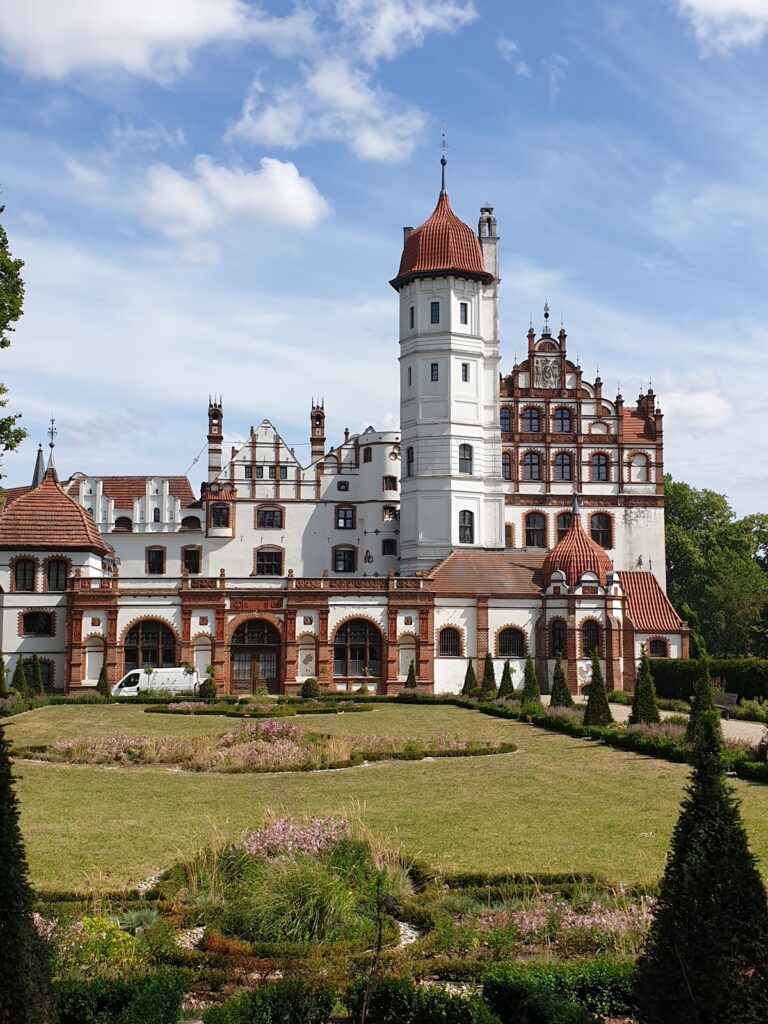
Duke George of Mecklenburg-Strelitz, the younger son of Grand Duke George, acquired Remplin in 1852 when he married the Russian Grand Duchess Catherine Mikhailovna. Although the couple lived primarily in Russia, Remplin served as their Mecklenburg residence during visits. From 1860, the estate’s 35-hectare Baroque park was reshaped as an English-style landscape park according to plans by Peter Joseph Lenné, a leading nineteenth-century German designer of formal gardens and landscape parks. From 1865, the Berlin architect Friedrich Hitzig, a pupil of Karl Friedrich Schinkel, remodelled the palace in the neo-Renaissance style.
The nineteenth-century work changed both the appearance and character of the residence. The central block gained a monumental arcaded loggia, while the garden façade received French-inspired Beaux-Arts decoration. The loggia was also described as Italianate in character. Art, furniture, and refurbishment materials were acquired mainly from Italy and France, giving the interiors an international character.
The Ducal Residence and the 1940 Fire
Duke Charles Michael of Mecklenburg-Strelitz inherited Remplin in 1894. He and his family initially used it only occasionally, maintaining their main residences in Saint Petersburg and Oranienbaum. After the Russian Revolution forced them to leave Russia and they lost their Russian properties, Remplin became their permanent residence. Family use of the palace continued into the 1920s, and Charles Michael spent his final years there from around 1930. He received guests including Emperor Wilhelm II, who visited in December 1891, and died at Remplin in 1934, unmarried, after adopting his nephew as his successor.
Duke George Alexander of Mecklenburg-Strelitz inherited the palace and estate in 1934. The National Socialist regime persecuted his family because of its dynastic connections with Russia and its political Catholicism. Under threat of expropriation, he was forced to sell most of the estate’s land and forests. By the beginning of the Second World War, the property had been reduced to the palace and approximately 30 hectares.
On the evening of 10 April 1940, the palace caught fire. The main building burned to the ground within about two hours. Contemporary newspaper reports attributed the blaze to a chimney fire, while arson connected with local Nazi Party members was suspected but never proved. Firefighters were reportedly prevented from working effectively, and the Malchin fire brigade apparently lacked the fuel needed to assist. The fire destroyed much of the family’s art collection and library, including paintings by Franz Xaver Winterhalter and François Boucher and correspondence between Johann Wolfgang von Goethe and Queen Louise of Prussia.
Expropriation and Later Ownership
After the fire, the Grand Ducal family left Remplin for Berlin. Duke George Alexander was arrested by the Gestapo, Nazi Germany’s secret state police, and imprisoned in Sachsenhausen concentration camp, an SS camp north of Berlin, until 1945. After the Second World War, the Communist authorities of the German Democratic Republic, the state established in eastern Germany, expropriated the family’s remaining property. The family moved to Sigmaringen in southwestern Germany, and the palace was never rebuilt.
The family completed a restitution process with the state in 2004 and regained ownership of land and buildings at Remplin. The surviving north wing was severely damaged, and restoration costs exceeded the family’s private resources. The palace was therefore sold at auction in March 2019.
Remains
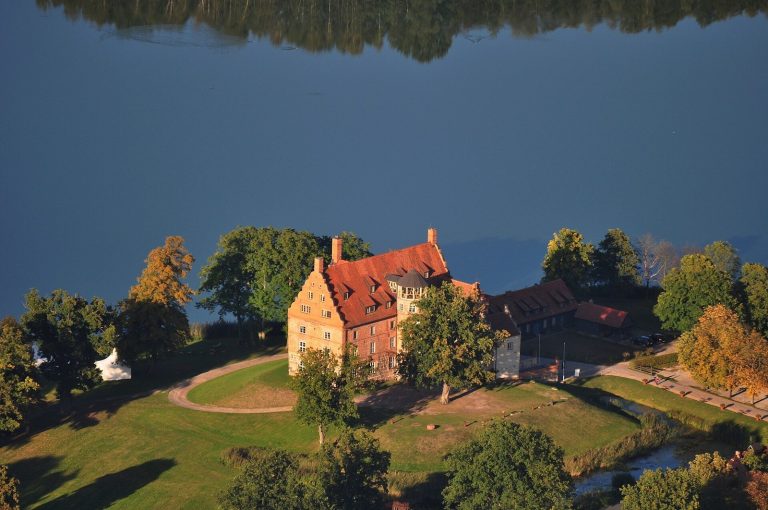
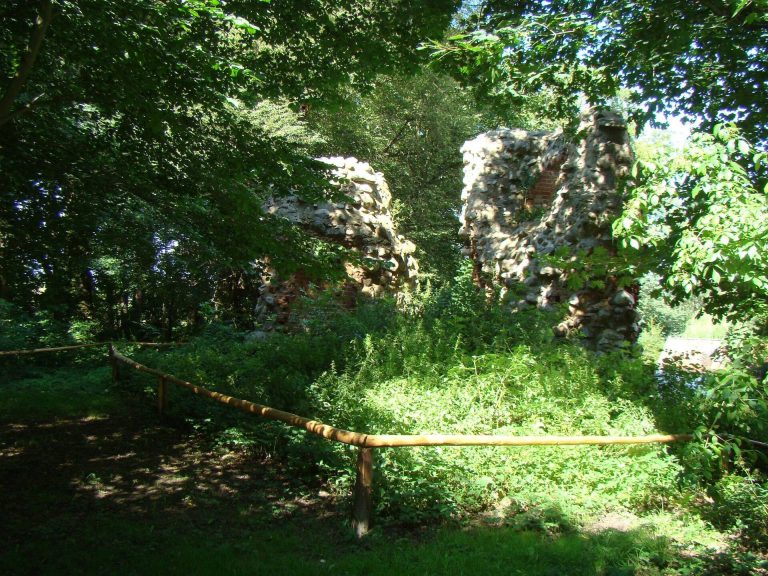
Remplin’s surviving remains combine fragments of the palace complex, estate buildings, and parts of the former park. The original Renaissance castle had become a three-winged Baroque arrangement, with a central principal block, known as the corps de logis, and two lateral wings. Nineteenth-century rebuilding gave the central block its arcaded loggia and neo-Renaissance character. The 1940 fire destroyed the main building, while the northern wing survived in severely damaged, unrestored condition.
The Palace and Its Surviving Wing
Central Palace Block
The central palace block contained the principal ceremonial and domestic rooms. Entry was through a large hall with a marble dome. A gallery furnished with pieces by André Charles Boulle, the French cabinetmaker associated with elaborate inlay using contrasting woods, metals, and tortoiseshell, connected the rooms on either side. One side held the oak room, souvenir room, and red dining room; the other contained the paintings room, music room, tea room, and yellow dining room.
The music room contained two Blüthner grand pianos, and Robert Schumann and Pyotr Ilyich Tchaikovsky performed there. The library held approximately 12,000 volumes, including some that could be traced to Count Friedrich Hahn’s collection. Three chapels served the Russian Orthodox, Roman Catholic, and Evangelical confessions represented within the Grand Ducal family. The palace also included family apartments and stables in the southern wing, while servants’ rooms, a laundry, and a garage occupied the northern wing.
Northern Wing
The northern wing is the only surviving part of the palace itself. It was saved from the fire but later remained severely damaged and unrestored. Its survival preserves part of the former three-winged arrangement, although the central building that once joined the wings no longer stands.
Park and Observatory
Landscape Park
The park covers 35 hectares and was converted from its Baroque design into an English-style landscape garden from 1860, while retaining portions of the earlier formal arrangement. Surviving elements include a lime-tree avenue approximately two hundred years old. Parts of the park have been built over, but sections of the Baroque layout remain visible and the park continues to be maintained.
Observatory Tower
An observatory tower associated with the former park observatory survives in the grounds. The tower dates from 1801 and is connected with the astronomical institution established by Count Frederick II von Hahn around 1792 on the southern edge of the park.
Estate Buildings
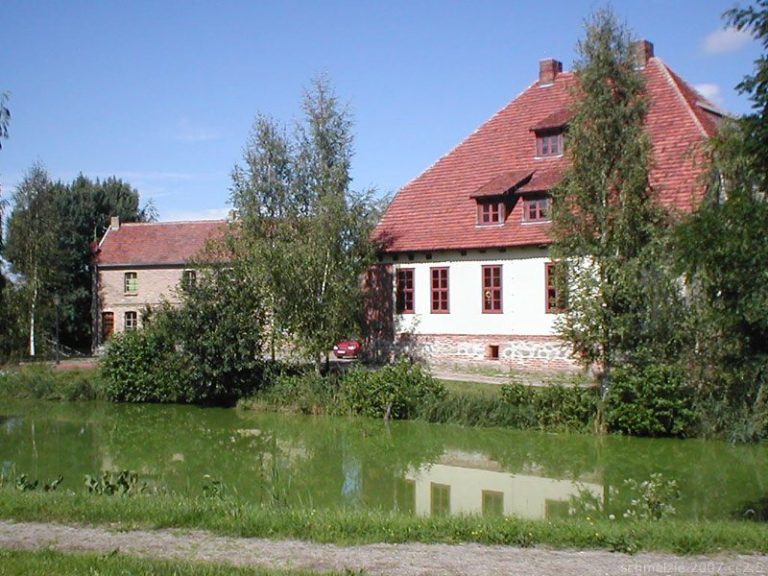
Other surviving components of the former estate include an entrance gate tower approximately 37 metres high and dating from the eighteenth century. The estate and service buildings also remain, together with the estate church and a pigeon tower. These structures preserve parts of the wider residential and working estate that surrounded the palace.