Grubenhagen Castle (Vollrathsruhe): A Medieval Lowland Castle in Germany


Site at a Glance
- Rating
- 3.6
- Popularity
- Very Low
- Country
- Germany
- Primary era
- Medieval
- Eras represented
- Medieval
- Civilizations
- Holy Roman Empire
- Site type
- Military
- Remains
- Castle
On this page9 sections
History
Grubenhagen Castle is a medieval lowland castle in Germany, in the settlement of Schloss Grubenhagen within Vollrathsruhe. The von Grube family founded it in the thirteenth century, and the complex was expanded through the fifteenth century. It later became associated with the von Maltzan family and served as the centre of an estate whose administration continued after the castle itself fell into ruin.
From the von Grube Family to the Maltzans
The von Maltzan family eventually became the castle’s lords and established an estate north of the castle. During the nineteenth century, this estate replaced the castle as the family’s manor seat. Grubenhagen was regarded as an old fief, meaning land held from a superior lord in return for obligations such as service or loyalty.
A separate genealogical line of the barons von Maltzahn developed at Grubenhagen. By 1815, a Maltzan or Moltzan-Grubenhagen line was documented. August Christoph Freiherr von Maltzahn and his first wife, Johanne von Ramin, established the House of Grubenhagen. Their descendant August Wilhelm Julius von Maltzahn later took over the estate. He served as chamberlain of Mecklenburg-Strelitz, a senior court official responsible for duties connected with the ruler’s household and administration, and as administrator of Malchow Abbey, overseeing its estates and temporal affairs.
August Wilhelm Julius’s son Curt von Maltzahn later became lord of Grubenhagen Castle. Curt was a Prussian major and was married for a second time to Luise von Bülow. Their two daughters were not entitled to inherit, so the property passed to the Maltzahn-Moltzow family line. This line also supplied the estate owners during the twentieth century.
The Estate in the Twentieth Century
Sheep farming formed a central part of the estate’s operation in northeastern Germany. In the early twentieth century, Grubenhagen included intensive livestock production, with 236 sheep and 76 cattle. The agricultural address book for 1928 gave the estate an area of approximately 352 hectares, while another description places it at about 353 hectares.
Wilhelm von Maltzahn-Moltzow, who lived from 1884 to 1931, was the owner at that time and was associated with Renate von Müller-Klein Luckow. His heir was Bernd-Wilhelm von Maltzahn, born in 1911 and killed in 1945. Bernd-Wilhelm was married to Rosemarie Schilling, and their daughter and two sons were all born at Schloss Grubenhagen. The family’s main residence ultimately became the much larger 1,316-hectare Moltzow estate. Grubenhagen Castle is now a ruin within Vollrathsruhe in the Mecklenburgische Seenplatte district of Mecklenburg-Western Pomerania.
Remains
Grubenhagen was arranged as a lowland castle within a settlement and was enclosed by a broad water-filled moat. The surviving structure is fragmentary, with the principal standing fabric belonging to the former fortified tower. Geological features of the site also preserve the outline of the castle’s main enclosures.
Fortified Tower
Former Bergfried
The most substantial surviving remains are parts of the former bergfried, the principal fortified tower of a medieval German castle, used chiefly for defence and refuge rather than as a permanent residence. Its walls remain approximately 10 metres high and 3.3 metres thick. Fieldstone and brick were used in its construction, and the fragmentary tower now forms the chief visible structural remnant of the castle.
Castle Enclosures and Moat
Inner and Outer Wards
The castle’s remaining layout can largely be reconstructed from the geological features of the site. A circular inner ward, the principal enclosed area of a castle, occupied the northwest. To its southeast lay a somewhat lower, approximately rectangular outer ward, a secondary enclosure commonly used for service, storage, agricultural, or defensive purposes.
Water-Filled Moat
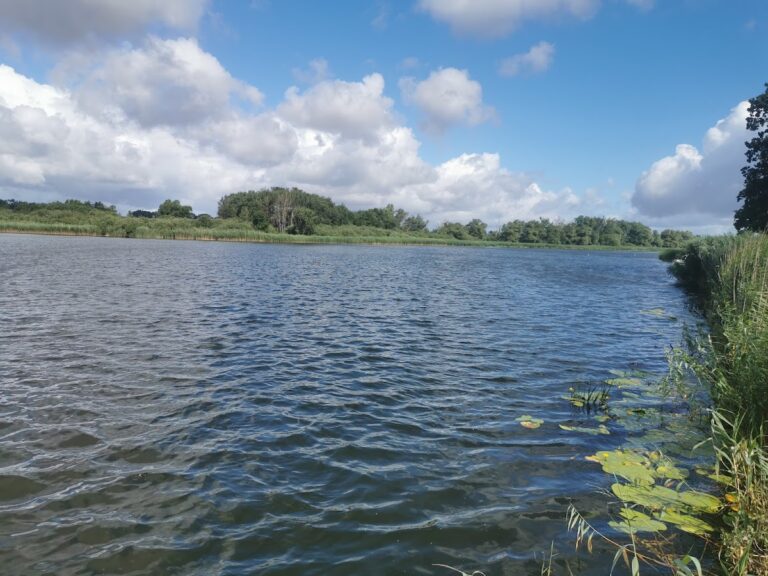
A broad moat surrounded the entire castle complex. Parts of this water-filled defensive feature survive and help define the former extent of the castle grounds.
Nearby sites