Schloss Reichenberg: A Medieval Hill Castle in Germany


Site at a Glance
- Rating
- 4.4
- Popularity
- Low
- Country
- Germany
- Primary era
- Medieval
- External website
- Open
- Eras represented
- Medieval, Early Modern, Modern
- Civilizations
- German, Holy Roman Empire
- Site type
- Military
- Remains
- Castle
On this page15 sections
History
Schloss Reichenberg is a medieval hill castle in Germany, located above Reichelsheim in the Odenwald. Its origins are associated with the Lords of Crumpach around 1150, while construction is also attributed to Johann I, Schenk of Erbach, between the mid- and late thirteenth century. The castle later became a shared possession of the Schenks of Erbach, an Odenwald noble family whose hereditary court title, Schenk, became part of its name.
Origins and the Erbach inheritance
The area around Reichelsheim passed to the Schenks of Erbach shortly after 1200. Eberhard III, Schenk of Erbach, was associated with Reichenberg in 1251. The castle appears in a document from around 8 December 1307, when Eberhard of Erbach and Eberhard Rauch of Erbach concluded a castle peace agreement there. Fourteen years later, another settlement restored peace after disputes over Reichenberg and other properties.
These conflicts followed the division of the Schenks of Erbach into two principal lines during the late thirteenth century. One line lived at Reichenberg, but the castle remained jointly owned. It became the namesake and administrative seat of the Reichenberg district office, giving the fortress an enduring role beyond its residential and defensive functions.
Expansion and family history
During the late fourteenth century, the castle was enlarged to the east and south. The expansion created an outer bailey, a secondary enclosure for service and agricultural buildings, together with a fortified approach south of the inner castle. St Michael’s Chapel was incorporated beside the gate as part of this enlarged defensive arrangement.
Schenk Eberhard X and his wife, Marie of Bickenbach, commissioned the chapel. Their son Dietrich grew up at Reichenberg and became Archbishop of Mainz and an elector in 1434. An archbishop-elector was entitled to participate in choosing the German king, who normally became Holy Roman Emperor. Another son, Philipp Schenk of Erbach, became a Benedictine abbot at the monastery of Wissembourg and died in 1467.
Siege, Reformation, and Renaissance transformation
Landgrave William of Hesse besieged Reichenberg in 1504 during the War of the Bavarian-Palatine Succession, a conflict over territorial and dynastic claims in the Holy Roman Empire. The siege was abandoned after the castle commander threatened to place the daughters of Erasmus of Erbach on the walls. Reichenberg’s defenses would not have withstood an assault using artillery and firearms, and the castle might otherwise have shared the fate of Schönberg Castle.
At the beginning of the sixteenth century, the old keep, or fortified tower, was demolished. The principal residential hall was then enlarged as the Krumme Bau. From 1531, after the Michelstadt line of the Schenks of Erbach had died out, the castle belonged to the later Imperial Count Eberhard XIII, who remodeled it in the Renaissance style. The Renaissance was a European cultural and architectural movement that revived classical forms from the fifteenth century onward.
Reichelsheim adopted the Reformation in 1543, and St Michael’s Chapel was abandoned as a place of worship soon afterward. A Croatian and French force attacked Reichenberg on 23 June 1622 during the Thirty Years’ War, the major European conflict of 1618 to 1648 involving religious, dynastic, and political struggles. The castle survived the attack. Church-register entries from 1620 onward show that many families sought refuge inside the complex during wartime.
Decline and changing uses
The castle was remodeled again in 1723, but it remained a residence only until 1731. In that year, Count Georg Wilhelm moved to the newly built Erbach Castle, and the Reichenberg line left the site. The administrative office was transferred to Reichelsheim in 1825. Although an image from 1804 shows the complex in good condition, it later deteriorated and was partly used as a source of building stone.
The former administrative building gained a new role during the nineteenth and twentieth centuries as the seat of a boys’ educational institution. Pastor Georg Anthes founded the school in 1875 and transferred it to his second-oldest son in 1894. Known as the German Family School Schloss Reichenberg, it educated sons of wealthy families from across Europe. Inflation forced its final closure in 1923.
Preservation and modern community use
Jakob Siefert of Reichelsheim bought Schloss Reichenberg in 1924 and helped prevent the Krumme Bau from falling into complete decay. He established a guesthouse in the former administrative building. The German Federal Postal Service acquired the property in 1963 and used it as a recreation home. In 1979, the Offensive Junger Christen acquired parts of the complex and converted them into an international meeting and conference center with a public castle café. Since 1994, the organization has owned the entire complex. The ecumenical community brings together Christians across denominational boundaries.
St Michael’s Chapel underwent restoration from 1982 under the sculptor and master craftsman Erich Schneider, working with a team from the Offensive Junger Christen. It was rededicated for worship in 1988, after which the community resumed regular devotions and communion services there. The historical knights’ hall in the Krumme Bau was rediscovered in 2006, restored, and inaugurated in May 2011. The complex now serves as a meeting and conference center and hosts the educational experience course Ways to Life for school classes, confirmation groups, youth and parish groups, and families.
Continuous maintenance has also produced archaeological discoveries. In 2011, building workers uncovered foundations in the eastern intermediate defensive area, or zwinger, and identified them as the castle’s sanitary tract. Excavation and reconstruction of portions of the remains provided insight into the complex’s history through the seventeenth century.
Schloss Reichenberg is also identified as the birthplace of the German physician and botanist Christian Gottfried Daniel Nees von Esenbeck, who was born there on 14 February 1776.
Remains
Defensive layout and inner castle
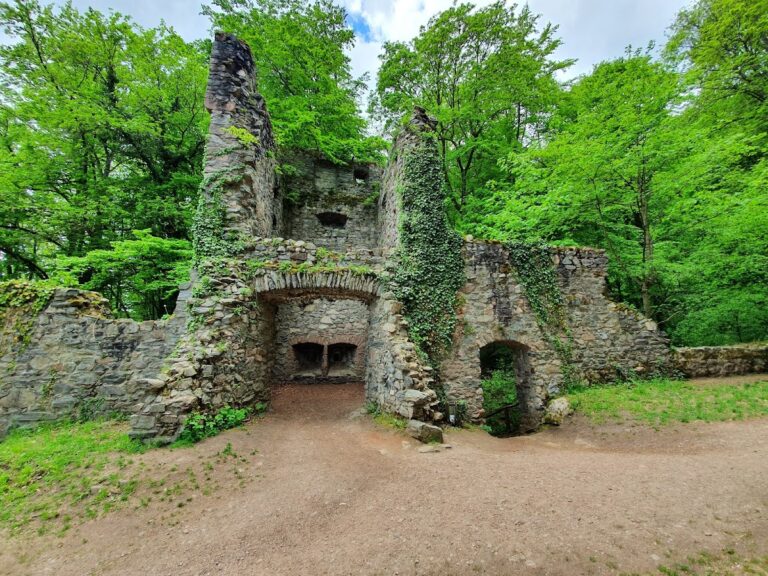
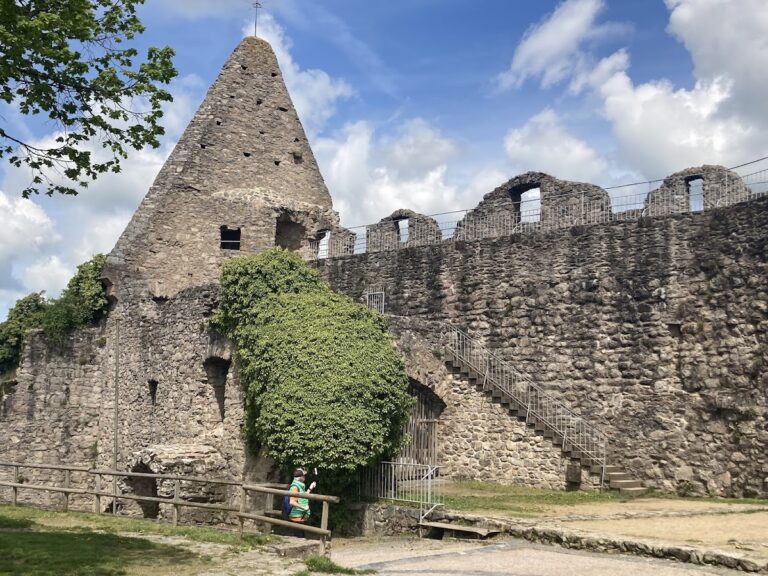
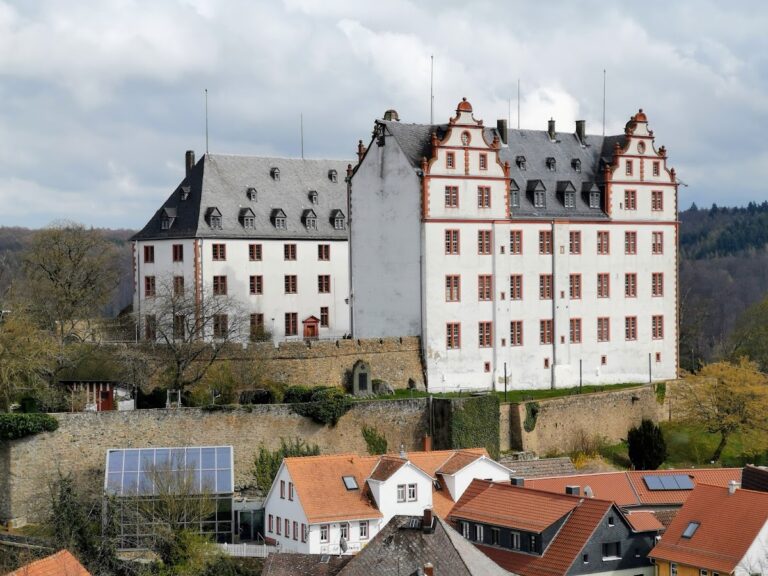
Schloss Reichenberg stands on a hill northeast of Reichelsheim, rising about 100 metres above the town and reaching approximately 311.9 metres above sea level. It is a hill castle rather than a purpose-built palace. The surviving complex is organized around an inner defensive wall, the inner castle with the Krumme Bau residential hall, an eastern outer bailey containing service and agricultural buildings, and a secured approach south of the inner castle that leads to the gate.
Krumme Bau
The Krumme Bau occupies the residential-hall part of the inner castle. It was enlarged after the old keep was demolished at the beginning of the sixteenth century and later preserved from complete ruin after Jakob Siefert purchased the property in 1924. Its historical knights’ hall, rediscovered in 2006, was restored and inaugurated in 2011.
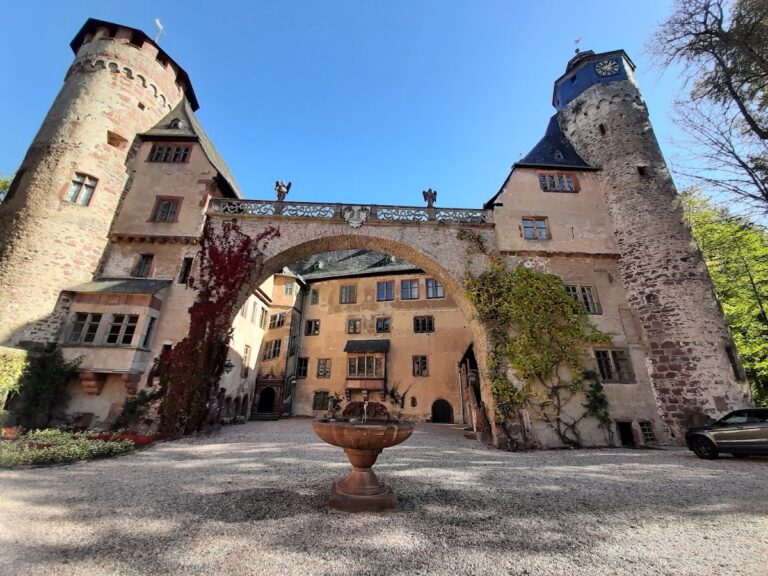
Courtyard well
A draw well in the courtyard carries the arms of the Erbach family and the Palatinate. The dates 1557 and 1567 are displayed with the heraldic carvings.
Gate chapel
St Michael’s Chapel
St Michael’s Chapel stands beside the castle gate and forms part of the outer defensive wall. Its foundations descend to solid rock. This rock may have formed part of a pre-Christian cult site, although that interpretation remains uncertain.
The chapel contains restored Gothic sandstone windows, sandstone tracery, vaulting, carved bosses, and an altar. Its chancel vault was completely destroyed and has been reconstructed. One boss shows three hares joined by three ears, a representation of the Trinity. Another depicts a pelican, an early Christian symbol of self-sacrificing love.
The restored historic structure is combined with modern interior details. Glass artist Robert Münch designed the chapel windows in 2014 around the themes of gratitude, reconciliation, love, resurrection, commandments, mission, the Heavenly Jerusalem, and Christ as the living water.
Outer bailey and archaeological remains
Eastern zwinger and sanitary tract
The eastern zwinger, a defended intermediate area between lines of fortification, contains excavated foundations identified as the castle’s sanitary tract. The finds include ordinary stoneware, Chinese porcelain, simple pottery from the Frankfurt and Hanau region with Chinese-inspired decoration, tin-glazed pottery, and broken glasses from the late seventeenth and eighteenth centuries. Wine-bottle remains, stove-tile fragments, Dutch blue-patterned tiles, and the handle of a fan add evidence of the material life of the complex.
Numerous animal bones were also recovered from the area and indicate that the castle’s feudal inhabitants consumed a protein-rich diet. The varied forms of the glass fragments reflect changing fashions from the late seventeenth and eighteenth centuries. Archaeologists reconstructed portions of the excavated remains.
Former administrative building
The former administrative building survives as part of the complex and is associated with its later educational, residential, and meeting uses. The former castle café and conference facilities are also incorporated into the present arrangement. A commemorative plaque marks the birthplace of Christian Gottfried Daniel Nees von Esenbeck.
Nearby sites