Palace in Rozdil: Historic Residence and Lanckoroński Estate


Site at a Glance
- Rating
- 4.1
- Popularity
- Low
- Country
- Ukraine
- Primary era
- Modern
- Eras represented
- Early Modern, Modern
- Civilizations
- Habsburg, Polish–Lithuanian Commonwealth
- Site type
- Domestic
- Remains
- Elite Residence
On this page9 sections
History
The Palace in Rozdil, in Ukraine, is a historic aristocratic residence whose principal masonry palace was built around 1740 in the Classical and French Neo-Renaissance traditions. Its history began with the Rzewuski family and continued under the Lanckorońskis, whose residence became known for its collections, archaeological connections, and extensive park.
The Rzewuski estate
In 1631, Stanisław Rzewuski, a Polish landowner and judge, married Anna, the heiress whose grandfather had been the first owner of Rozdół. The estate passed to Stanisław as her dowry, and he established a summer residence there. A surviving wing belongs to this earlier residence.
Around 1740, Michał Józef Rzewuski financed a new masonry palace at Rozdół. He named it Frankopol after his second wife, Franciszka of the Cetner family. The decoration involved the woodcarver Jan “Getner,” the architect Bernard Meretyn, and the painter Szymon Jaremkiewicz.
Lanckoroński ownership and remodelling
The original eighteenth-century palace was demolished at the beginning of the nineteenth century. Antoni Józef Lanckoroński subsequently built a Classical residence on the site. The Lanckoroński family had inherited the estate from the Rzewuskis and retained it until 1939.
Karol Lanckoroński remodelled the residence between 1874 and 1908 in the French Neo-Renaissance style, a nineteenth-century revival based on Renaissance architectural forms. A later reconstruction project was undertaken by the Lviv architect Julian Oktawian Zachariewicz, and the French architect Charles Baujeu worked on the palace in 1904.
Karol Lanckoroński was a collector and patron of archaeology who financed and personally joined expeditions to Turkey and Greece. Following the 1884 expedition, he installed ancient sculptures at Rozdil. He and his family spent about half of each year at the estate, where Karol regularly celebrated his birthday. The palace was also Karolina Lanckorońska’s favourite residence.
War, dispersal, and institutional change
In September 1914, shortly before the front reached Rozdil, local inhabitants looted the palace. Part of the library and other objects disappeared. Before the Second World War, Antoni Lanckoroński moved the most valuable possessions to the family palace in Vienna, while in 1929 Karol transferred part of his collection, chiefly the photographic archive, to the Polish Scientific Library in Krakow.
The palace had also housed a Turkish tent associated by tradition with Colonel Michał Florian Rzewuski, described as a hero of the Battle of Vienna. The Lanckorońskis later donated the tent to Wawel in Krakow. After the Second World War, remaining valuables were removed from present-day Ukraine or dispersed among museums, including the Hermitage, the Odesa Archaeological Museum, the Drohobych Historical Museum, and the collections at Olesko Castle. Much of the Lanckoroński family documentation is held in the Central State Historical Archive in Lviv.
After Soviet rule was established, the palace became an orphanage and later a branch of a sanatorium associated with Morshyn. During the second half of the twentieth century, the Rozdil Sanatorium treated digestive diseases and substantially altered the building’s interior. It operated until 2004, when a private company acquired the property at auction.
Recent ownership and protection
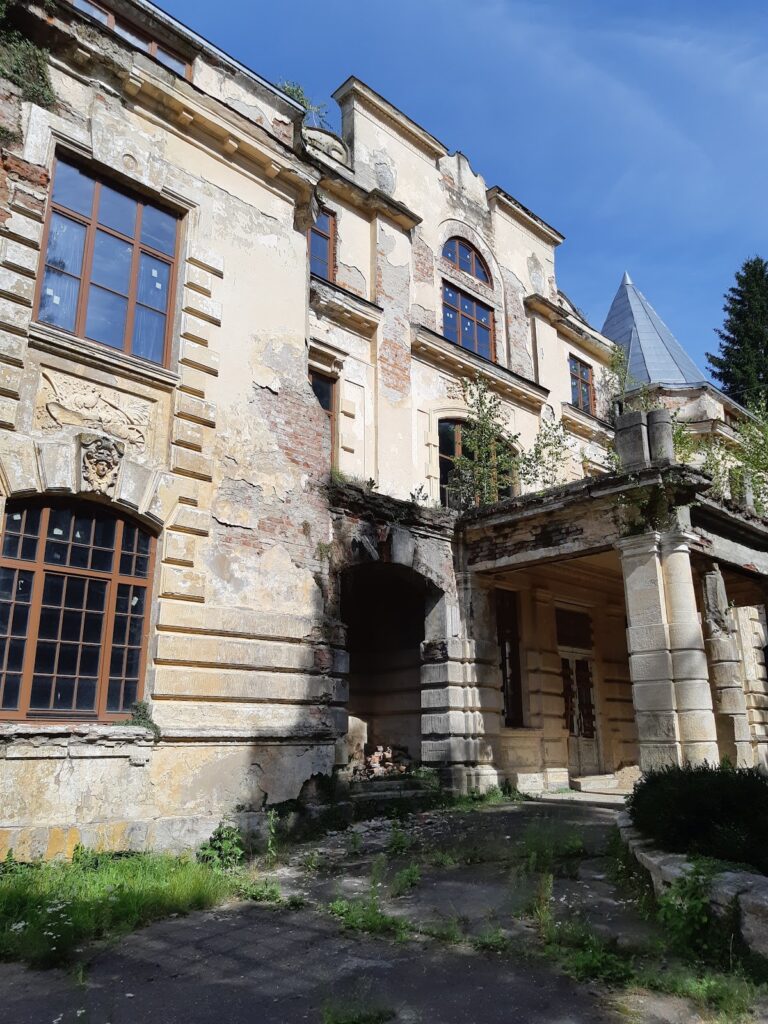
In 2017, the Supreme Court decided that the palace should be returned to the state. By June 2018, the building was in an extremely neglected and partly ruined condition. In 2022, management passed to the State Property Fund, which conducted privatization proceedings in 2023. EFI Group acquired the property at the June 2023 privatization auction, after which public consultations and an expert process considered its future use.
The Palace in Rozdil is recognized as a monument of local architectural significance in Ukraine. Its surrounding park forms part of Ukraine’s nature-conservation fund.
Remains
The surviving complex combines a palace shaped by Classical and French Neo-Renaissance work with an outbuilding linked to the main building by a semicircular connector. The grounds include a park of more than seven hectares, while the building retains evidence of aristocratic residence, collecting, and its later conversion to institutional use.
Palace and surviving interiors
The earlier Rzewuski summer residence is represented by a surviving wing. The later palace was constructed in masonry and remodelled over several phases. Its main building is connected to an outbuilding by a semicircular passage, forming the principal architectural arrangement that survives within the complex.
The residence once contained ancient sculptures, Renaissance paintings, antique furniture, Oriental carpets, Western tapestries, weapons, porcelain, and a library of about 20,000 volumes. Some books dated from the fourteenth century. The family archive included letters from King Stanisław August and Tadeusz Kościuszko, the Polish national hero.
Another part of the collection consisted of approximately 120,000 photographs of Renaissance artworks in museums and private collections around the world. The photographs could help trace artworks that were later permanently lost. Two ancient sculptures remained through the postwar dispersal of the palace’s contents.
Park and technical installations
A park was established around the palace, and its planting may have begun as early as the beginning of the eighteenth century. Under Karol Lanckoroński, it was enriched with rare or exotic plants, including Chinese dawn redwood, ginkgo, Japanese redbud, Weymouth pines, and rare varieties of common oak. Four greenhouses served the cultivation of exotic plants.
By the end of the nineteenth century, the palace had its own water supply. It later received electric lighting produced by Siemens & Halske, a telephone, and other contemporary technical installations.
Sanatorium alterations and surviving sculpture
The conversion to a sanatorium changed the internal plan. Partitions created additional rooms and hospital wards, while door portals were added or blocked and the staircases were altered. In one hall, the staircase leading downward was completely removed, leaving the interior fabric shaped by the building’s medical use.
A tradition concerns a putto with a dolphin, a putto being a small child figure used in European art as a decorative or allegorical motif. The figure was allegedly found at a scrap-metal collection point after being handed in for 24 hryvnias. The same tradition attributes its casting to a teacher of Leonardo da Vinci, but this attribution remains a legend rather than an established fact.