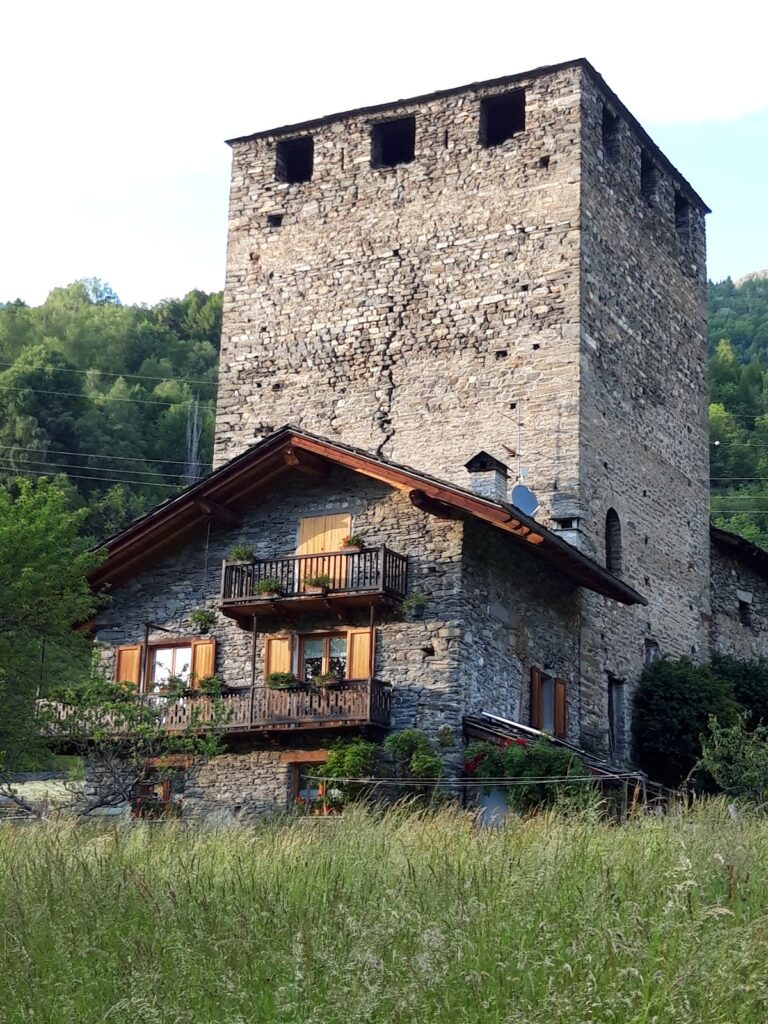
Saint-Michel-du-Lac Castle: A Medieval Fortress at the Entrance to the Chamonix Valley


Site at a Glance
- Rating
- 4.3
- Popularity
- Very Low
- Country
- France
- Primary era
- Medieval
- External website
- Open
- Eras represented
- Medieval
- Civilizations
- Unclassified
- Site type
- Military
- Remains
- Castle
On this page10 sections
History
Saint-Michel-du-Lac Castle is a medieval fortified castle in France, at Les Houches above the former commune of Servoz. Built in the thirteenth century, it stood at the entrance to the Chamonix Valley and formed part of the Faucigny lordship, a medieval territory in the upper Arve and Chamonix valleys.
The Fief and the Castle
The first recorded mention of the site dates to 26 October 1289. Richard de Villette, prior of Chamonix, granted Béatrice de Faucigny the mollard du Lac promontory, including its existing and future buildings, as a fief. A fief was property granted by a superior lord in return for recognized obligations and allegiance. Béatrice acknowledged the authority of the priory of Chamonix over the valley and its inhabitants, while the priory remained under the protection of the lord of Faucigny.
The agreement received confirmation on 26 March 1290 from Raymond, abbot of Saint-Michel-de-la-Cluse. The earlier document shows that the promontory was already occupied and contained buildings. It probably included a fortification that could offer refuge to local people during danger. Béatrice later had a fortified castle constructed there for strategic purposes, especially to protect the priory and control the entrance to the valley. The castle took the name Saint-Michel in honor of Chamonix’s patron saint.
Rival Jurisdictions
Saint-Michel developed within a long rivalry between the counts of Geneva and the lords of Faucigny over the protection of the priory and control of the valley. Servoz and the villages of Bouchet and Mont belonged ecclesiastically to the parish of Lac, which depended on the priory of Chamonix, while the Faucigny lords held temporal authority.
The castle also overlooked routes connecting Passy and Saint-Gervais with Les Houches through the Forclaz-du-Prarion pass. The Faucigny lords controlled this route from Montjoie Castle. Guard duty at Saint-Michel was assigned to the castellan of Montjoie, an official responsible for military and administrative matters from a castle-based territorial district. This office did not give him jurisdiction over the village of Lac. The first recorded castellan came from the Chissé family of Sallanches.
Conflict between local inhabitants and the priory began in 1289 and ended in 1292 with a renewed statement of the priory’s authority. Disputes between the prior and the castellan resumed in 1300. Arbitration favored the prior, and in 1302 the bailiff of Faucigny reminded the castellan that his duty was to protect the priory and its property.
Administrative Reorganization and Savoyard Rule
In 1302, Saint-Michel became the seat of a separate Faucigny châtellenie, or mandement, a territorial administrative district governed from a castle by a castellan. It had been detached from Montjoie and was one of the smallest such districts in the region, while its position continued to give it strategic value.
A confirmation agreement of 1319 names the castle as castrum Sancti Michaelis de Lacu. The agreement was made between Guillaume de Villette, prior of Chamonix, and Hugues, Dauphin of Viennois and lord of Faucigny. The Dauphin of Viennois ruled the Dauphiné, a principality in southeastern France, and Hugues also held Faucigny as Béatrice’s grandson.
An inquiry in 1339 counted 101 households in the châtellenie, including 35 under noble authority. The district was later reunited with Montjoie and remained joined to it until 1355. That year, the Treaty of Paris transferred Faucigny to the counts of Savoy. The castle was ceded to Humbert de Chissé, and the incorporation of Faucigny into the Savoyard states brought Saint-Michel’s strategic role to an end.
Return to the Priory and Later Memory
On 2 May 1435, a transaction between the prior of Chamonix, Humbert de Chissé, and Jacques de Crescherel, the last castellan, transferred the castle back to the priory. Responsibility for guarding the valley passed to the duke of Savoy.
Later tradition connected the ruined fortress with satanic cults, hidden treasure, and monsters. One story tells of two brothers who searched for treasure. According to the legend, only one returned, driven mad and speaking of a demon. The site also attracted celebrated visitors, including Horace-Bénédict de Saussure, François-René de Chateaubriand, Alphonse de Lamartine, and Victor Hugo.
In Fragment d’un voyage aux Alpes, Hugo described the ruined walls, fragments of towers, pointed openings, deep fissures, and an overgrown moat and approach. He wrote of ivy covering the places once occupied by drawbridges and iron portcullises, while presenting the fortress through local tradition as the former citadel of the legendary figures Aymon and Gérold.
Remains
Promontory and Layout
The castle occupied a high, solid rocky promontory upstream from Servoz, on the left bank of the Arve. From this position it overlooked the entrance to the Chamonix Valley. The site lies beside the railway connecting Saint-Gervais-les-Bains and Le Fayet with the Chamonix Valley. Its approach was difficult and dangerous. The fortress itself was small and rectangular, measuring approximately 30 by 13.20 metres, and contained two storeys. The principal entrance stood on the northwestern side.
The landscape below the rock has also changed over time. Around the second century AD, a lake lay beneath the promontory. It later became the marsh known as Les Rosières.
Walls and Towers
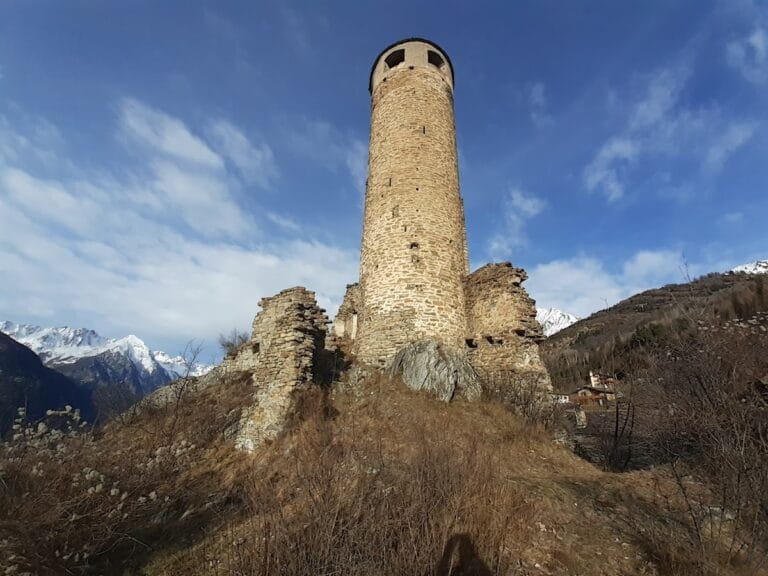
Southern Round Tower
A round tower stood on the southern side of the castle. It measured approximately 14 metres and had a diameter of 9 metres, with walls 2.63 metres thick. The surviving tower remains form part of the fragmentary defensive structure that once occupied the promontory.
Wall Fragments and Entrances
Only sections of dismantled walls and remains of towers survive. Descriptions of the ruins include narrow pointed openings and large cracks. The moat and approach were partly obstructed by holly, broom, brambles, and other vegetation. Ivy covered areas formerly occupied by the drawbridges and iron portcullises, preserving the outlines of parts of the castle’s defensive access.