Fachsenfeld Castle: A Renaissance Residence and Cultural Museum in Germany


Site at a Glance
- Rating
- 4.6
- Popularity
- Low
- Country
- Germany
- Primary era
- Modern
- External website
- Open
- Eras represented
- Early Modern, Modern
- Civilizations
- German, Holy Roman Empire
- Site type
- Domestic
- Remains
- Castle
On this page16 sections
History
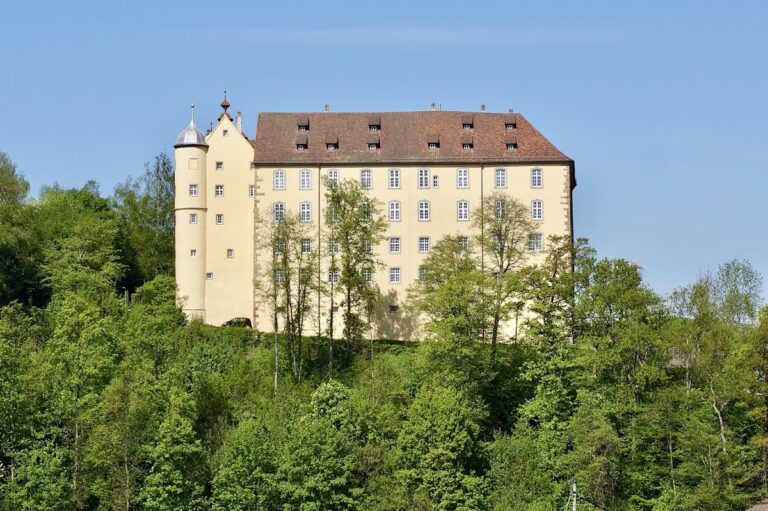
Fachsenfeld Castle is a sixteenth-century Renaissance castle in Aalen, Germany, later remodeled and enlarged as a classical country house. Fachsenfeld was first mentioned in 1230, when Heinrich von Fachsenfeld appeared as a retainer of the Hohenstaufen, the medieval dynasty that supplied several kings and emperors of the Holy Roman Empire. After the Hohenstaufen period, the settlement passed to the Counts of Oettingen and then, in 1401, to the Woellwarth-Laubach family.
From rural house to Renaissance castle
Georg Sigmund von Woellwarth commissioned a substantial building at Fachsenfeld in 1540. It began as a large rural residence rather than a castle. Around 1567, his son Hans Sigmund von Woellwarth transformed it into a Renaissance castle, a building shaped by the period’s renewed use of classical forms, ordered proportions, and restrained decoration.
Hans Sigmund introduced the Reformation, the movement that challenged established Catholic institutions and practices, within his lordship in 1569. In 1591 he founded the parish church at Fachsenfeld. His epitaph is set into the church’s northern nave wall.
War, destruction, and rebuilding
The Thirty Years’ War, a European conflict from 1618 to 1648 involving religious, dynastic, and political struggles, brought severe disruption to the estate. In 1634, Kaspar von Woellwarth lost Fachsenfeld Castle because he supported Swedish forces invading German territory. By imperial order, Johann Kaspar von Stadion occupied the property. He was the Grand and German Master of the Teutonic Order, a medieval German religious and military order whose senior offices included these titles.
Kaspar von Woellwarth recovered the castle in 1638, but the building had been severely devastated. A fire at Christmas in 1699 caused further destruction. The castle was rebuilt in a simplified form during the late seventeenth and early eighteenth centuries, with the reconstruction completed no later than 1710.
The Koenig-Fachsenfeld estate
In 1813, Heinrich Wilhelm von Woellwarth transferred the estate to his son-in-law Karl von Varnbüler, who later became Württemberg’s finance minister. Varnbüler’s daughter Sofie Ernestine married the Stuttgart legal councillor Wilhelm von Koenig in 1826. Wilhelm acquired the castle from his father-in-law the following year.
The Koenig family retained Fachsenfeld for almost 170 years. Its members later adopted the name Koenig-Fachsenfeld to distinguish their branch from the related Koenig-Warthausen line. During their ownership, the castle became a center of German art and culture. The former Renaissance residence was remodeled as a classical country house influenced by Italian country houses and set within an English landscape garden, a designed park intended to appear naturalistic through lawns, trees, water, and composed views.
Wilhelm von Koenig-Warthausen repaired the deteriorating main building between 1829 and 1831. From 1837, a new agricultural and service building replaced the former barn. After 1839, Wilhelm rebuilt and enlarged the castle, adding new rooms and extending the building. The exterior and interior work was complete by 1859.
Collections, technology, and the foundation
Wilhelm’s son Ferdinand von Koenig-Fachsenfeld continued the family’s interest in collecting and developed a particular devotion to hunting. The hunting room’s trophies and antler collection are associated with him. His son Franz von Koenig-Fachsenfeld assembled a collection of Swabian Impressionist art and arranged the Art Nouveau library in the early twentieth century. Art Nouveau was a style characterized by flowing lines and organic decoration.
Franz also had Fachsenfeld connected to the electricity network in 1916. A historic electrical cabinet commemorates that change. Reinhard von Koenig-Fachsenfeld, the last owner of his family line, pursued experiments in aerodynamics and vehicle engineering from the 1920s. Aerodynamics examines how air moves around objects, while streamlined vehicle bodies can reduce air resistance and improve speed and efficiency.
Reinhard developed streamlined automobile bodies, including one for racing driver Manfred von Brauchitsch. A modified Mercedes-Benz SSKL associated with the two men won the 1932 ADAC race on Berlin’s AVUS, a pioneering high-speed racing and test circuit. In 1982 Reinhard established the charitable Fachsenfeld Castle Foundation because he had no direct heirs. The foundation was charged with preserving the castle, its collections, and its park, operating the estate as a museum, and encouraging links between art, science, technology, and nature.
Reinhard died in 1992, bringing the era of the Koenig-Fachsenfeld barons to an end. Fachsenfeld Castle has been open to the public since 1999 as a museum with its adjoining park. The foundation also established the Reinhard von Koenig-Fachsenfeld Prize, awarded every two years at the castle for innovative technological solutions and contributions to sustainable scientific and technical progress.
Remains
Fachsenfeld Castle incorporates the foundations of the sixteenth-century building within a later nineteenth-century structure. Two-storey additions on the south and west sides created the garden hall in 1839, the hunting room and dining room in 1844, and the main hall in 1846. A belvedere, an elevated feature designed to provide a broad view, was added to the roof as a viewing terrace over the castle park.
Outbuildings and grounds
Agricultural and service building
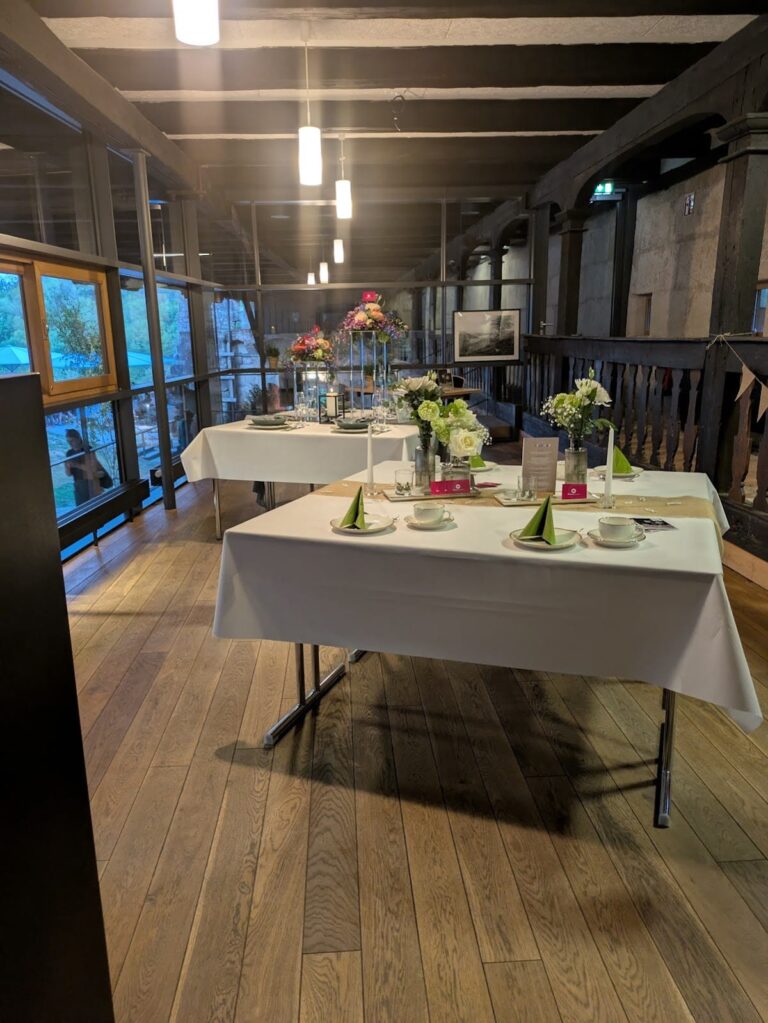
North of the castle, the agricultural and service building replaced the former barn in 1837. The foundation restored the building, which now serves as a cultural and event space.
Aviary
An aviary dating from 1827 stands east of the castle. It retains its original form and continues to house peacock pigeons.
Landscape park
The landscape park extends east of the castle across 7.8 hectares. It grew from an earlier 4.6-hectare area through land purchases and was laid out by Johann Wilhelm Bosch, the royal Württemberg head court gardener. Its features include an orchard meadow, a potato field used for horticultural and agricultural experiments, seating areas, and a small pond.
The park follows the valley of the Steinbach, which flows farther downstream into the Kocher. Its old tree population is predominantly native, and the park preserves its original flora and fauna. The former main entrance, known as the Hintere Tor, lies about 400 metres from the present entrance and about 40 metres lower. A historical sightline connects the park with Niederalfingen Castle, approximately 2.6 kilometres away.
A copper beech planted beside the pond’s south bank in 1851 and a giant sequoia planted in 1864 are among the notable trees. The grounds are also used for open-air theatre performances. Since 2020, around thirty sculptures by Karl Ulrich Nuss have stood at different locations in the park. They include figurative and symbolic works, as well as a circular group of twelve sculptures representing the signs of the zodiac.
Rappendenkmal
The Rappendenkmal, or horse monument, was commissioned by Wilhelm von Koenig-Warthausen in 1862. It commemorates the black horse that saved Wilhelm during the retreat of Württemberg forces across the Berezina in 1812. The monument consists of a stone pedestal on a rectangular base, two columns, and a stone slab supporting a saddled horse facing east.
An inscription on the pedestal is dedicated to Wilhelm’s riding horse and records its death at Fachsenfeld in 1839, after six years of retirement. The upper slab lists the locations and months of Wilhelm’s campaigns at Smolensk, his entry into Moscow, the Berezina, Bautzen, Jüterbog, and Leipzig between 1812 and 1813. Court architect Ludwig von Zanth designed the monument, Carl Martin Ebersberg modeled the horse, and the Wasseralfingen ironworks cast it. The horse is a cast-iron sculpture measuring 75 by 57 by 18.5 centimetres. It stands on a sandstone pedestal that was originally painted yellow and later red, measuring 165 centimetres high without its base.
Interiors and collections
Historic rooms
The renovated interiors retain historic furnishings and arrangements. The men’s room contains portraits of Wilhelm von Koenig-Warthausen and Sofie Ernestine von Koenig dating from around 1838 and 1828. The terrace room served as a breakfast room in the mornings and a games room in the afternoons. A small dining room contains Historicist furniture, an approach that revived earlier historical styles, and a dining service dating from 1864.
Garden hall and dining rooms
The garden hall, also called the Golden Salon, is the castle’s largest room. It contains portraits of Ferdinand von Koenig-Fachsenfeld and his wife Anna from around 1868, together with Historicist oak furniture from 1875. The room is now used as a ceremonial wedding room.
The hunting room contains a gun cabinet and hunting trophies installed by Ferdinand, including the antler collection associated with him. The large dining room contains a 122-piece English porcelain service from 1875 and seventeenth-century Ulm cabinets.
Library and kitchen
Franz von Koenig-Fachsenfeld established the Art Nouveau library in 1903 in the former main hall and designed its tables and chairs himself. The kitchen is the oldest room in the castle and retains a seventeenth-century stone floor. It remained in use until 1992.
The first floor is used for changing special exhibitions. The second floor contains further original furnished bedrooms and living rooms, together with a bathroom. The attic provides access to the belvedere.
Art and vehicle engineering
Franz’s painting collection includes works by Swabian Impressionists such as Hermann Pleuer and Otto Reiniger. A permanent exhibition on vehicle aerodynamics includes a screening room and two historic vehicles designed by Reinhard von Koenig-Fachsenfeld.
One vehicle is based on a DKW F 1 racing car and has an aluminium aerodynamic body. At Montlhéry near Paris in November 1931, it reached 140 kilometres per hour and achieved four world records. The second is an aluminium streamlined twin-hull car whose design principle was patented in 1941. A Mercedes-Benz SSKL associated with Reinhard and Manfred von Brauchitsch is also displayed in the castle garage.
Nearby sites