Schloss Nöthnitz: A Renaissance Castle and Historical Library Site in Germany


Site at a Glance
- Rating
- 3.9
- Popularity
- Low
- Country
- Germany
- Primary era
- Early Modern
- External website
- Open
- Eras represented
- Medieval, Early Modern, Modern
- Civilizations
- Electorate of Saxony, German, Holy Roman Empire
- Site type
- Domestic
- Remains
- Castle
On this page13 sections
History
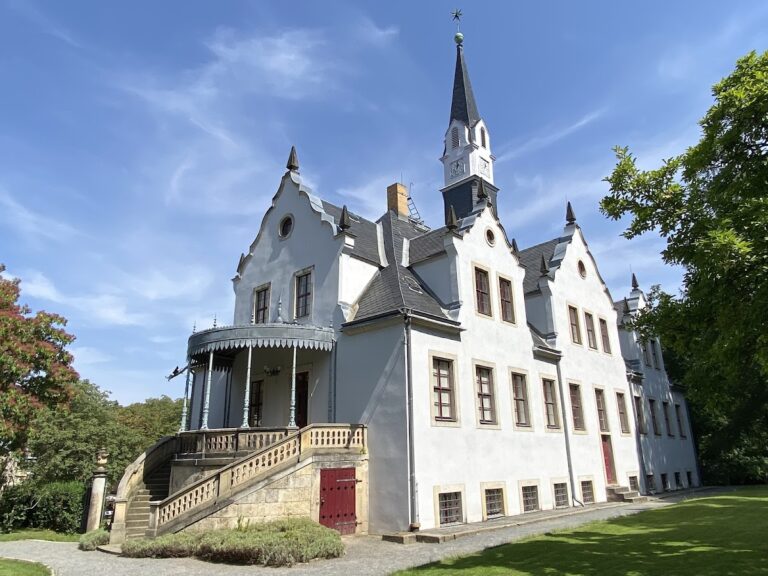
Schloss Nöthnitz is a historic castle complex in Germany, in the village of Nöthnitz within Bannewitz south of Dresden. It developed from a medieval estate and became a Renaissance castle around 1630, after Heinrich von Taube of Reichstädt acquired the property. Its later history connected it with the Bünau Library, Johann Joachim Winckelmann, the Battle of Dresden, and successive phases of rebuilding and conservation.
From Medieval Estate to Renaissance Castle
In 1453, the landholding at Nöthnitz passed from the Bishopric of Meissen to the Saxon electors, who granted it to noble families. A Nöthnitz manor is recorded in 1524. The property entered a new phase in 1629, when Heinrich von Taube of Reichstädt purchased it for 6,500 florins. As chief chamberlain and court marshal at the Electoral Saxon court, he was a senior official serving the rulers of Saxony. He commissioned the Renaissance castle around 1630, and castle privileges followed in 1634.
The estate passed to the Vitzthum von Eckstädt family in 1681. In 1739, Christiane von Arnim married Count Heinrich von Bünau, bringing Nöthnitz into the Bünau family. The following year, Bünau transferred his private library from Dresden to the castle. With approximately 42,000 volumes, the publicly accessible Bünau Library ranked among the largest book collections in Saxony and was known well beyond Nöthnitz.
Winckelmann and the Bünau Library
Johann Joachim Winckelmann worked at Nöthnitz as a librarian with Johann Michael Francke from 1748 to 1754. Winckelmann was an eighteenth-century German archaeologist, antiquarian, and writer on art whose work helped establish scientific archaeology and art history and influenced Classicism in the German-speaking world. At Nöthnitz, he assisted Bünau with an unfinished history of the German emperors and the Empire. The final completed volume ended with the death of Conrad I in 918, although the manuscript continued into the Ottonian period.
The castle was heavily damaged during the Seven Years’ War, fought from 1756 to 1763 between major European powers. Financial pressure later affected the library’s future. In 1769, Bünau’s son and heir sold the collection to Elector Friedrich August III for 40,000 thalers. The holdings were transferred to Dresden and subsequently formed the foundation of the present Saxon State and University Library Dresden.
War, Ownership, and Nineteenth-Century Change
During the Wars of Liberation, the campaigns of 1813 to 1815 against Napoleonic France, Nöthnitz served as the headquarters of Tsar Alexander I and Prince Karl Philipp zu Schwarzenberg during the Battle of Dresden on 25 and 26 August 1813. Alexander I ruled the Russian Empire during the Napoleonic Wars, while Schwarzenberg was an Austrian field marshal associated with the allied forces.
The estate changed hands several times before 1945. The succession included members of the Alnbeck, Bock, Ziegler, Taube, Vitzthum von Eckstädt, Bünau, Sahr, Könneritz, and Finck families. Rudolf Carl Freiherr von Finck acquired Nöthnitz in 1871, and his son Carl held it from 1920 until its expropriation in 1945. Rudolf Carl von Finck commissioned alterations and modernization in 1872 and 1873, including the addition of another storey. He also continued the Bünau tradition by assembling a new library.
Destruction and Public Use after 1945
A bomb hit the castle in 1945, and the wing containing the library burned out. After the postwar land reform in the Soviet occupation zone of Germany, large estates were expropriated and reorganized. Nöthnitz became public property and was used as an agricultural school, specifically an engineering school for ornamental-plant cultivation, with a boarding facility.
In 1990, the castle became the property of the Free State of Saxony. From 1991 it was leased through the state property administration to Viktor Freiherr von Finck, who purchased it in 1997. The agreement required future public use of the castle park. In the same year as the lease began, Viktor von Finck founded the association Studienstätte Schloss Nöthnitz to commemorate Winckelmann and Heinrich von Bünau.
Partly renovated rooms operated until May 2009 as a museum and Winckelmann memorial site, using Wolfgang von Wangenheim’s collection, and also served as a cultural and events venue. Viktor von Finck sold the castle to the Austrian-Czech entrepreneur Jan David Horsky in April 2009 because of his age and illness. Horsky later brought an eviction action against the Studienstätte association. Material connected with the former Winckelmann exhibition subsequently became associated with the Winckelmann Museum in Stendal and the Bürgerhaus in Bannewitz.
Recent Conservation
Ownership listings record Jan David Horsky until 2012 and Jan David Horsky junior thereafter. In 2019, local residents founded the association Förderverein Freunde Schloss Nöthnitz. In 2022, Horsky junior arranged work on the lower courtyard facade, doors, and windows.
In July 2024, the Bundestag’s Budget Committee approved funding through a monument-protection program for repairs to a wall of the north wing and the roof of the south wing. The work is intended to remove roof extensions added in the 1950s and restore the historic roof structure.
Remains
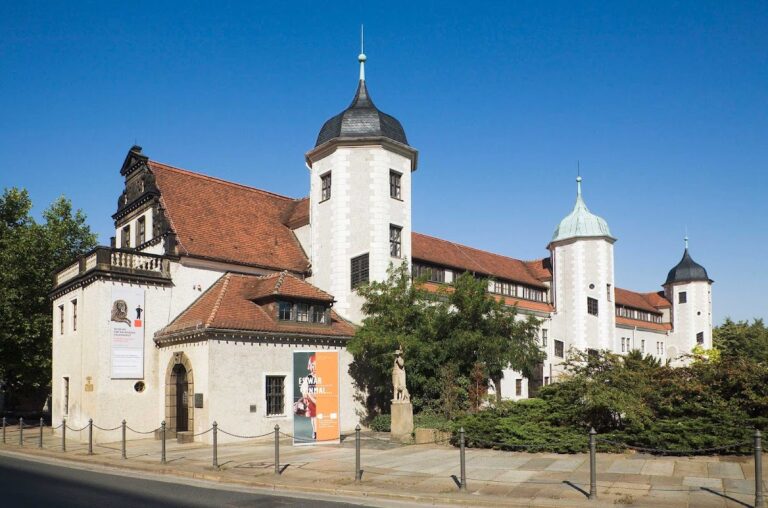
The present Schloss Nöthnitz complex combines a medieval core with the Renaissance castle built around 1630. It forms a U-shaped arrangement of three wings. The main building faces northwest, while two side wings enclose the principal castle courtyard. An extensive service courtyard adjoins this principal court, giving the surviving complex both a representative and a working area.
Castle Buildings and Courtyards
Main Building
The main building contains a ground-floor cross-vault dating from the period of the Renaissance construction. The castle gained an additional storey during the modernization of 1872 and 1873, changing the height of the earlier structure while retaining the older building phases within the complex.
Stair Tower
An octagonal stair tower occupies a corner of the courtyard. Its spiral staircase and window profiles date from the first half of the seventeenth century, linking this visible courtyard feature with the period in which the Renaissance castle was created.
Library Wing
The wing associated with the castle library was gutted by fire after the bombing of 1945. Its destruction forms part of the physical evidence of the wartime damage that altered the historic complex. Partly renovated rooms later accommodated museum displays devoted to Winckelmann. A memorial plaque bearing his portrait commemorates his work at Nöthnitz, and a ballroom was used for concerts.
Castle Park
Schlosspark Nöthnitz combines elements of a Baroque garden, characterized by formal and ordered design, with those of an English landscape park, which uses a more naturalistic arrangement of grounds. When the property returned to private ownership after 1990, public use of the park was secured by contract.
Conservation of the Historic Fabric
The current conservation program addresses a wall of the north wing and the roof of the south wing. Its planned removal of twentieth-century roof additions and reinstatement of the historic roof construction is intended to clarify and preserve the architectural form of the castle’s earlier building phases.