Château de la Treyne: A Historic Residence Above the Dordogne


Site at a Glance
- Rating
- 4.8
- Popularity
- Low
- Country
- France
- Primary era
- Medieval
- External website
- Open
- Eras represented
- Medieval, Early Modern, Modern
- Civilizations
- French
- Site type
- Domestic
- Remains
- Castle
On this page14 sections
History
Château de la Treyne is a historic residence in Lacave, France, above the Dordogne River. Its existence is recorded from 1342, and its construction is probably associated with Guillaume and Hughes de Rouffilhac, a family from Gourdon whose presence there is known from the twelfth century. The château’s surviving medieval core belongs to the fourteenth century, while later rebuilding and enlargement shaped the residence through the eighteenth century.
The Rouffilhac and Cluzel Lords
On 27 January 1356, Guillaume de Rouffilhac paid homage for La Treyne to Guillaume de Beaufort, vicomte of Turenne. Homage was a formal feudal ceremony through which a vassal acknowledged allegiance and obligations to a superior lord. After the Rouffilhac line apparently died out, the vicomte granted the lordship to Annet Hugon du Cluzel on 12 May 1462, together with high, middle, and low justice, the judicial powers exercised by a lord over his territory.
Annet’s son, Jean de la Treyne, married Jeanne de Coustin de Bourzolles in 1519. In 1540, Jean paid homage to François III de La Tour, vicomte of Turenne, for the château, its woods, rents, and jurisdiction. By 1553, Louis de Cluzel held La Treyne. His sister Gallienne married Pierre de La Ramière, known as Captain La Ramière, who adopted the Protestant faith.
Religious Conflict and Restoration
After Pierre de La Ramière died in 1569, Gallienne faced persecution because of her Protestant beliefs, including legal proceedings and the pillaging of her houses. Their son, Jean de La Ramière, later inherited the lordship. La Treyne was regarded as a Huguenot stronghold. Huguenots were French Protestants, principally followers of the Reformed tradition during the religious conflicts of the sixteenth and seventeenth centuries. In 1586, the château was burned on the orders of the Duke of Mayenne, lieutenant of King Henri III.
Louis de Cluzel was assassinated in 1592, and the lordship passed to his son Jacques Galiot du Cluzel. Jacques paid homage to Henri I de La Tour d’Auvergne, vicomte of Turenne, in 1600, but died without issue in 1607. Jean de La Ramière then inherited La Treyne and died in 1616. In 1622, the Parliament of Toulouse ordered the destruction of the château because of the rebellion and excesses of Jean’s son, who was found guilty of lèse-majesté, an offense understood as an attack on the authority or dignity of the sovereign.
The destruction order apparently was not carried out. Around 1625, Gédéon I de La Ramière began restoring and adapting the residence, and this work was complete before 1643. Gédéon II later abjured Protestantism, as stated in his testament of 5 April 1701. His son Pierre died without issue in 1710, so the lordship passed to Pierre’s sister Marie de La Ramière. Her marriage to Jean III de Cardaillac in 1711 transferred La Treyne into the Cardaillac family.
The Cardaillac Estate
After Marie’s death, their son François-Emmanuel de Cardaillac inherited the lordship and enlarged the château around 1760. The vicomté of Turenne, a major feudal territory ruled by the viscounts of Turenne, had been sold to Louis XV in 1738 to repay Charles-Godefroy de La Tour d’Auvergne’s gambling debts. François-Emmanuel received the barony and marquisate of Cardaillac in 1759. These were hereditary aristocratic jurisdictions and titles under France’s ancien régime. From 1760 to 1778, he paid homage to the king for the lands and lordships of La Treyne and Meyraguet.
François-Emmanuel died in 1782. His son Joseph de Cardaillac, lieutenant of the king for Guyenne, was at La Treyne on 28 September 1822. The Cardaillac family retained the property until Jean-Jacques-Joseph-Frédéric, marquis de Cardaillac, sold the château and estate on 20 September 1910 to Auguste-Gabriel Savard, a Parisian industrialist and inventor.
Restoration, Protection, and Changing Use
Savard restored and refurnished the interiors and commissioned Édouard André, a prominent French landscape designer and botanist, to create the formal garden. In 1922, Savard sold the property to the Spanish industrialist Fontana. Fontana ordered a coffered ceiling and wood paneling for the Grand Salon, along with wood paneling for the Music Room.
During the Second World War, André Chamson, who was responsible for the Egyptian Antiquities Department of the Louvre Museum, supervised the protection of part of the museum’s treasures. They were temporarily stored at La Treyne, including the celebrated ancient Egyptian statue known as the Seated Scribe. The château’s association with this wartime safeguarding was commemorated when it was designated a scenic site of the Lot by ministerial order on 6 November 1946.
Santiard and Bulteau bought La Treyne on 10 April 1954 and displayed a collection of sixteenth-century Renaissance furniture and works of art there. That collection was later transferred to the Château de Bourdeilles. The Gombert family acquired La Treyne in 1982. After ten years of work, the property entered the Relais & Châteaux network, an international association of independently operated luxury hotels and restaurants, reflecting its conversion to hospitality use.
The façades, roofs, straight staircase, Grand Salon decoration, and ground-floor billiard-room decoration were entered on the French register of historic monuments by an order of 3 May 1990. The protection was amended on 17 September 2008.
Remains
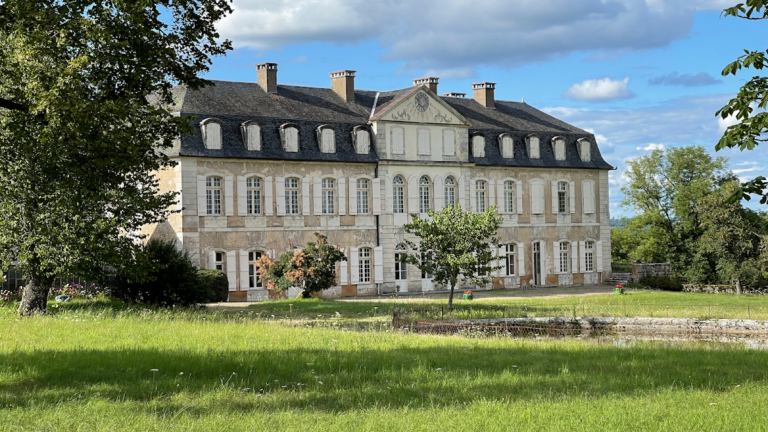
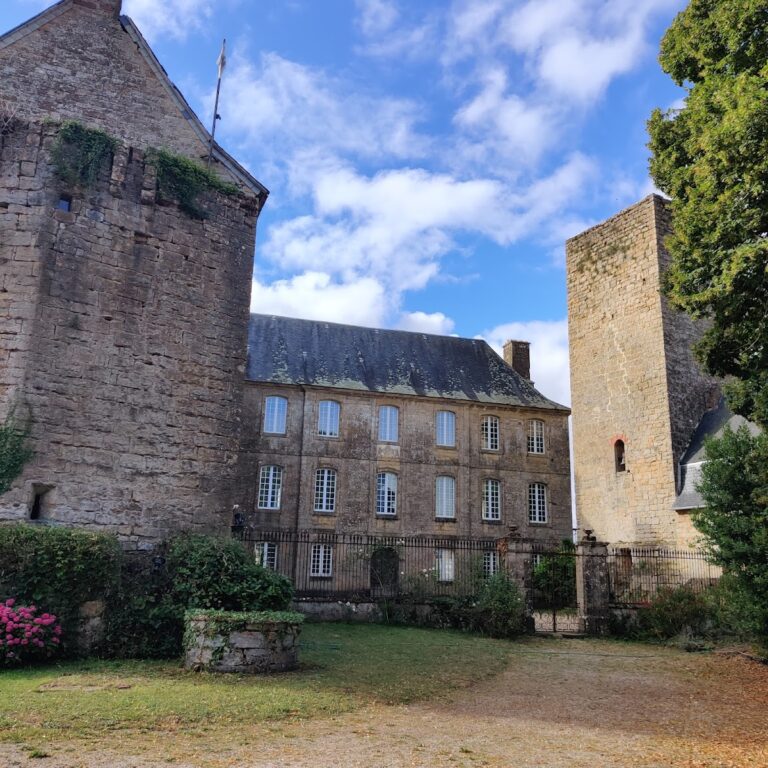
Château de la Treyne stands above the Dordogne, with its façade facing the river. The building began as a residential château and retains a square fourteenth-century keep as its medieval core. Its present form combines that fortified principal tower with a later residential range, a large round tower, eighteenth-century enlargement, restored interiors, and landscaped grounds.
Medieval Core and Later Residence
Fourteenth-Century Keep
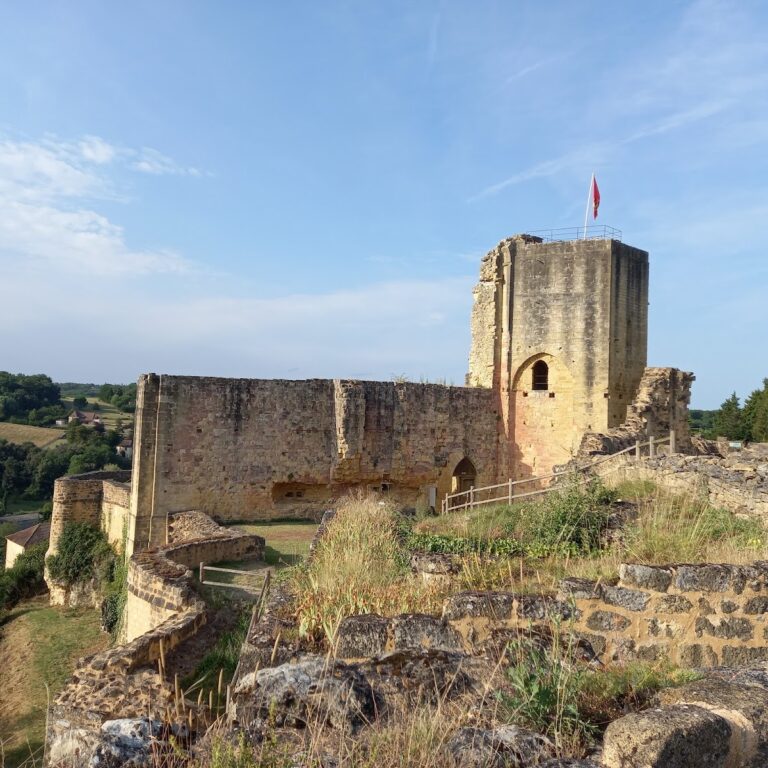
The square keep is the principal surviving medieval structure. A keep was a fortified main tower designed for both defense and residence within a medieval castle. At La Treyne, it forms the earliest surviving element of the château and remains integrated into the later residential complex.
Seventeenth-Century Addition
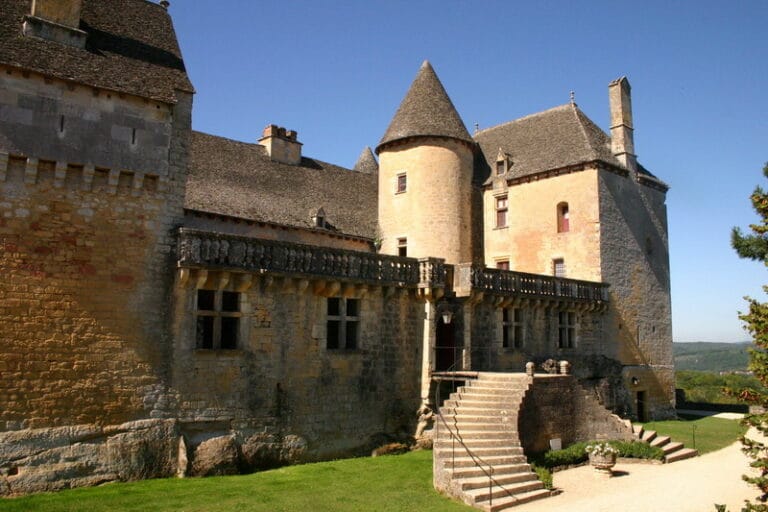
During the rebuilding carried out around 1625 and completed before 1643, a residential building was attached to the north side of the keep. This addition was equipped with a large round tower, creating the core of the expanded residence that developed around the medieval structure.
Eighteenth-Century Enlargement
The château was enlarged again around 1760 under François-Emmanuel de Cardaillac. Its protected architectural elements include the façades and roofs, the straight staircase, the decoration of the Grand Salon, and the decoration of the billiard room on the ground floor.
Interiors and Grounds
Restored Rooms
Auguste-Gabriel Savard restored the interior arrangement and furnishings after acquiring the estate in 1910. Under Fontana, the Grand Salon received a coffered ceiling and wood paneling, while the Music Room was also fitted with wood paneling. These interiors form part of the protected fabric of the château.
Formal Garden and Chapel
The grounds include a French formal garden designed by Édouard André. Around 1954, a Neo-Romanesque chapel was built in the park. It incorporates Romanesque and Gothic elements brought from Cuelvas in Spain, adding a later historicist structure to the château’s landscaped setting.
Wartime Collections
La Treyne temporarily housed Egyptian antiquities from the Louvre during the Second World War, including the Seated Scribe. The Renaissance furniture and works-of-art collection later associated with the property was subsequently transferred to the Château de Bourdeilles.
Nearby sites