Dolmen du Pech de Grammont: A Neolithic Double Burial Monument in France
Site at a Glance
- Popularity
- Very Low
- Country
- France
- Primary era
- Stone Age
- Eras represented
- Stone Age
- Civilizations
- Unclassified
- Site type
- Burial
- Remains
- Burial Mound
On this page11 sections
History
Successive prehistoric construction
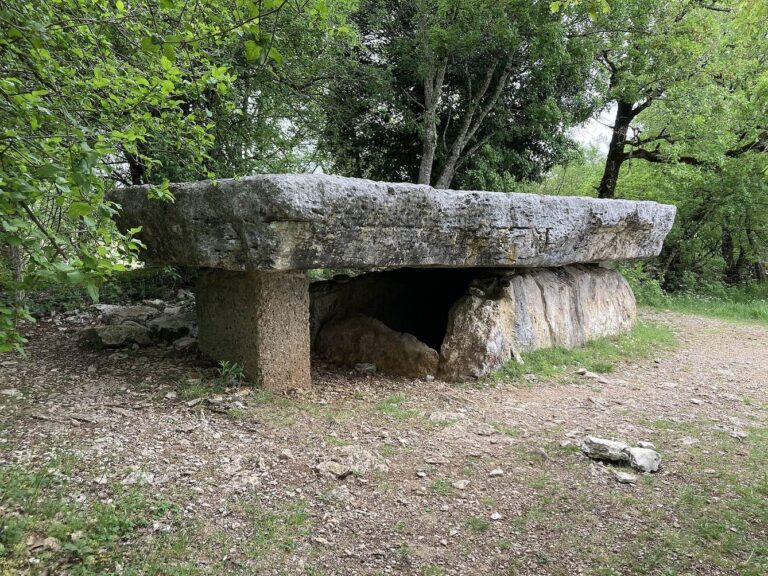
Dolmen du Pech de Grammont is a Neolithic funerary monument near Gramat, France, formed by two dolmens, prehistoric stone burial chambers, built in successive phases within one mound. Archaeologist Jean Clottes later used the term double dolmen for a monument combining two distinct dolmens and regarded Pech de Grammont as its archetype.
The smaller, western dolmen was built first; the larger, eastern one followed in a separate period. Differences in their construction and burial goods led Clottes to conclude that a chronological gap separated the two phases. The reason for building the second dolmen at this location is unknown. Both chambers were used for burials.
Excavation and interpretation
Historian and antiquarian Jacques-Antoine Delpon had remarked on the monument’s unusual design and excavated its chambers. The objects recovered during that earlier work were later lost. In 1968 and 1969, Clottes and Michel Carrière excavated the monument, recording its structures and recovering human remains and grave goods.
After this work, Clottes proposed double dolmen as a term for monuments containing two separate dolmens arranged together. Deposits of pottery outside the larger chamber were interpreted as part of a ritual practice, an interpretation informed by similar observations at Dolmen du Rat. Since 2012, the monument has held France’s national protected historic-monument status.
Remains
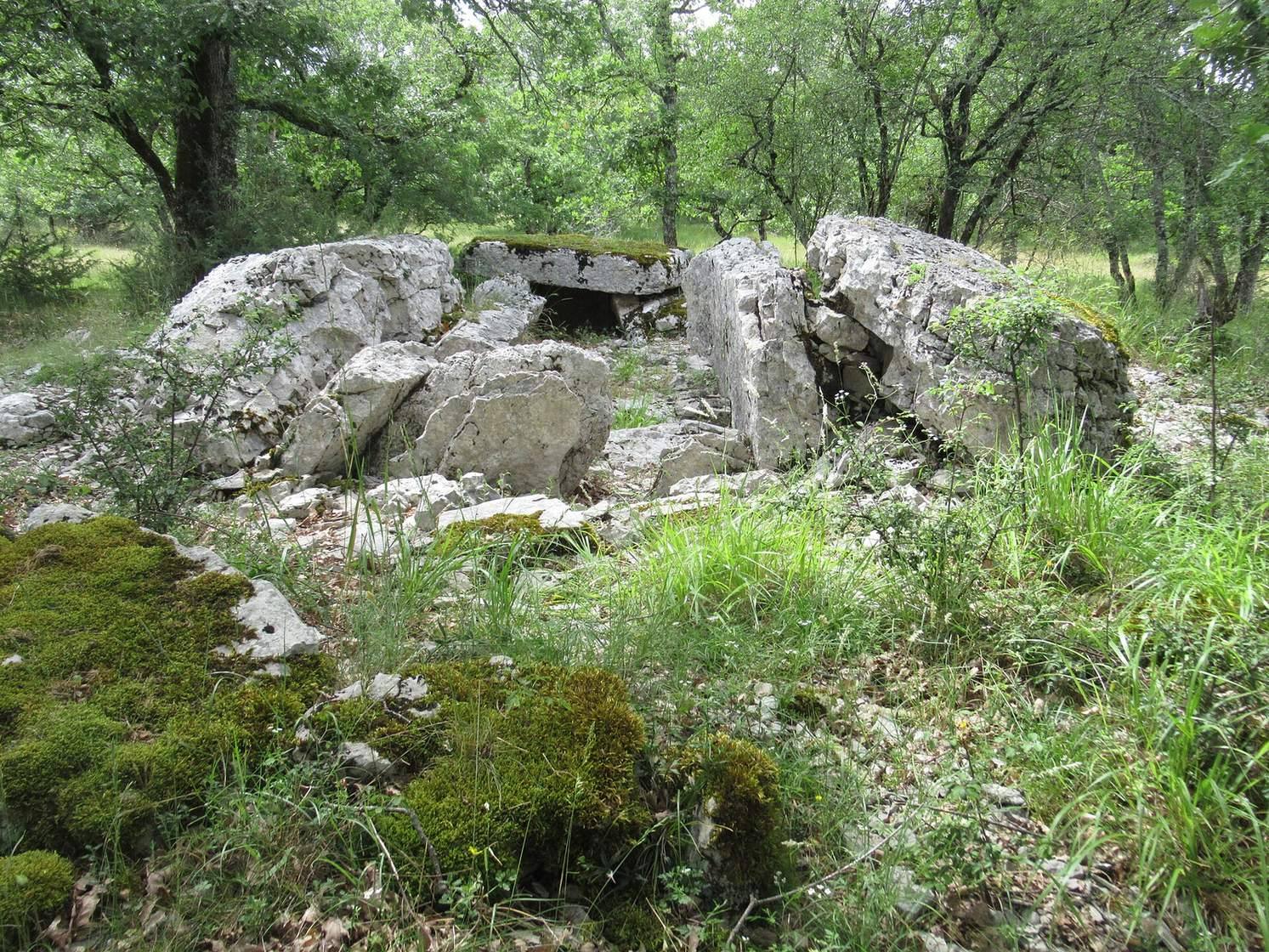
The monument occupies a ridge above a deep sinkhole and the Alzou Valley. Its oval mound measures about 19 by 16 m and consists of piled stone blocks mixed with substantial amounts of earth. Vegetation growing in the soil has disturbed the structure. The chambers are arranged from west to east: the smaller one lies near the mound’s center, and the larger occupies its eastern part. Construction of the second dolmen changed the mound’s original shape. Between the chambers stands a slab about 1.20 m long, 1.50 m high, and 0.15 m thick. It was deliberately set into the limestone ground rather than displaced there later.
The burial chambers
Smaller, western dolmen
A low wall built from stones laid without mortar forms a complete rounded enclosure about 2 m from the smaller chamber. Near its entrance, the wall has a short, spiral-like section. It is made of seven or eight courses of flat slabs, stands about 0.65 m high, and is topped with 0.10 to 0.15 m of rubble from the mound’s surface. Larger blocks strengthen it at several points.
The rectangular chamber faces eastward, on an axis of 110 degrees, and measures 1.60 m long, 1 m wide, and 1 m high. Its two side stones and end slab lean inward. The side stones are held at their bases in a groove cut into the rock. Because they are different heights, the left-hand stone was set deeper so the roof slab could rest level. Three supporting stones survive, reaching up to 1.9 m in length, and the roof slab remains in place in very good condition.
The floor follows the natural limestone surface, covered by a thin layer of clay rather than cut into the bedrock or paved. It slopes slightly from north to south.
Larger, eastern dolmen
The larger chamber is also rectangular and faces eastward on an axis of 110 degrees. It measures 2.80 m long, 2 m wide, and 1.35 m high. Its rectangular enclosing wall has been partly broken by roots. The surviving sections show construction like that of the smaller dolmen’s wall, though at a lower height of about 0.55 m. The walls probably helped support the mound while the roof slabs were positioned, after the chamber supports had been raised.
The left support, originally aligned with the corresponding support of the smaller dolmen, broke into pieces and fell inward. The right support remains upright and extends about 0.45 m into the ground. Two large fragments beside the chamber probably came from its roof slab, estimated at about 3.5 m long and 0.5 m thick. The slab may have been broken during an attempt to plunder the burial chamber. The floor is nearly level and follows the natural ground rather than a cut or paved surface.
An oval slab that closed the entrance is still present. Outside it, a second slab stands at right angles to the chamber’s right support and has an almost circular opening 0.38 to 0.40 m across. The inner edge of the opening was carefully polished, while the slab’s upper portion is broken. It was added after the dolmen had been completed: unlike the other large stones, it rests on the ground with simple packing instead of being set upright. The entrance slab has since tipped inward and partly covers the opening; its original position left the opening clear. The pierced slab type is rare in southern France but common in the Paris Basin. The small stone compartment and pierced slab are distinctive architectural features in Quercy, a historic region broadly corresponding to the Lot area.
A small cist, or stone-lined compartment, was made in the chamber floor by widening the groove around the right support. It measures about 0.80 m long, up to 0.40 m wide, and 0.40 m deep. It may have held a human skull or a vessel, but its contents are uncertain.
Burial evidence and finds
Human bones from both chambers were mostly broken into small fragments and scattered, with little connection between bones from the same body. Exceptions include five vertebrae still associated with rib fragments in the smaller chamber and a connected pair of heel bones in the larger one. Counts of teeth and ankle bones from the chambers and the space between them suggest minimum totals of 9 to 10 people in the smaller dolmen and 22 to 25 in the larger. Animal remains were limited to teeth from sheep, foxes, rabbits, and hares. They may represent offerings, or remains carried into the chambers by burrowing animals; the evidence does not resolve the question.
Smaller chamber finds
The smaller chamber contained 25 ring-shaped calcite beads, a small undecorated vessel with a flat base, and two large pottery sherds in the style of the Urnfield culture, a Bronze Age tradition named for its characteristic urn burial grounds. This pottery style alone does not establish when either chamber was built.
Larger chamber finds
Finds from the larger chamber included 605 ring-shaped shell beads, two calcite beads of the type also found in the smaller chamber, and fragments of other beads. Other objects were a perforated fox tooth, a carefully shaped leaf-form arrowhead of bluish flint, two transverse arrowheads of blond flint, a small stone blade, six flakes, and pottery sherds either in the style of the Urnfield culture or without a distinct style.
Deposits outside the larger chamber
Outside the entrance, excavators found 83 shell beads, 79 of them in a style different from the other beads, along with 29 marine shells of the genus Columbella and 51 buttons with V-shaped perforations, belonging to two distinct groups. A separate deposit of sherds from two vessels lay almost opposite the opening in the pierced slab. Together with comparable observations at Dolmen du Rat, these deposits supported an interpretation of pottery offerings as a recurring ritual practice rather than an isolated occurrence.